
Agentforce vs. Custom AI Agents: Which Should Your Company Choose?
If you run on Salesforce and you're evaluating AI agents, you'll quickly hit a fork: use Salesforce's native Agentforce, or build custom agents. Agentforce comes with the "platform-y" pieces already handled — authorization, security, workflow, data, routing — so you're configuring rather than building, and it sits right next to your CRM data. Custom agents give you architectural freedom and can reach across any system, but require significantly more technical expertise to design, build, and operate. The surprising part, when you run the total-cost math, is that the numbers often end up closer than expected — which means the decision is really about fit, not price.
Quick Answer: Choose Agentforce when Salesforce is your operating core, the workflow lives inside Sales/Service/Marketing Cloud, and you value speed and consolidation — it deploys faster (often 4–6 months) with lower risk. Choose custom agents when your workflow spans multiple systems Salesforce doesn't own, you need model flexibility or fixed/predictable pricing, you face regulated multi-step processes needing deep auditability, or you want long-term architectural control. Many enterprises run both, letting each cover what it does best.
Key Takeaways:
Agentforce's strength is data proximity — native access to your account, case, and opportunity data with no custom integration — grounded through Data Cloud and governed by the Einstein Trust Layer.
Agentforce's constraints are boundaries and cost: agents are strongest inside Salesforce and hit integration bottlenecks when workflows span custom databases, Slack, or third-party tools. Pricing is consumption-based (commonly cited around $2/conversation or Flex Credits) and production grounding usually requires Data Cloud (a meaningful added annual cost).
Custom agents win when the workflow reaches well outside the CRM — e.g. "verify identity, find why a payment failed in the payments provider, refund the fee, update the address, log it for audit" is a multi-step chain across systems Salesforce doesn't own.
The build-vs-configure trade shows up in timeline: Agentforce deployments run months of configuration; custom builds run longer and demand in-house or partner AI expertise, but offer total flexibility and model choice.
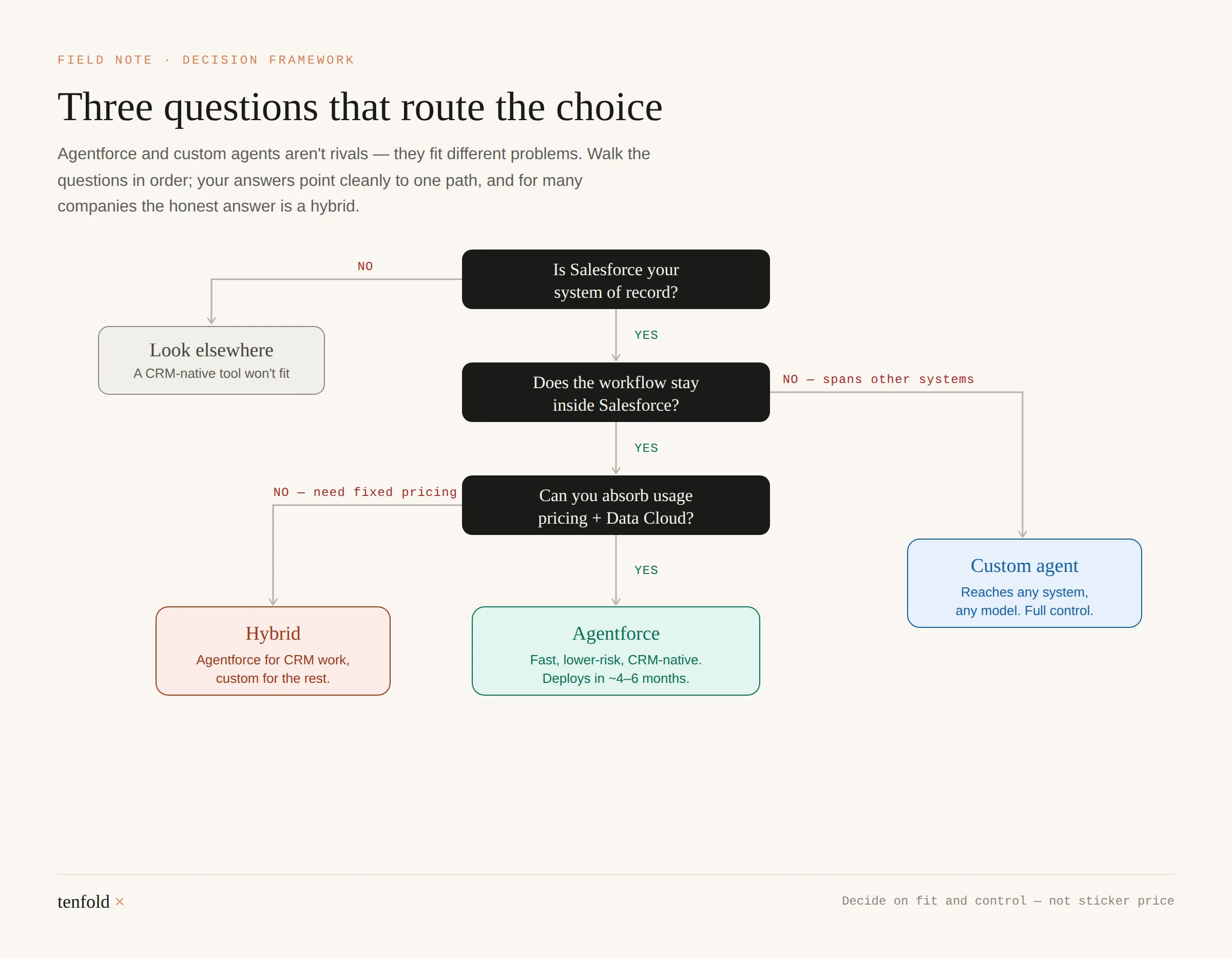
The decision tree: Is Salesforce your system of record? If no, look elsewhere. If yes, do you need autonomous agents reaching beyond Salesforce, and can you absorb consumption pricing plus Data Cloud? If yes to native and cost, Agentforce; if you need reach, model choice, or predictable pricing, custom.
The Case for Agentforce
If Salesforce is where your service, sales, and customer data already live, Agentforce is the path of least resistance to production AI. The agents have immediate access to your customer histories, pipelines, and support cases — a data advantage external tools can't easily replicate without complex synchronization. Its Atlas Reasoning Engine plans and executes actions; agents are defined by topics, actions, and guardrails; and they escalate to humans with full transcript and history attached. Because so much is handled inside the platform, your work shifts from building orchestration code to configuring behavior and policies. The payoff is speed and lower risk — deployments commonly run 4–6 months, versus far longer for custom builds — plus procurement simplicity and ongoing platform innovation backed by Salesforce's AI investment.
The Case for Custom Agents
Custom agents win when Salesforce is not the whole picture. The moment a workflow has to work across Salesforce, custom internal tools, product databases, billing systems, and third-party APIs — without being designed around one platform first — a vendor-neutral custom build is the better fit. The classic example is a multi-step chain that reaches outside the CRM: verify identity, diagnose a failed transfer in the payments provider, refund the fee, update the record, and log everything for a compliance audit. Custom builds also give you model flexibility (choose Claude, GPT, or Gemini per use case), fixed or predictable pricing rather than per-conversation consumption, and long-term ownership of the architecture. The trade-off is real: more time, more technical expertise, and more of the design work falls on you or your partner.
The Cost Reality
The instinct is that native must be cheaper — but the total-cost picture is more nuanced. Agentforce's consumption pricing (often cited around $2/conversation or via Flex Credits at roughly $500/100k) makes annual budgeting harder, and production grounding usually requires Data Cloud, which adds a meaningful annual cost that buyers often approve only after the Agentforce budget is set. Custom builds carry higher upfront development but can offer fixed, forecastable running costs and no per-conversation meter. When you run the full total-cost-of-ownership math, the two often land closer than the sticker prices suggest — which is exactly why the decision should turn on fit and control, not headline price.
The Deciding Questions
Walk the decision tree honestly. Is Salesforce your system of record? If no, Agentforce isn't the natural choice. If yes: does the workflow stay inside Salesforce, or does it need to reach across systems Salesforce doesn't own? Do you need to choose your own models? Can you absorb consumption pricing plus a Data Cloud dependency, or do you need predictable, fixed costs? Is the process regulated enough that you need replayable, multi-step auditability across external systems? Your answers point cleanly to one path — and for many companies, the honest answer is a hybrid: Agentforce for CRM-native service and sales workflows, custom agents for the cross-system, proprietary-logic work. (Note that running both adds maintenance and user-experience complexity, so draw the boundary deliberately.)
Summary
Agentforce and custom agents aren't really rivals — they're fits for different problems. Agentforce is the fast, lower-risk choice when Salesforce is your core and the workflow lives inside it; custom agents are the flexible, far-reaching choice when the workflow spans systems Salesforce doesn't own or you need model choice and predictable pricing. Decide on fit and control, not sticker price, and don't rule out running both. If you want help mapping which of your workflows belong in Agentforce and which need a custom build — and building either — the Tenfold team works across both, with the agent-first delivery model our sister company Inforge runs on Salesforce every day.
Frequently Asked Questions
Q: What's the main difference between Agentforce and custom AI agents? A: Agentforce is Salesforce-native — pre-built, fast to configure, with direct access to your CRM data but constrained largely to the Salesforce boundary. Custom agents are vendor-neutral — more work to build, but able to reach across any system and use any model.
Q: Which is cheaper? A: It's closer than it looks. Agentforce uses consumption pricing (around $2/conversation) and usually requires Data Cloud, which adds cost; custom builds cost more upfront but can offer fixed running costs. On full total-cost-of-ownership, the two often land near each other — so decide on fit, not sticker price.
Q: How much faster is Agentforce to deploy? A: Agentforce deployments commonly run 4–6 months of configuration, versus longer for custom builds that require more design and engineering. Speed and lower risk are Agentforce's main advantages when Salesforce is your core.
Q: Can we use both? A: Yes, and many enterprises do — Agentforce for CRM-native sales and service workflows, custom agents for cross-system or proprietary-logic work. Just draw the boundary deliberately, since running both adds maintenance and user-experience complexity.
