
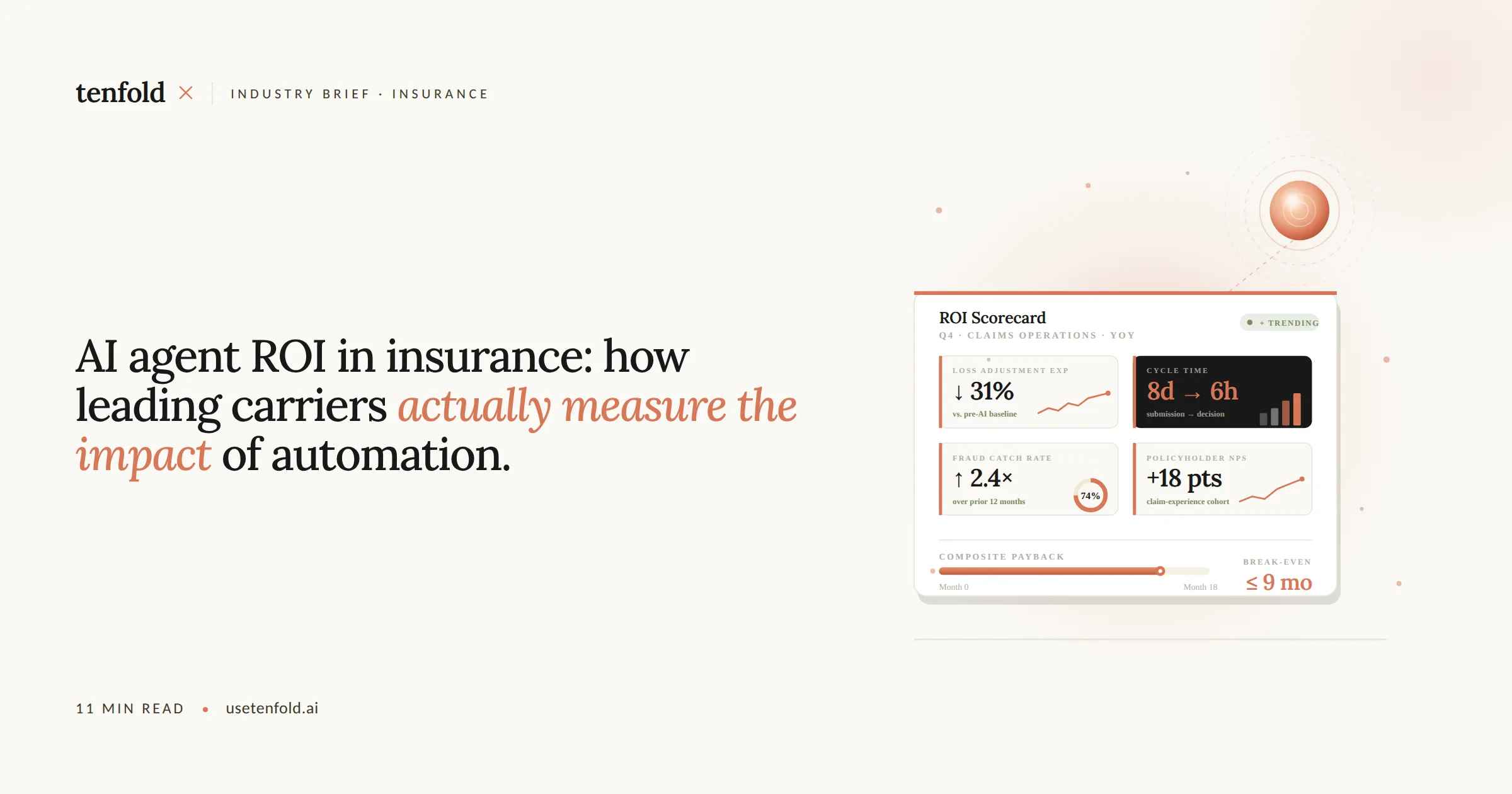
AI Agent ROI in Insurance: How Leading Carriers Are Actually Measuring the Impact of Automation
Insurance companies are investing heavily in AI agents — but most are still measuring ROI the wrong way. They track time saved, pilot completion rates, and hours recovered. What they're not tracking is the thing that actually matters: whether the automation is changing the financial structure of their operations.
The insurers pulling ahead aren't just deploying AI. They're redesigning their workflows around it, measuring outcomes against baselines, and scaling what works. That gap — between AI as a tool and AI as an operating model — is where the real ROI story lives.
Quick Answer: AI agent ROI in insurance is best measured through claims resolution time, processing cost reduction, fraud detection rate improvements, underwriting accuracy, and customer retention. Insurers that tie agent deployment to specific operational KPIs — rather than generic efficiency metrics — consistently see faster and more defensible returns.
Key Takeaways:
AI agents are delivering 30–50% reductions in processing costs for automated insurance workflows, but only when deployed against the right use cases.
Claims processing and fraud detection offer the highest and most immediate ROI benchmarks — not underwriting, which remains early-stage.
Most insurers are stuck measuring activity. The ones posting real ROI are measuring outcomes: cycle time, loss ratio, fraud recovery, and NPS.
Pilot-stage AI rarely pays off. BCG data shows only 7% of insurers have successfully scaled AI across their organizations.
Speed-to-ROI is now the top implementation priority for insurers — not capability or feature richness.
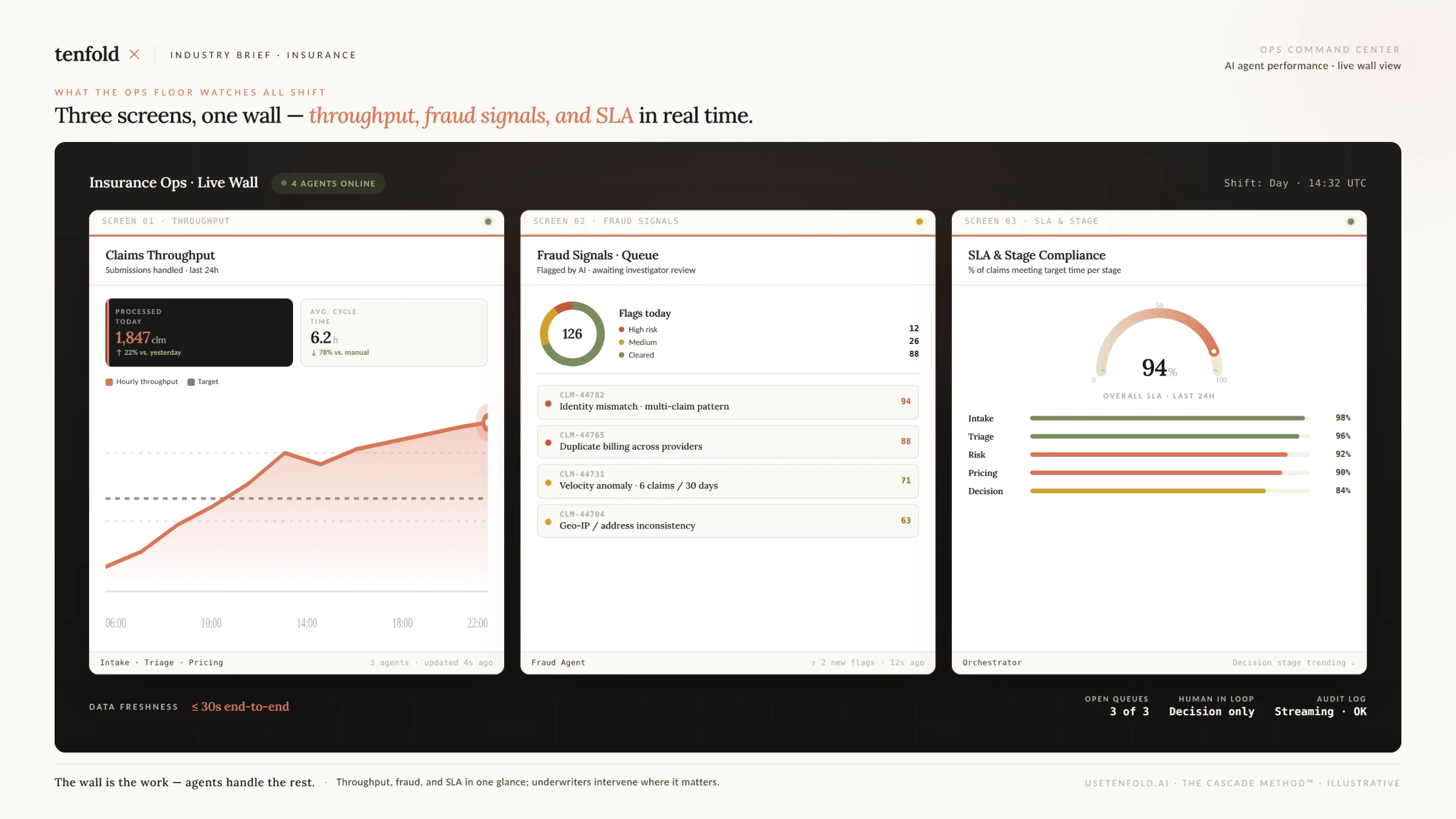
Why Most Insurers Are Getting AI ROI Wrong
The problem isn't the technology. It's the measurement model.
Most insurance organizations evaluate AI success through the lens of individual tasks: how many documents processed, how many calls deflected, how many hours saved per week. Those are activity metrics. They tell you whether the tool is running. They don't tell you whether the business is changing.
According to McKinsey, most insurers lacking bold, enterprise-wide AI strategy with measurable financial outcomes are the ones stuck in AI inertia — and the data backs that up. They underestimate investment requirements, run fragmented pilots, and end up with poor ROI that's hard to defend to leadership.
The insurers generating real returns frame ROI differently. They start with an operational problem — claims leakage, cycle time, fraud exposure, underwriting error rate — and deploy AI agents specifically to move that number. The ROI case builds itself from there.
The bottleneck isn't AI capability. It's that most insurers aren't yet set up to delegate to it at scale.
The Metrics That Actually Capture AI Agent Impact
If you want to measure AI agent ROI in insurance, you need to track outcomes — not outputs. Here's where the data is most defensible:
Claims Resolution Time
This is the clearest signal. According to Datagrid, overall claims resolution time has been reduced by 75% through AI automation — from 30 days down to 7.5 days — with routine claims processing dropping from 7–10 days to just 24–48 hours. Policy coverage verification has dropped from 15–20 minutes to seconds.
Those aren't marginal improvements. They're structural changes to the cost of running a claims operation. When you reduce cycle time by that magnitude, you reduce labor cost, reduce leakage, and improve policyholder satisfaction simultaneously.
Processing Cost Reduction
According to Databricks, insurance carriers typically report 30–50% reductions in processing costs for AI-automated workflows compared to manual processes. Industry benchmarks show 15% efficiency gains in claims processing and improved fraud detection that reduces annual claims payouts.
At the top of the range: AI-powered claims automation is saving insurers an estimated $6.5 billion annually by reducing processing time by up to 70%. That's an industry-level number — but at the carrier level, it translates directly to combined ratio improvement.
Fraud Detection Rate
According to Coinlaw, predictive analytics has increased fraud detection rates by 28%, while ML-based fraud detection is saving the insurance industry an estimated $47 billion annually by flagging and preventing fraudulent claims. Deep learning models have delivered a 35% reduction in fraudulent claims at leading insurers.
Fraud detection is one of the highest-adoption AI use cases in insurance at 65%, precisely because the ROI is immediate and auditable. Every prevented fraudulent claim is a direct dollar figure you can put in a board presentation.
Underwriting Accuracy
According to Coinlaw, machine learning in underwriting has improved accuracy by 54%, and AI-powered underwriting systems can process applications 70% faster while maintaining or improving accuracy. ML algorithms have improved premium accuracy by 53%, enabling fairer and more customized pricing.
Underwriting is still early-stage — currently at 14% AI adoption — but the trajectory is clear. Projected to reach 70% adoption by 2028, it will become the next major source of measurable AI ROI once the infrastructure matures.
Customer Retention and NPS
According to Coinlaw, AI in customer experience has boosted Net Promoter Scores by 29%, and AI-generated risk profiles have contributed to a 15–20% increase in customer retention rates. AI virtual assistants running 24/7 have lifted policyholder satisfaction rates by 26%.
These numbers matter for ROI calculations that go beyond cost reduction. Retention is a revenue metric. A carrier that improves retention by 15% while reducing operational cost by 30% is compounding returns in ways that pure efficiency plays can't match.
The Deployment Gap: Why Only 7% Have Scaled
Here's the uncomfortable number: according to BCG, only 7% of insurance companies have successfully scaled AI across their organizations. About two-thirds of insurers are still in the piloting stage.
The most advanced insurers — those engaged in what BCG calls "strategic deployment" — use AI to redesign end-to-end business processes with annual investments of $25 million or more. The ones stuck in pilots invest under $5 million and focus on isolated task-level automation.
The difference isn't budget. It's approach.
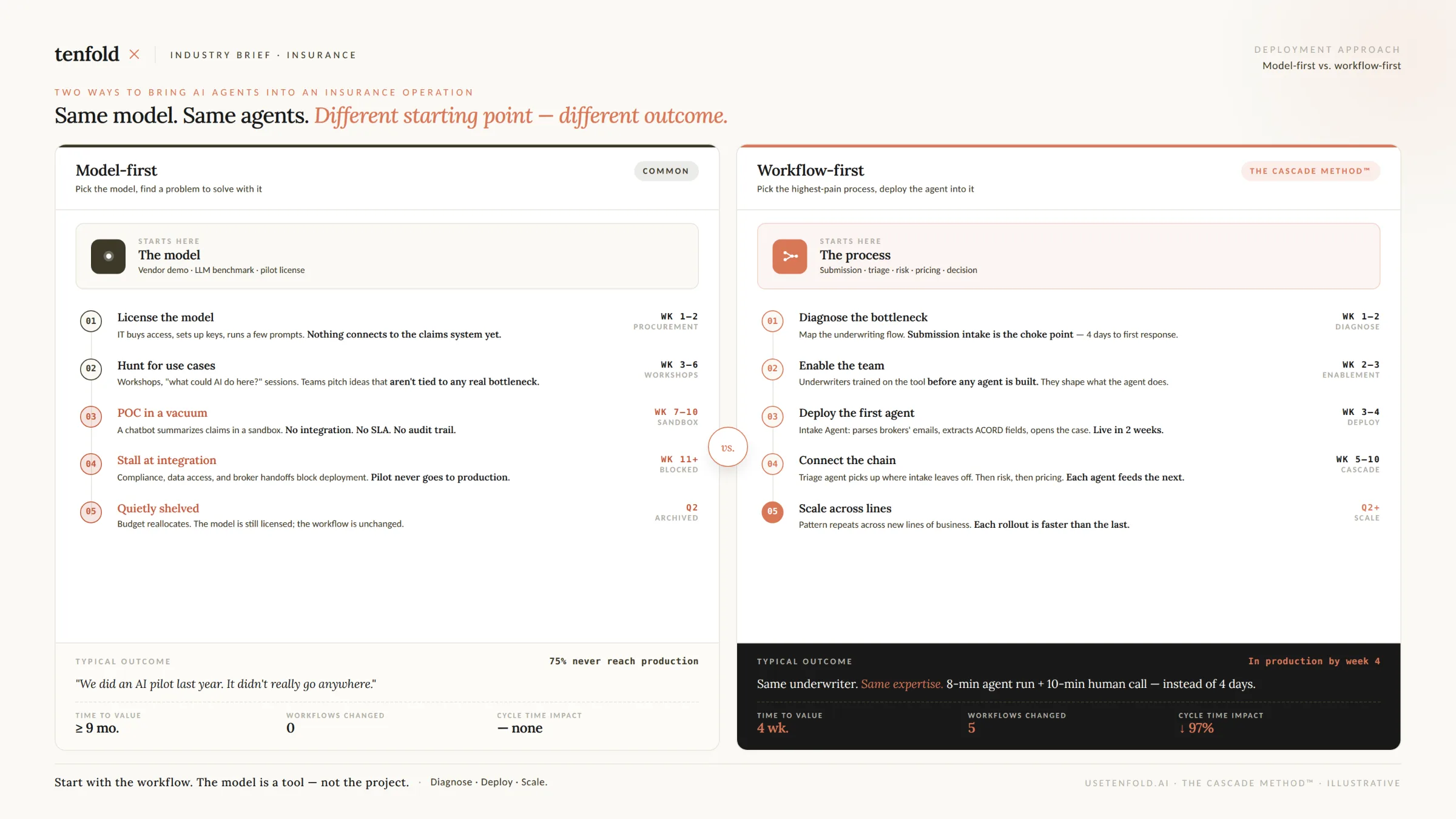
According to CIO Dive, quoting a Simplifai report: "The difference isn't technological access — every carrier can buy the same models and platforms. The difference is approach: workflow-first deployment with governance built in versus model-first pilots with integration as an afterthought."
Insurers deploying agentic AI into workflows — rather than as standalone tools — reported 30–40% productivity gains in claims and underwriting operations. That's not a coincidence. Workflow-first deployment forces you to define the ROI target before you deploy. Model-first pilots defer that question until after launch, which is how you end up with impressive demos and flat business results.
How to Build an ROI Framework That Holds Up
The insurers generating defensible ROI from AI agents follow a consistent pattern. Here's what that looks like in practice:
1. Start with a cost center, not a use case.
According to Evident Insights research, insurers are primarily applying AI to the industry's largest cost centers: claims processing, customer service, and underwriting. That's the right instinct. Pick the function that consumes the most budget, measure its baseline performance, and deploy AI against that number.
2. Set measurement baselines before deployment.
You can't claim ROI without a before. Track cycle time, error rate, cost per transaction, and staff hours per workflow before the agent goes live. This is the step most organizations skip — and it's exactly why they can't defend their ROI case six months later.
3. Track total cost of ownership, not just labor savings.
According to Roots AI, insurers should use total cost of ownership (TCO) and ROI frameworks to communicate enterprise value to leadership. Infrastructure costs, model maintenance, retraining cycles, and governance overhead all belong in the denominator.
4. Measure impact beyond productivity.
According to Roots AI, leading insurers track performance across accuracy, compliance, customer satisfaction, and speed to resolution — not just headcount and hours. If your ROI model only captures labor efficiency, you're missing fraud recovery, loss ratio improvement, and customer lifetime value.
5. Define the scaling trigger.
Pilots fail to scale because no one defines what success looks like in advance. The scaling trigger should be a specific metric threshold — claims resolution time under 48 hours, fraud detection rate above a set baseline, underwriting error rate below a defined ceiling. When the pilot hits that threshold, it scales. When it doesn't, you diagnose before you invest more.
Summary
AI agent ROI in insurance is real — but only when insurers measure the right things. Claims automation, fraud detection, underwriting accuracy, and customer retention are where the numbers are largest and most defensible. The carriers pulling ahead aren't running more pilots. They're deploying with workflow-first discipline, measuring outcomes against hard baselines, and scaling what moves the business. At Tenfold, we work with operations leaders who are ready to move past the pilot phase and build AI agent programs that produce auditable, scalable results. The measurement framework is where that work starts.
Frequently Asked Questions
Q: What is a realistic ROI timeline for AI agents in insurance?
A: According to industry benchmarks, insurance companies report average ROI within 14 months for comprehensive AI implementation. Medicare-focused organizations with high call volumes often see faster returns. The key variable is how tightly the deployment is tied to a specific cost center metric from day one.
Q: Which insurance functions deliver the fastest AI agent ROI?
A: Claims processing and fraud detection offer the most proven and immediate ROI benchmarks, with claims processing leading AI adoption at 64% and fraud detection at 65%. Both deliver measurable, auditable results that are easy to present to leadership. Underwriting is growing fast but remains earlier-stage.
Q: Why are so many insurers stuck in AI pilot mode?
A: According to BCG, about two-thirds of insurers remain in the piloting stage, with only 7% having successfully scaled AI across their organizations. The primary cause is organizational resistance and the absence of an enterprise-wide AI strategy with measurable financial outcomes — not technology limitations.
Q: What metrics should insurers track to measure AI agent performance?
A: The most defensible metrics are claims resolution time, processing cost per transaction, fraud detection rate, underwriting accuracy, and customer retention rate. Leading insurers also track NPS, combined ratio impact, and compliance audit performance. Productivity hours alone is not sufficient.
Q: How does agentic AI differ from standard automation in insurance?
A: Standard automation handles discrete, rules-based tasks. Agentic AI executes multi-step workflows autonomously — reviewing applications, verifying coverage, flagging fraud, drafting settlement recommendations, and updating policy language — without human handoffs at each step. According to PagerDuty, more than three in five IT decision-makers anticipate agentic AI will eventually yield more than 100% ROI, versus generative AI tools used in isolation.
*Ready to build an AI agent program with a defensible ROI framework? [Talk to Tenfold](https://tenfold.ai/contact) — we help insurance operations leaders move from pilots to production.*
