
AI Agent vs Chatbot vs RPA: Which One Does Your Business Actually Need?
If your team is evaluating AI automation, you've almost certainly encountered three terms used interchangeably when they shouldn't be: AI agents, chatbots, and RPA. They are not the same tool. They don't solve the same problems. And deploying the wrong one — or defaulting to whichever vendor reached you first — is one of the most avoidable and expensive mistakes in enterprise technology today.
The answer to which you need comes down to one question: what does "done" look like for the workflow you're trying to automate?
Quick Answer: Use a chatbot when done means a question was answered. Use RPA when done means a structured task was repeated flawlessly. Use an AI agent when done means a multi-step process — one that normally requires human judgment across several systems — was completed end-to-end without manual intervention.
Key Takeaways:
Chatbots, RPA, and AI agents solve fundamentally different problems — the technology should follow the workflow requirement, not the other way around.
RPA remains the right tool for high-volume, stable, rules-based processes where inputs are consistent and the environment never changes.
AI agents handle variability, multi-system orchestration, and exception-handling that RPA cannot — and they do it at a fraction of the long-term maintenance cost.
Most organizations need two of these three technologies, not one.
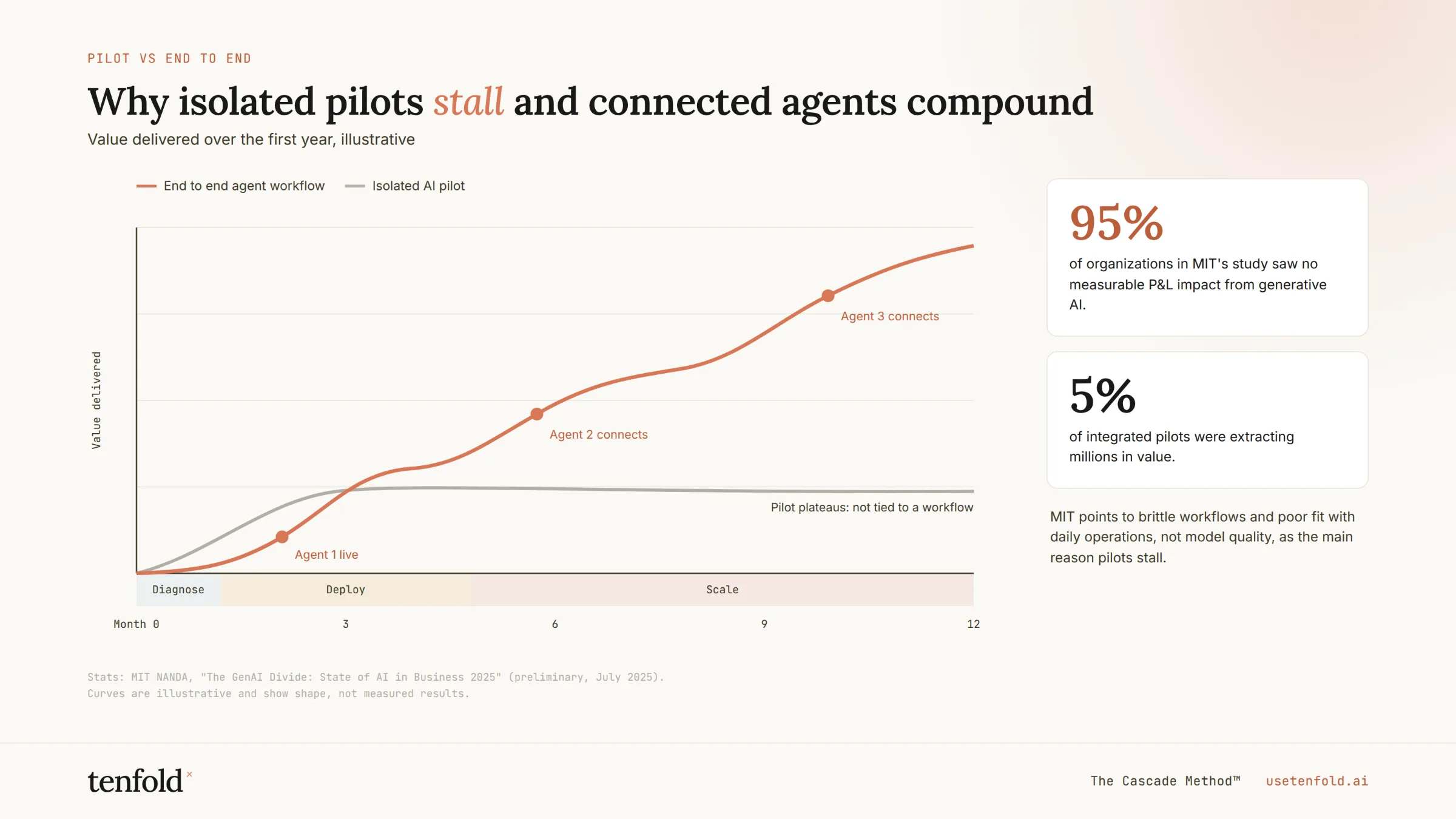
The difference between a failed AI pilot and a 210% ROI isn't the model — it's operational integration across full workflows.
What Each Technology Actually Does
Before comparing them, it's worth being precise about definitions — because most market confusion starts here.
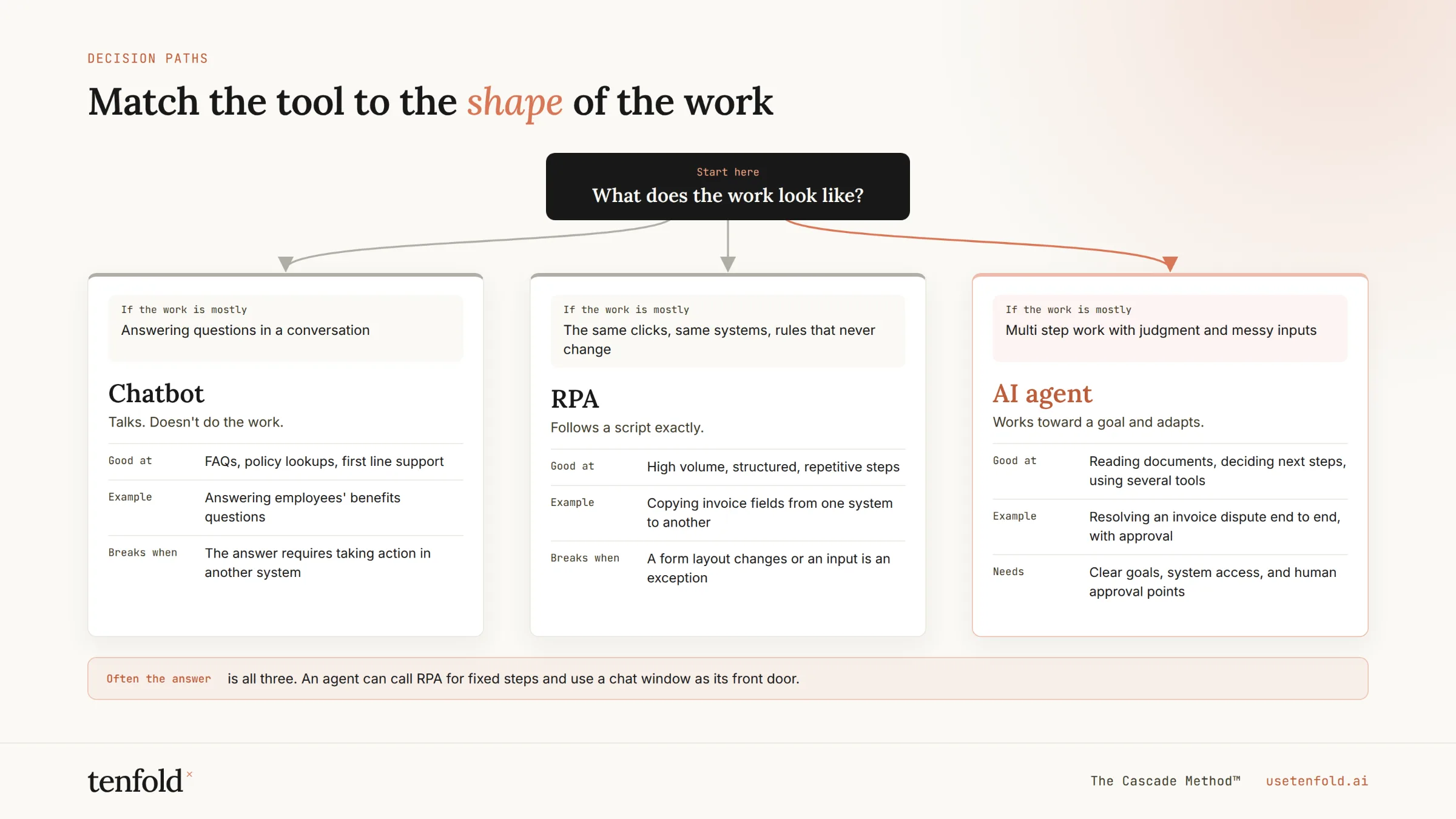
Chatbot: A conversational interface that answers questions from a script or knowledge base. Modern chatbots use NLP to interpret intent, but their core function is informational. They respond — they don't act. A chatbot can tell a customer their order status. It cannot update the order, process a refund, and send a confirmation — not unless it has been deeply integrated with backend systems, at which point it's functioning more like an agent.
RPA (Robotic Process Automation): A software robot that executes a fixed, rule-based sequence of steps across your systems. RPA works exactly like a macro on steroids: it clicks buttons, copies data, fills fields, and moves files — precisely as programmed, every time. The moment the environment changes (a UI update, a new field, a different PDF format), the bot breaks. RPA requires structured inputs and identical conditions on every run.
AI Agent: A goal-directed system that uses a language model to decide what to do next, calls tools or APIs, reasons through exceptions, and completes a multi-step objective. Unlike RPA, an AI agent isn't following a script — it's working toward an outcome. It processes structured and unstructured data, adapts when conditions vary, and escalates to a human only when confidence is genuinely low.
According to beam.ai, RPA handles data entry in a process like invoice validation, but an AI agent reads the invoice regardless of format, extracts the relevant fields, validates them against purchase orders, and routes exceptions to a human — autonomously.
The Core Differences: A Side-by-Side View
Here's what the three technologies look like across the dimensions that matter most to operations and IT leaders:
| Dimension | Chatbot | RPA | AI Agent |
|---|---|---|---|
| Best for | FAQs, routing, self-serve support | Stable, repetitive, rules-based tasks | Multi-step workflows requiring judgment |
| Input handling | Natural language | Structured data, fixed formats | Structured + unstructured, any format |
| Decision-making | Guided by intent classification | If-then logic only | Dynamic reasoning based on context |
| Adaptability | Medium | Low — breaks when UI or process changes | High — adapts to variation autonomously |
| Exception handling | Escalates to human | Stops and escalates to human | Reasons, retries, or finds alternatives |
| Maintenance burden | Low–medium | High (brittle scripts, frequent breaks) | Lower (self-adapting to changes) |
| Typical implementation time | 2–8 weeks | 1–4 months | 3–6 months |
| Typical cost range | $5K–$50K | $20K–$200K | $50K–$500K+ |
| Common failure mode | Answers but doesn't resolve | Bot breaks after app update | Unsafe actions / inconsistent execution without proper guardrails |
The shortcut that cuts through the noise: if the workflow needs a human to answer, use a chatbot. If it needs a human to repeat, use RPA. If it needs a human to think, use an agent.
When to Use a Chatbot
Chatbots solve one class of problem well: deflecting and routing conversational demand at scale.
If your support team fields the same 40 questions 200 times a day, a chatbot handles that volume without incremental headcount. If your website visitors need to find a product, book a demo slot, or check a policy — chatbot is the right tool.
Where chatbots consistently fail is in confusing *answering* with *resolving*. A customer who asks "why was I charged twice?" hasn't had their problem solved when the chatbot explains your billing policy. Resolution requires a backend action — a refund, a credit, a case opened in CRM. That's not a chatbot problem. That's an agent problem.
Use a chatbot when:
The workflow is primarily Q&A, routing, or self-serve information delivery.
No backend system action is required for the interaction to count as complete.
Response quality is consistent and doesn't depend on context that varies per user.
The chatbot market reflects this positioning. According to Grand View Research, the global chatbot market was valued at $9.6 billion in 2025 and is projected to grow to $11.8 billion in 2026 — steady, double-digit growth driven by support deflection and lead qualification use cases, not complex automation.
When to Use RPA
RPA is still the right tool for a defined class of work — and it's a mistake to write it off just because AI agents are getting the headlines.
High-volume, deterministic, stable back-office processes are where RPA delivers consistent ROI. Nightly reconciliation. Payroll data transfers. ERP to CRM record syncing when the field mapping never changes. These are processes where structured inputs are guaranteed, the environment is controlled, and any deviation should *always* be flagged to a human anyway.
Use RPA when:
Inputs are predictable and the process does not vary.
The workflow is identical every single time — same steps, same systems, same data format.
Volume is high enough to justify the setup and maintenance investment.
Your team manually reviews exceptions regularly and those exceptions are edge cases, not the norm.
According to Mordor Intelligence, large enterprises accounted for 70.12% of RPA adoption in 2025 — concentrated in BFSI, IT, and manufacturing, where exactly these conditions exist at scale.
The honest caveat: RPA maintenance compounds. According to beam.ai, traditional RPA implementations cost approximately $228,000 in year one, and maintenance runs 20–30% of initial development annually. Every UI update, process change, or system migration requires script rewrites. For stable workflows, this is manageable. For anything with variability, the maintenance debt eventually exceeds the automation value.
When to Use an AI Agent
AI agents are the right tool when the process currently requires a human to read context, make a decision, and take action across multiple systems — and when that sequence of steps varies from case to case.
Customer complaint resolution. Lead qualification and routing based on behavioral and firmographic signals. Invoice processing across variable formats. Onboarding workflows that pull from HR, IT, and CRM systems. Claims assessment that involves reading documents, checking policy, identifying missing data, and routing appropriately. These are all agent-grade problems.
According to aetherixsystems.com, AI agents automate 70–90% of workflow steps — roughly doubling or tripling RPA's ceiling of 40–60%.
According to beam.ai, organizations that executed the transition from RPA to AI agents report a 40% reduction in total cost of ownership within 24 months, with AI agent maintenance running 10–15% of initial development cost compared to RPA's 20–30%.
The adoption signal is clear. According to McKinsey's State of AI (2025), 62% of enterprises are at least experimenting with AI agents, and 23% are actively scaling an agentic AI system somewhere in their enterprise. Gartner forecasts that 40% of enterprise applications will embed task-specific AI agents by end of 2026 — up from less than 5% in 2025.
But adoption headlines obscure a harder truth: most AI agent initiatives don't fail because the technology doesn't work. They fail because organizations deploy agents on isolated tasks rather than full workflows. According to agentmarketcap.ai, companies that deploy AI end-to-end across full workflows achieve 210% ROI with sub-six-month payback — while those running isolated pilots average just 7% ROI. The difference is not model capability. It is operational integration.
At Tenfold, we've found this consistently: the organizations extracting real returns from AI agents are the ones who approached deployment as a workflow redesign problem — not a software installation problem.
The Decision Framework: Three Questions
Before selecting a tool, define what "done" looks like for the workflow you're automating. Then run through this framework:
Question 1: Does the workflow require a backend action to count as resolved?
If yes, a chatbot alone is the wrong tool. The interaction might *start* with conversation, but resolution requires system access — which means you need either a deeply integrated chatbot (approaching agent territory) or an actual agent.
Question 2: Does the input vary in format, content, or exception type?
If yes, RPA will require ongoing maintenance that eventually exceeds its value. Variable inputs — documents in different formats, data from different sources, cases that differ by customer — are agent territory.
Question 3: Does a human currently read context, make a decision, and take action across multiple systems to complete this?
If yes, that workflow is a candidate for an AI agent. The more that description matches your process, the stronger the agent case.
If the answer to all three is yes, you're looking at a workflow where AI agents deliver production-grade outcomes. If the workflow is purely structured execution with no variation, RPA is still the right tool. If the interaction is purely informational, chatbot is the right tool.
The honest summary: Most businesses need two of these three technologies — not one. A common and effective architecture pairs a chatbot for first-contact interaction and FAQ deflection with an AI agent for complex case handling, using RPA bots for the stable, deterministic sub-tasks the agent orchestrates within a larger workflow.
The Cost Reality
Cost is frequently the deciding factor in technology selection — and frequently misunderstood because teams compare upfront implementation costs instead of total cost of ownership.
Chatbots carry the lowest upfront cost and fastest deployment timelines. The risk isn't the build cost — it's deploying a chatbot where an agent is actually needed, creating a customer experience that frustrates rather than resolves.
RPA sits in the low-to-medium range at initial deployment, but the TCO picture changes as maintenance compounds. According to beam.ai, enterprises that transitioned from RPA to AI agents report a 40% reduction in total cost of ownership within 24 months.
AI agents carry the highest upfront investment — $50K to $500K+ depending on scope — and require additional engineering for data grounding, guardrails, evaluation, and observability. But the return trajectory is fundamentally different from the other two. Forrester TEI studies commissioned by vendors like Microsoft and Salesforce show 106%–396% three-year ROI for agentic AI deployments. Even applying significant discount for the vendor-commissioned nature of those studies, the directional signal is consistent: well-scoped, properly integrated agent deployments generate measurable business returns within months.
The critical variable isn't which technology is cheapest to buy. It's whether you've correctly matched the technology to the workflow — and whether you have implementation partners who can build for production rather than proof-of-concept.
The Hybrid Architecture: Where Most Enterprises Land
The most effective enterprise automation architectures don't pick one technology — they combine all three in complementary roles.
A practical example: a customer service workflow that starts with a chatbot for intent capture and FAQ deflection, routes complex cases to an AI agent that reads case history, checks CRM, assesses the issue, determines the appropriate resolution, and closes the case — while the agent orchestrates specific RPA bots to enter data into legacy systems that lack APIs.
According to aetherixsystems.com, hybrid architectures (agent + RPA) achieve 85–95% process automation coverage, compared to 70–90% for AI agents alone and 40–60% for RPA alone. Exception rates in hybrid deployments drop to 3–10%, versus 15–30% for pure RPA.
The question shifts from "which technology should we use?" to "what does the end-to-end workflow look like, and which layer handles which part?"
Summary
AI agents, chatbots, and RPA are purpose-built for different problems. Chatbots answer. RPA repeats. AI agents decide. Getting this distinction right before you commit budget is the difference between a tool that earns its place in your stack and one that creates technical debt you spend the next two years managing.
The organizations getting the most out of AI automation right now aren't picking the newest or most talked-about technology. They're defining what done looks like — then selecting the tool that gets them there. That's exactly the approach Tenfold brings to every AI agent implementation: workflow-first, outcomes-driven, with the receipts to prove it.
Frequently Asked Questions
Q: What is the main difference between an AI agent and a chatbot?
A: A chatbot focuses on conversation — answering questions and routing users based on intent. An AI agent can reason, plan, and take actions to achieve a goal across multiple systems, with guardrails for exception handling and human escalation. The key distinction is whether the interaction ends with an answer or with a completed action.
Q: Is RPA becoming obsolete because of AI agents?
A: No. RPA remains the right tool for high-volume, stable, rules-based processes where inputs are consistent and the environment doesn't change. What's shifting is the ceiling: RPA automates 40–60% of a given workflow, while AI agents can automate 70–90%. For complex, variable workflows, agents are the better fit. For deterministic, structured ones, RPA still delivers strong ROI.
Q: Can AI agents and RPA work together?
A: Yes — and this is often the most effective architecture. An AI agent can handle the reasoning, exception management, and multi-system orchestration in a workflow, then delegate specific structured sub-tasks to RPA bots. Hybrid architectures achieve 85–95% process automation coverage, the highest of any approach.
Q: How long does it take to implement an AI agent vs. RPA vs. a chatbot?
A: Chatbots typically deploy in 2–8 weeks. RPA implementations run 1–4 months. AI agents require 3–6 months, depending on workflow complexity, data grounding requirements, and the level of integration with existing systems. The implementation timeline reflects the depth of workflow redesign required — not just the tool configuration.
Q: What ROI can businesses expect from AI agents?
A: ROI varies significantly based on how deeply agents are integrated into full workflows. Research cited by enterprise adoption studies shows that companies deploying AI end-to-end across complete workflows achieve 210% ROI with sub-six-month payback — while isolated pilots average just 7%. Scope and integration depth are the primary ROI drivers, not model capability.
