
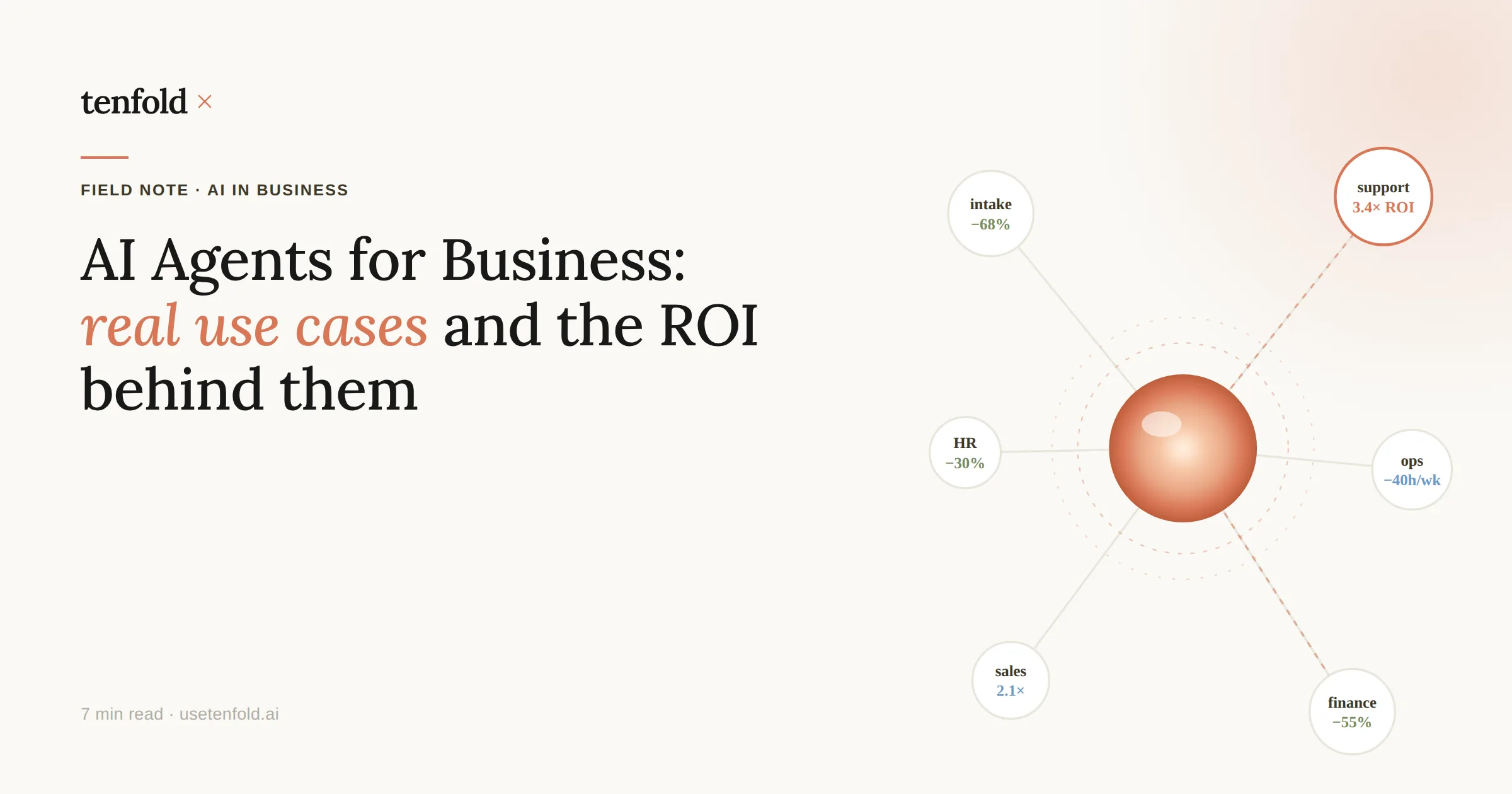
AI Agents for Business: Real Use Cases and ROI (2025 Data)
AI agents for business are delivering measurable, verified returns — not in two to three years, but within the first twelve months of deployment. The question for most leadership teams is no longer whether agents work. It's which use case to fund first.
At Tenfold, we implement AI agents for enterprise operations teams. We've seen what separates the deployments that compound into structural advantage from the ones that stall at proof-of-concept. This post covers both: the hard numbers from across the market and the practical logic behind where to start.
Quick Answer: AI agents deliver business ROI through process automation, faster customer resolution, and revenue ops improvements. According to Google Cloud's 2025 ROI of AI Report, 74% of executives report achieving ROI within the first year of agent deployment, with 39% seeing productivity at least double.
Key Takeaways:
74% of executives report achieving ROI from AI agents within the first year, and 39% saw productivity at least double (Google Cloud, 2025)
Companies report an average ROI of 171% from agentic AI deployments — roughly 3x the return of traditional automation
The highest-ROI use cases are customer service, sales operations, finance back-office, and HR — all characterized by high volume, multi-step workflows
Workflow redesign — not technology selection — is the single strongest predictor of enterprise-wide AI impact (McKinsey, 2025)
The gap between a pilot and a production agent is definitional, not technical: scope the use case, define the KPI, measure from day one
What AI Agents Actually Are (And What Sets Them Apart)
AI agents are autonomous software systems that perceive their environment, reason about a goal, and take action — without waiting for a human to script every step. Unlike traditional automation or basic chatbots, which follow fixed rules or decision trees, agents adapt when a workflow veers off-script, pull relevant data in real time, and decide what to do next on their own.
The operational implication is significant. A standard RPA bot executes step A → B → C. An AI agent can handle step A, encounter an exception, find the resolution, update the downstream system, and log the action — all in a single pass. That capability is why agentic AI deployments are generating 3x the ROI of traditional automation [INSERT STAT: Landbase/AIMonk enterprise deployment data].
[IMAGE: diagram showing AI agent workflow vs. traditional RPA bot — alt text: "AI agent multi-step autonomous workflow compared to rule-based RPA bot"]
This distinction matters for the business case. Executives evaluating agents aren't just buying faster bots. They're buying a system that can own end-to-end processes — with human checkpoints at the moments of genuine judgment.
The ROI Numbers: What the 2025 Data Actually Shows
The data on AI agent ROI is no longer speculative. Multiple large-scale surveys and verified enterprise case studies published between 2025 and 2026 tell a consistent story.
According to Google Cloud's 2025 ROI of AI Report, which surveyed executives globally on production AI agent deployments:
74% of executives report achieving ROI within the first year
39% of executives report productivity has at least doubled across functions where agents are deployed
52% of organizations now have AI agents running in production — not in pilots
Among "agentic AI early adopters" (13% of respondents), 88% report seeing ROI from generative AI on at least one use case, compared to 74% across all organizations
On the revenue side, companies adopting agentic AI report average revenue increases of 6% to 10%, with sales ROI rising 10% to 20% among organizations deploying agents across revenue operations, according to McKinsey's 2025 State of AI research.
For context on scale: organizations report an average ROI of 171% from agentic AI deployments, with U.S. enterprises hitting 192% — roughly 3x the return of traditional process automation tools.
Time-to-ROI varies by use case. Customer service deployments can show returns within two weeks. Supply chain orchestration can take 12 or more months. The fastest path is always starting with high-volume, multi-step workflows that have a clear, pre-existing performance baseline.
Use Case 1: Customer Service and Experience
Customer service is the highest-deployed and fastest-returning AI agent use case in the enterprise today.
According to Google Cloud's 2025 study, customer service and experience is the top cross-industry application for AI agents, cited by 49% of executives. It also produces the highest ROI gap between early adopters and the average: 43% of agentic AI leaders report seeing ROI from customer service agents, versus 36% of the broader market.
What are agents actually doing here? They resolve common requests instantly by grounding answers in approved knowledge bases, execute safe actions like refunds or password resets, and route complex cases to the right human with full context attached. After each conversation, they can summarize transcripts, tag dispositions, and flag compliance gaps — giving managers coaching insights without manual call review.
The Klarna case is the most cited benchmark in this space. Klarna's AI customer service agent saved $60 million and handled the equivalent workload of 853 full-time agents by Q3 2025.
ServiceNow's deployment produced a 52% reduction in time required to handle complex customer service cases.
At scale, chat and voice agents handle up to 80% of customer queries, reduce resolution time, and improve CSAT — consistently, across deployments. For operations leaders, the math is straightforward: agents handle volume, humans handle judgment.
Use Case 2: Sales Operations and Revenue Generation
AI agents in sales operations do things that static CRM workflows can't: they qualify leads, enrich contact records, schedule follow-ups, personalize outreach based on behavioral signals, and log every action back to the CRM — without rep intervention.
The outcomes are measurable. Automated SDRs (AI sales development agents) research leads and personalize outreach at 4x the speed of manual efforts, according to enterprise deployment data. McKinsey reports a 10% to 20% improvement in sales ROI among organizations deploying agents across revenue operations.
In one documented deployment, a luxury car rental company deployed an AI voice agent that captured 1,017 calls and produced 778 qualified leads in four months — a 76% conversion rate — by handling inquiry volume that would have been missed outside business hours.
For Salesforce-native environments, agents can operate across lead scoring, opportunity stage updates, renewal alerts, and quote generation — turning CRM data from a system of record into a system of action. Salesforce's own internal use of AI agents drove a 15% increase in deals closed and shortened sales cycles by 25%.
Use Case 3: Finance and Back-Office Operations
Finance back-office is where AI agents produce some of the least visible but most material ROI.
The highest-ROI applications in this category are accounts payable matching, invoice processing, trade reconciliation, compliance report generation, and KYC/AML monitoring. These use cases share three traits: high transaction volume, frequent unstructured exceptions, and significant analyst time consumption.
Agents can process invoices, perform PO matching, approve payments, and reconcile accounts with 90%+ accuracy and up to 70% lower costs compared to manual processing. PwC documents up to an 80% cycle time reduction in transaction matching workflows where agentic AI has been deployed.
JPMorgan runs 450+ AI use cases in production daily. Their agents generate investment banking presentations in 30 seconds — work that previously took junior analysts hours. On the legal side, Salesforce cut $5 million in legal costs through AI-driven contract automation.
For financial services firms specifically, 43% of companies using AI in financial services saw a significant boost in operational efficiencies — and approximately 70% of financial institutions now use AI for fraud detection, reducing false positives while improving detection speed.
The back-office ROI case is particularly strong right now because CFO-led headcount pressure is forcing efficiency mandates that AI agents can fulfill without adding staff. The conversation is fast because the alternative is visible.
Use Case 4: HR and People Operations
HR is emerging as one of the highest-adoption functions for AI agents outside of customer service and IT.
More than 45% of global leaders are using AI agents for HR operations, with another 39% planning to adopt them in the near term. Among those who have deployed, 65% report significant enhancement in efficiency and productivity for HR-related tasks.
The use cases cluster around high-volume, repeatable work: employee onboarding, benefits administration, payroll support, policy Q&A, and candidate screening. Agents handle the transactional layer — routing tickets, answering FAQs, scheduling interviews, triggering system updates — while HR teams focus on strategic and interpersonal work.
Unilever's deployment of AI agents in recruiting saved $1 million+ per year and reduced time-to-hire by 75% — one of the most frequently cited benchmarks in enterprise HR automation.
HR automation ROI comes from streamlined onboarding, benefits administration, and payroll support — improving processing speed while freeing HR staff for higher-value work. In most mid-market deployments, the productivity reclaimed is equivalent to one to two full-time roles per HR function.
What Separates the Organizations Getting Real ROI
The data is clear that AI agent ROI is achievable. It's also clear that it isn't universal. McKinsey's 2025 State of AI research found that only 39% of organizations report EBIT impact at the enterprise level — despite widespread use-case-level gains.
The gap isn't technology. It's implementation approach.
Organizations achieving the strongest results share three patterns:
1. They start with a scoped use case, not a platform.
Focus first on processes where autonomous decision-making creates immediate value — customer service resolution, invoice matching, lead qualification. These provide clear ROI metrics and build organizational confidence for broader deployment.
2. They redesign the workflow, not just the tool.
McKinsey identifies workflow redesign as the single strongest predictor of enterprise-wide AI impact. High performers are nearly three times more likely to have fundamentally redesigned individual workflows than organizations that simply overlay agents on existing processes.
3. They define success metrics before deployment.
Cycle time, error rate, escalation volume, handle time — whatever the process baseline is, it needs to be established before agents go live. Organizations that skip this step can't demonstrate ROI even when it's happening.
The bottleneck isn't AI capability. It's that most organizations haven't yet redesigned their workflows to delegate to it.
How Tenfold Approaches AI Agent Implementation
Tenfold is an AI agent implementation consultancy built for enterprise operations teams. We're the go-to-market arm of Inforge, a Salesforce consultancy that replaced its entire delivery model with AI agents — running full Salesforce implementations through prompts, not headcount.
That's not a pitch. It's the proof of concept we run every day.
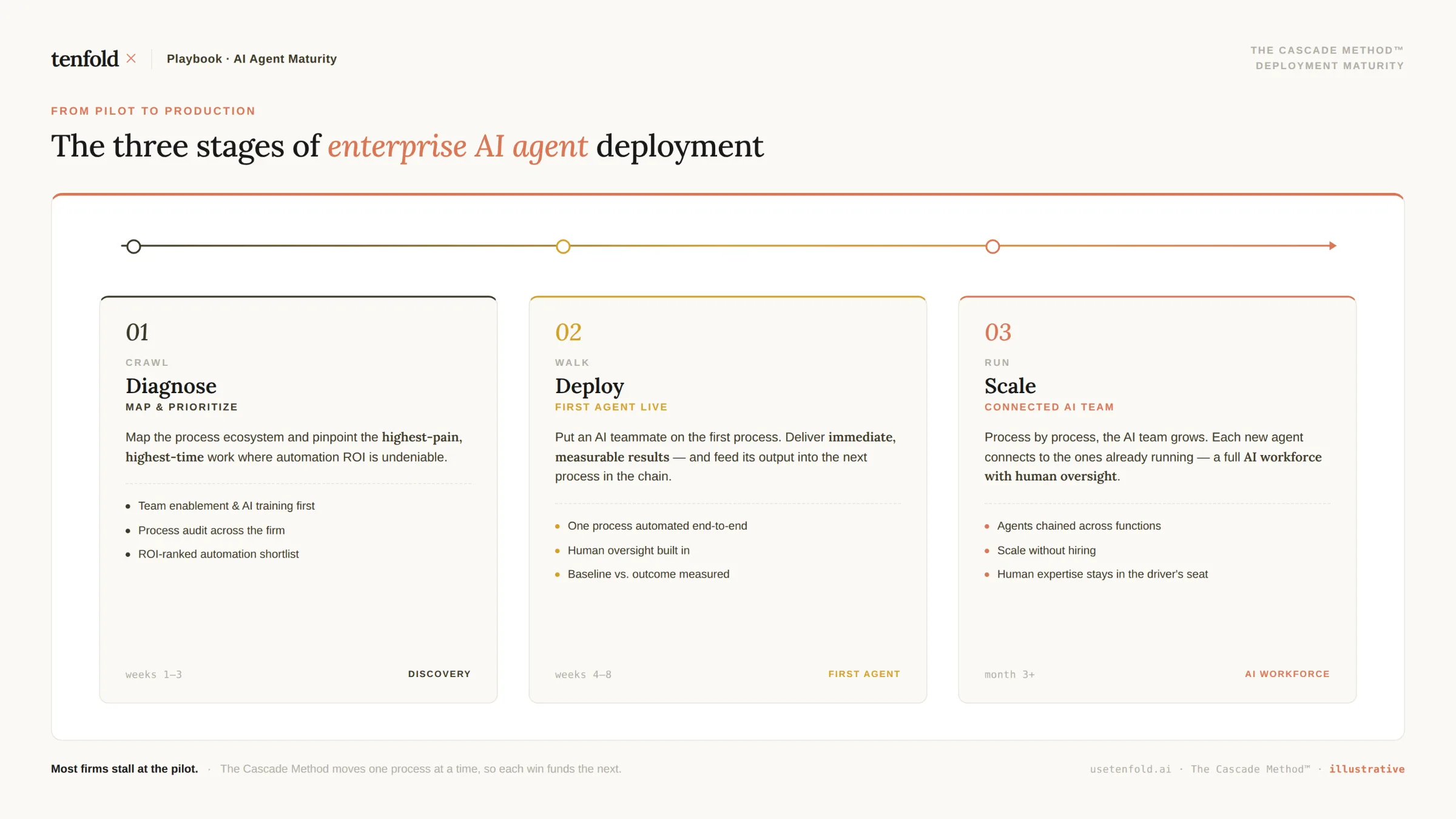
When we engage with a client, we don't start with a technology conversation. We start with a process audit: where is high-volume, multi-step work consuming team bandwidth that agents can own end-to-end? We define the KPI, scope the deployment, and move to production on a timeline most enterprise clients aren't expecting.
The organizations we work with don't need to be convinced that AI agents work. They need a partner that's already done it — and can show them exactly how.
Summary
AI agents for business are producing verified ROI across customer service, sales operations, finance back-office, and HR — with 74% of executives reporting returns within the first year and average ROI benchmarks exceeding 170% in enterprise deployments. The gap between pilots that stall and agents that scale comes down to use case scoping, workflow redesign, and clear success metrics from day one. Tenfold exists to close that gap — bringing the same agent-first model we use internally to operations teams ready to move from evaluation to production.
Frequently Asked Questions
Q: What is the ROI of AI agents for business?
A: According to Google Cloud's 2025 ROI of AI Report, 74% of executives report achieving ROI from AI agents within the first year of deployment. Average reported ROI from agentic AI deployments is 171% — roughly 3x the return of traditional automation tools. Actual ROI depends on use case, workflow complexity, and implementation approach.
Q: What are the best AI agent use cases for enterprise businesses?
A: The highest-ROI use cases in 2025 are customer service automation, sales operations (lead qualification, CRM enrichment), finance back-office (invoice processing, reconciliation, compliance), and HR operations (onboarding, recruiting, policy Q&A). These share common traits: high transaction volume, multi-step workflows, and clear pre-existing performance baselines.
Q: How long does it take to see ROI from AI agents?
A: Time-to-ROI ranges from two weeks for customer service deployments to 12 or more months for complex supply chain orchestration. Most enterprise pilot deployments targeting a single workflow — such as invoice reconciliation or lead qualification — reach production-grade performance within 8 to 12 weeks.
Q: How do AI agents differ from traditional automation or RPA?
A: Traditional RPA bots execute fixed, scripted sequences. AI agents reason about a goal, adapt to exceptions in real time, and complete multi-step processes end-to-end without human intervention at each step. Agents can handle unstructured inputs, interact with multiple systems simultaneously, and make decisions — not just follow rules.
Q: What do high-performing organizations do differently with AI agents?
A: McKinsey's 2025 research identifies workflow redesign as the single strongest predictor of meaningful enterprise AI impact. High performers treat agent deployment as a strategic capability — they scope use cases precisely, define KPIs before deployment, and redesign processes around what agents can own end-to-end rather than layering agents on top of existing workflows.
*Ready to move from evaluation to production? [Talk to Tenfold](https://tenfold.ai) about scoping your first AI agent deployment.*
