
AI Agents for Fintech: Automating Onboarding, KYC, and Customer Support
For fintechs, the onboarding funnel is where revenue quietly leaks out. A prospect downloads your app, starts identity verification, hits a multi-day review queue — and abandons. The math is brutal: financial KYC loses 30 to 40 percent of potential users to slow, multi-step verification, and 70 percent of firms reported losing clients last year because onboarding took too long. The bottleneck was never the customer's willingness. It was the operational machinery behind the signup screen.
AI agents are dismantling that machinery. Unlike the rule-based automation and rigid chatbots fintechs deployed for the last decade, agentic systems reason across multiple inputs, call APIs, and execute a sequence of actions autonomously. In lending, an agent can ingest an application, run KYC verification, apply risk models, check policy compliance, and advance the file toward approval without a human touching each step.
Quick Answer: For most fintechs, deploying AI agents across onboarding, KYC, and support is the fastest path to lower abandonment and lower cost-per-customer. The highest-ROI starting point is standard-tier onboarding, where agents run identity verification, sanctions screening, and document checks in parallel within seconds. Reserve human review for the genuinely complex cases — high-risk entities, ambiguous documents, enhanced due diligence — and let automation absorb the volume.
Key Takeaways:
Digital verification reduces manual KYC processing time by roughly 78 percent, improves fraud-detection accuracy by about 61 percent, and lowers onboarding costs by up to 48 percent, according to AU10TIX's 2026 research.
AI adoption in KYC surged from 42 percent to 82 percent in a single year per Fenergo — but only about 4 percent of banks have automated the majority of their workflows. Most firms are stuck in partial automation, and that gap is the opportunity.
One large Dutch financial institution achieved a 90 percent reduction in onboarding time and cut staff workload by 30 percent using AI across KYC and compliance.
By 2026, an estimated 70 percent of new-account onboarding will be fully automated for standard-tier customers.
The average firm spends roughly $72.9 million annually on AML and KYC operations alone — making this the single most expensive compliance activity to automate.
Why Onboarding Is the Highest-Value Place to Start
The reason onboarding tops the priority list isn't just cost — it's compounding loss. Every abandoned signup is a customer acquisition dollar spent with zero return. Organizations deploying agentic KYC typically reduce average onboarding time by 80 to 90 percent for standard-tier customers, who represent the bulk of volume. JPMorgan's agentic KYC system is targeting a process that once took up to five days, compressing it toward under a minute.
What makes the agentic approach different from old automation is that the agent doesn't just route data faster — it reimagines the process. JPMorgan's framing is explicitly "agentic-first": agents orchestrate the entire onboarding workflow from intake, rather than being bolted onto an existing sequential process. ING is rebuilding KYC to draw on data it already has from public registries, minimizing what it asks clients to provide. The principle is consistent: reduce client burden, not just internal processing time.
How AI Agents Handle KYC and Risk
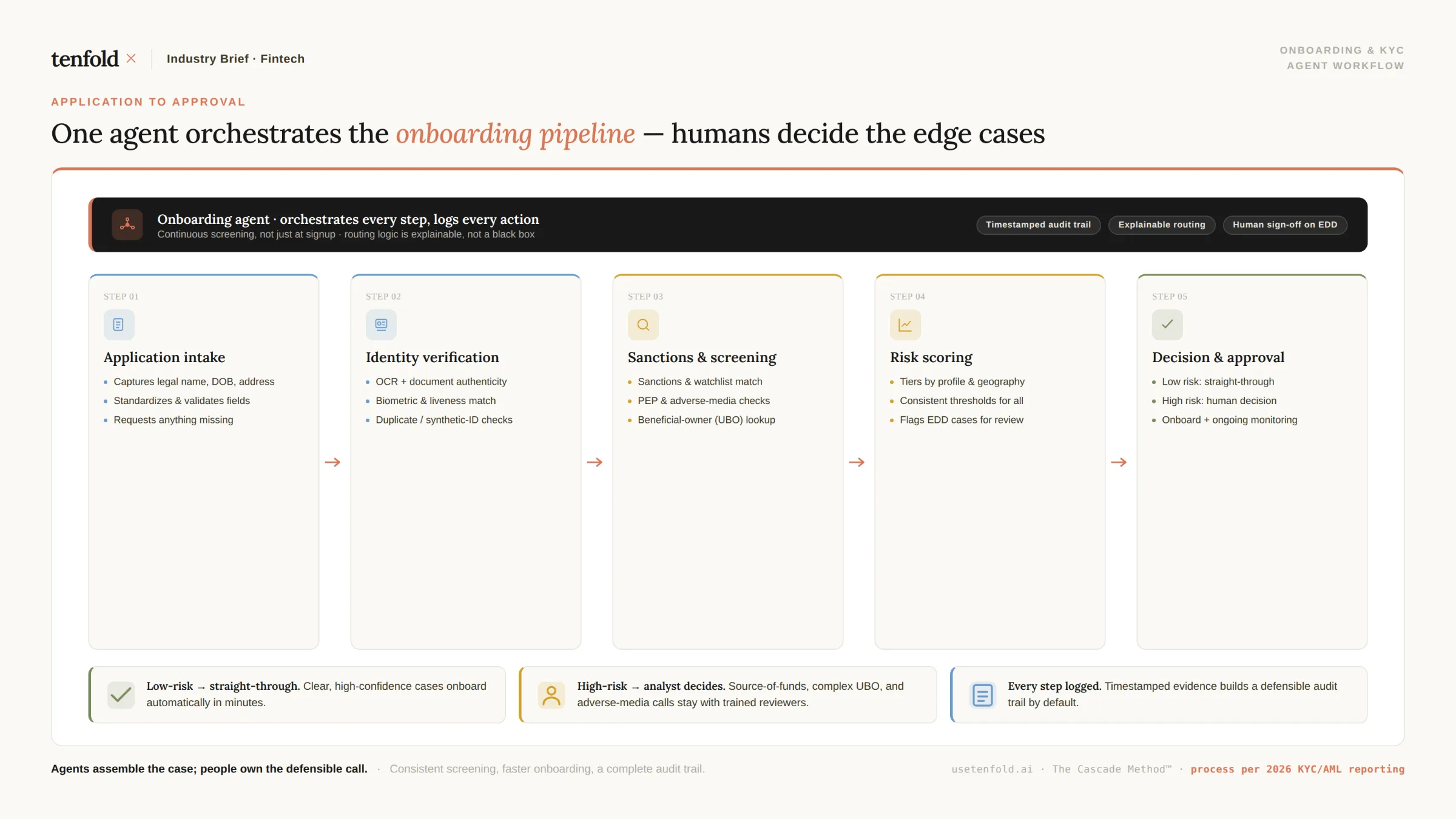
The smartest deployments use a tiered model. Standard, low-risk customers flow through fully automated verification — identity checks, document validation, sanctions and adverse-media screening, beneficial-ownership lookups, all running in parallel. Medium-risk cases trigger an agent to build a case file: pulling extra data, analyzing corporate registries, and producing a summarized report that a human analyst reviews in about a minute rather than an hour. High-risk entities route automatically to enhanced due diligence, where human investigation remains mandatory.
This isn't RPA versus AI. Predictable, rules-based steps stay on deterministic rules. The judgment-heavy parts — document interpretation, anomaly detection, real-time risk scoring — go to agents. Getting that boundary right is where good architecture starts.
The model also shifts KYC from a point-in-time snapshot to perpetual KYC: AI agents scan sanctions lists, adverse media, and corporate registries continuously, triggering an automated mini-review the moment a material change is detected.
Customer Support That Doesn't Sleep
Beyond onboarding, agentic AI is the fastest-growing category in financial services, with 52 percent of respondents actively adopting multi-step autonomous workflows per CCAF's April 2026 survey. On the support side, agents resolve routine inquiries — balance checks, payment confirmations, card servicing — across channels like WhatsApp and in-app chat, while escalating complex or emotionally sensitive issues to humans with full context attached.
The Guardrails You Can't Skip
Automating compliance work raises the compliance bar, not lowers it. The EU AI Act's transparency requirements, FinCEN's 2024 rulemaking encouraging AI-focused risk assessments, and NYDFS guidance treating AI risks as cybersecurity risks all converge on one demand: your system must explain why it flagged or cleared a customer. "The model said so" is not a defense. Auditable, explainable decision logic and red-teaming of models are non-negotiable.
Summary
Fintech onboarding, KYC, and support are no longer a build-it-and-hope proposition. The data is unambiguous: faster onboarding, lower costs, better fraud detection, and higher retention are all measurable today. The firms that push past partial automation to end-to-end agentic workflows — with governance built in from day one — will capture the retention and productivity gains that the 4-percent leaders are already banking. If you're evaluating where AI agents fit in your fintech stack, the Tenfold team can help you scope the highest-ROI starting point.
Frequently Asked Questions
Q: How much faster can AI agents make fintech onboarding? A: For standard-tier customers, agentic KYC typically reduces onboarding time by 80 to 90 percent — moving processes that took days down to seconds or minutes. JPMorgan's agentic system targets compressing a five-day process to under a minute.
Q: Does automating KYC increase regulatory risk? A: Done correctly, it reduces it. Automated systems produce complete audit trails and consistent application of rules. But regulators now require explainability — your agent must document why it flagged or cleared each customer, and the EU AI Act adds transparency obligations for high-risk systems in 2026.
Q: Will AI agents replace compliance analysts? A: No. The proven model is augmentation: agents handle the high-volume standard cases and pre-build case files, while analysts focus on enhanced due diligence, ambiguous documents, and high-risk entities where human judgment is mandatory.
Q: What's the realistic cost saving? A: Industry benchmarks indicate 48 to 70 percent reductions in direct onboarding costs for institutions automating document review, identity verification, and screening.
