
AI Agents for Hospitality: Booking, Concierge, and Guest Support Automation
A guest texts the front desk at 2 a.m. asking about a late checkout. Their room feels too cold. They want a dinner reservation for tomorrow. In 2026, meeting that demand with human staff alone is no longer mathematically possible — labor shortages and cost pressure have seen to that. In North America, 65 percent of hotels reported staffing shortages in 2025. Yet guest expectations have only climbed.
AI agents have become the operational answer. The industry has moved past the "should we use AI?" debate: 82 percent of hoteliers expect AI usage to increase across their organization within the next year, and 71 percent say AI is already having a significant or transformative impact.
Quick Answer: For most hotels, deploying AI agents for booking, concierge, and guest support delivers the fastest measurable ROI — typically within 3 to 6 months, with reservation automation paying back first. The winning model isn't AI replacing staff; it's AI handling the 70 to 80 percent of routine, repetitive inquiries so staff can focus on the 20 to 30 percent that require empathy and judgment.
Key Takeaways:
Hotels lose an estimated 30 to 40 percent of potential bookings to slow response times and abandoned reservations, per Oracle research — making instant, automated response a direct revenue lever.
AI assistants improve guest satisfaction by up to 25 percent and reduce running costs by up to 30 percent.
Hotels using AI chatbots report 20 to 35 percent higher conversion rates on direct booking inquiries compared to static web forms.
Guest acceptance is nuanced: 68 percent of travelers are comfortable with AI for routine inquiries, but 82 percent still want human assistance available for complex issues — making a hybrid model optimal.
One multi-location chain reported AI front-desk agents saving an average of $31,000 per location annually, with full ROI typically reached in 4 to 7 months.
Booking: Where the ROI Starts
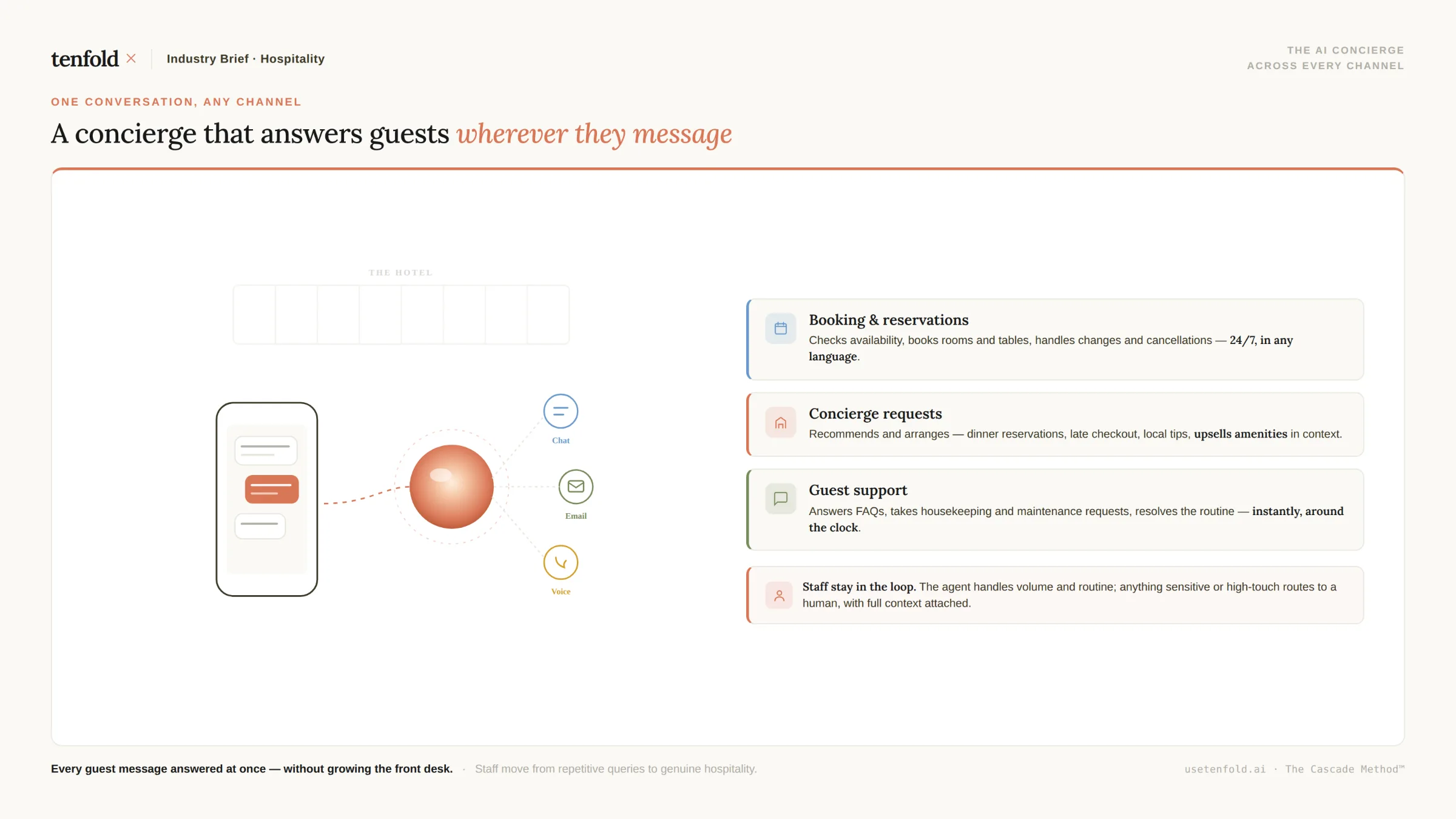
Reservation automation is the fastest payback in hospitality because abandoned bookings are pure lost revenue. Modern AI agents handle the full booking flow — answering policy questions while simultaneously processing a reservation, sending confirmation with pre-filled details, and managing rescheduling — without a coordinator touching routine requests. Because they use natural language processing rather than keyword matching, they understand intent: "my room is freezing" registers as a temperature issue, not a request for ice.
Concierge: Hyper-Local, Always On
The next frontier is the AI concierge as a hyper-local insider. A business traveler looking for lunch should get a different recommendation than a couple arriving for a romantic weekend — and ideally before check-in. Leading platforms deliver this across SMS, WhatsApp, email, and in-app messaging, with multilingual support spanning 50 or more languages and native integration with property management systems so every interaction writes back to the guest record. Brands from Hilton's "Connie" to IHG's virtual concierge are already proving the model at scale.
Guest Support: The Invisible Service Loop
The mature deployment runs a complete loop: pre-arrival messages, check-in instructions, in-stay support, upsell offers, checkout reminders, and post-stay surveys — all automated, all multilingual, all 24/7. When a request needs a human (a maintenance complaint, a high-value retention conversation), the agent creates a staff task automatically and hands off with full context. Hospitality professionals call the result "invisible service": guests get exactly what they need, when they need it, without friction.
The Human Touch, Repositioned — Not Removed
The most important strategic point: AI doesn't eliminate hospitality jobs, it redeploys them. With administrative load offloaded, concierges and front-desk staff move to guest-experience roles, local-expert positions, and revenue management. At the luxury end, some operators expect to employ more people, not fewer — using AI to absorb operational complexity so staff can act as genuine hosts. The augmentation model also reduces staff burnout from repetitive tasks.
What to Evaluate Before You Buy
Hotels run on a stack of systems — PMS, central reservation systems, channel managers, payment platforms. An AI agent that can't integrate deeply with these will be limited to surface-level FAQ handling. The platforms worth considering deliver four capabilities together: 24/7 automated messaging across channels, native PMS integration for real-time guest data, behavior-triggered upselling, and genuine multilingual support. A practical caution: one audit found 37 percent of a hotel group's "must automate" processes actually had negative ROI — so start by identifying your highest-volume, highest-friction touchpoints rather than automating everything at once.
Summary
The hospitality AI question in 2026 isn't whether to adopt — it's how to adopt without losing the human warmth that defines great hospitality. The answer is a hybrid model: automate the routine, elevate the human. Reservation automation pays back fastest, concierge and support deepen loyalty, and staff get repositioned to the work only people can do. If you're scoping where AI agents fit your property or portfolio, the Tenfold team can help you find the highest-ROI starting point.
Frequently Asked Questions
Q: How fast do hotels see ROI from AI agents? A: Typically 3 to 6 months, with reservation automation paying back fastest. Some multi-location chains report full ROI in 4 to 7 months and per-location savings around $31,000 annually on front-desk operations alone.
Q: Will guests accept being served by AI? A: For routine inquiries, yes — 68 percent of travelers are comfortable with it. But 82 percent still want human help available for complex issues, which is why the hybrid model (AI for routine, humans for complex) consistently outperforms either extreme.
Q: What functions should a hotel automate first? A: Start with the highest-volume, highest-friction touchpoints — usually booking inquiries and routine guest messaging (parking, breakfast, late checkout). Validate ROI before expanding; not every process is worth automating.
Q: Does AI integrate with my existing property management system? A: The strong platforms integrate natively with leading PMS solutions so every interaction writes back to the guest record in real time. Deep integration is what separates a true AI agent from a surface-level chatbot.
