
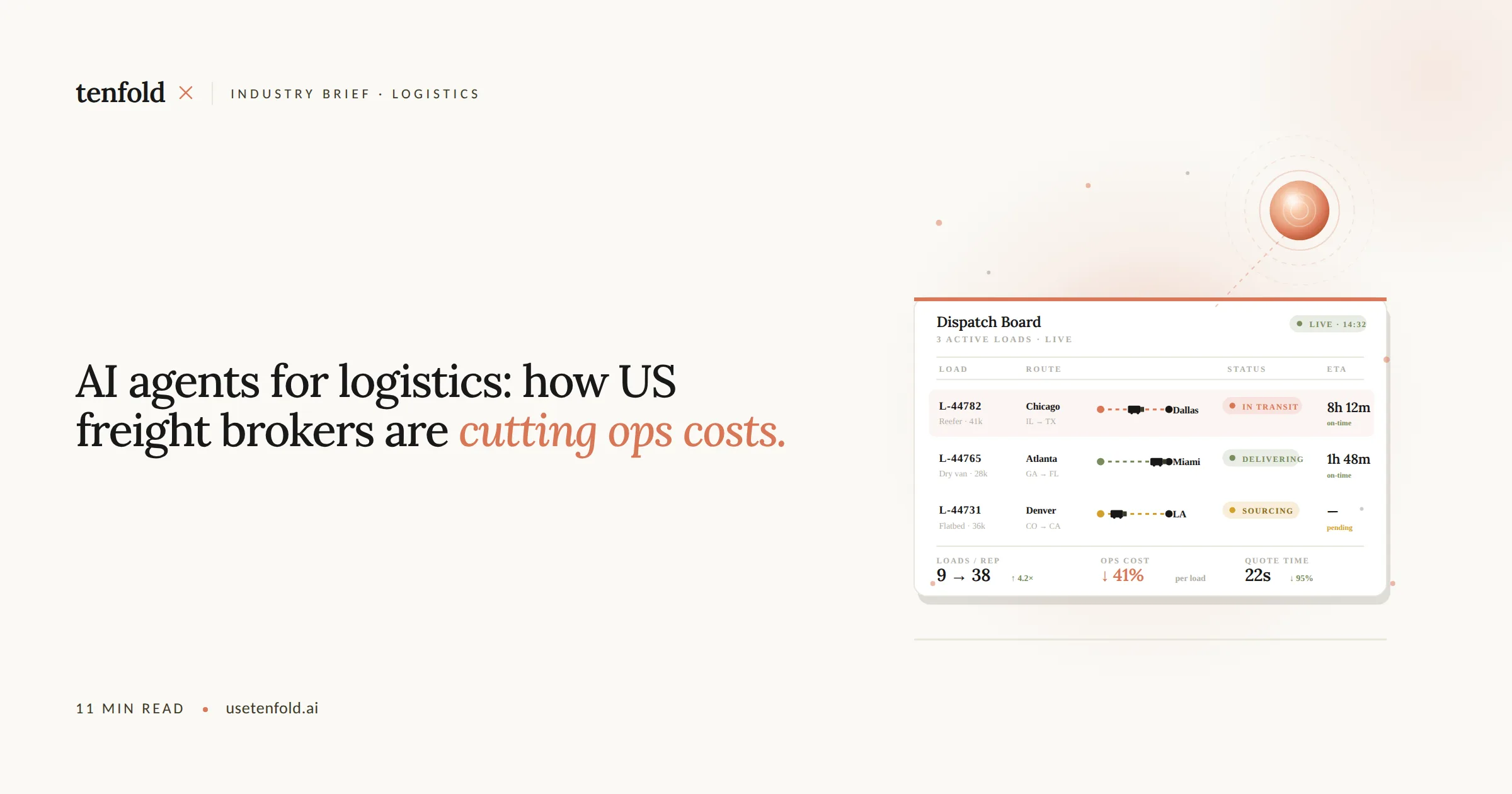
AI Agents for Logistics: How US Freight Brokers Are Cutting Ops Costs
US freight brokers are losing money on a per-load basis — not because they're badly run, but because the cost structure most brokers carry no longer fits the pricing environment. According to FreightWaves, a representative mid-market brokerage is already spending around $205 per load to move freight, against a gross margin of $189 — a loss of roughly $16 per load before interest expense. AI agents are the only lever that changes this equation structurally. The early movers have the receipts.
Key Takeaways:
The US freight brokerage market is valued at $19 billion in 2025 and growing at 8.6% CAGR — but margin pressure is intensifying, not easing.
AI agents are cutting operational costs by 15–30% across quoting, order processing, carrier sourcing, and document handling.
C.H. Robinson's fleet of 30+ AI agents has performed over 3 million shipping tasks and driven a 30% productivity gain since 2023.
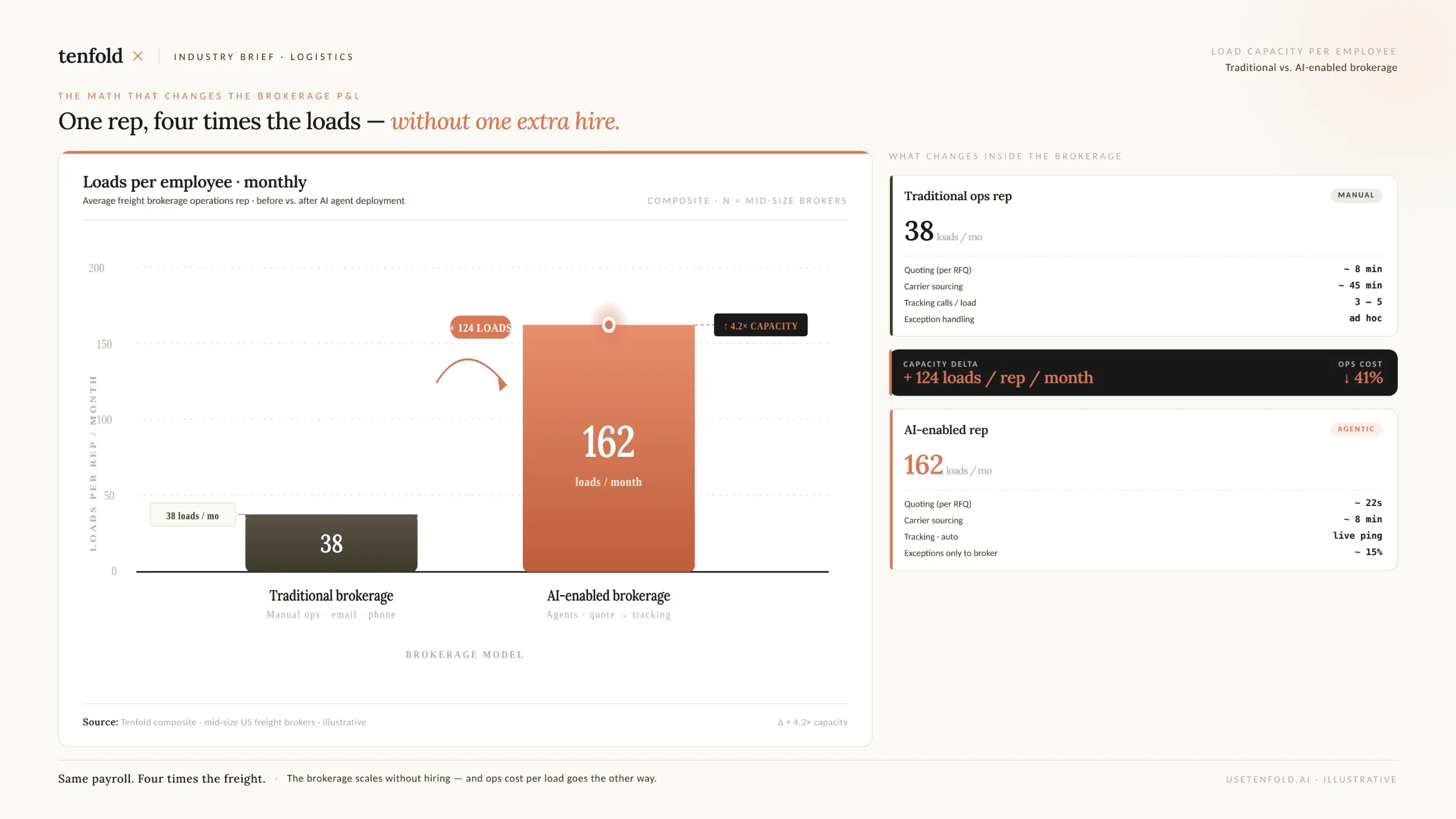
AI-enabled brokerages handle 2–3× more loads per employee than traditional operators, without increasing headcount.
The ROI window is short: implementations consistently deliver positive returns within 45–90 days.
Quick Answer: AI agents in logistics automate high-volume, repeatable tasks — quote generation, load matching, appointment scheduling, document processing, and shipment tracking — that previously required human labor at every step. For US freight brokers, deploying them reduces the cost to serve per load, decouples headcount from volume growth, and compresses response times from hours to seconds.
Why Freight Broker Unit Economics Are Broken Without AI
The margin problem in US freight brokerage is structural, not cyclical. According to FreightWaves, a brokerage needs roughly $210–215 in gross margin per load just to break even — and that's before factoring in bad debt, claims, or growth investment. At a revenue of $1,912 per load and a typical 10% margin, most brokers are operating below their actual break-even point every single day.
The market itself is healthy by volume. According to Market Data Forecast, the US freight brokerage market was valued at $19.01 billion in 2025 and is projected to reach $39.93 billion by 2034 at a CAGR of 8.6%. According to Mordor Intelligence, digital freight brokerage is growing at a 21.8% CAGR through 2030 — more than double the broader market rate.
But volume growth without cost reduction is a trap. According to FreightWaves, chasing volume to grow through it is exactly the mistake that turns struggling brokers into failing ones. Every load moved below true break-even adds risk, consumes working capital, and erodes equity — even if top-line revenue looks strong.
The brokers beating this are not the ones with the biggest teams. They're the ones who reduced their carrier-ops cost per load by 40–50% through automation. That's the structural advantage AI agents create.
What AI Agents Are Actually Doing in Freight Brokerage
AI agents in logistics are not chatbots. They are autonomous software routines that execute multi-step workflows — parsing emails, making decisions, updating records, and triggering downstream actions — without requiring a human in the loop for each task.
According to MindStudio, an AI agent makes decisions and takes actions without constant human supervision, handling tasks like monitoring shipment status, rerouting based on live conditions, processing invoices, and flagging billing discrepancies. The difference from older automation tools is adaptation — these agents don't follow a fixed script; they reason through imperfect inputs.
In freight brokerage specifically, the highest-impact use cases fall into five categories:
1. Instant Quoting and Pricing
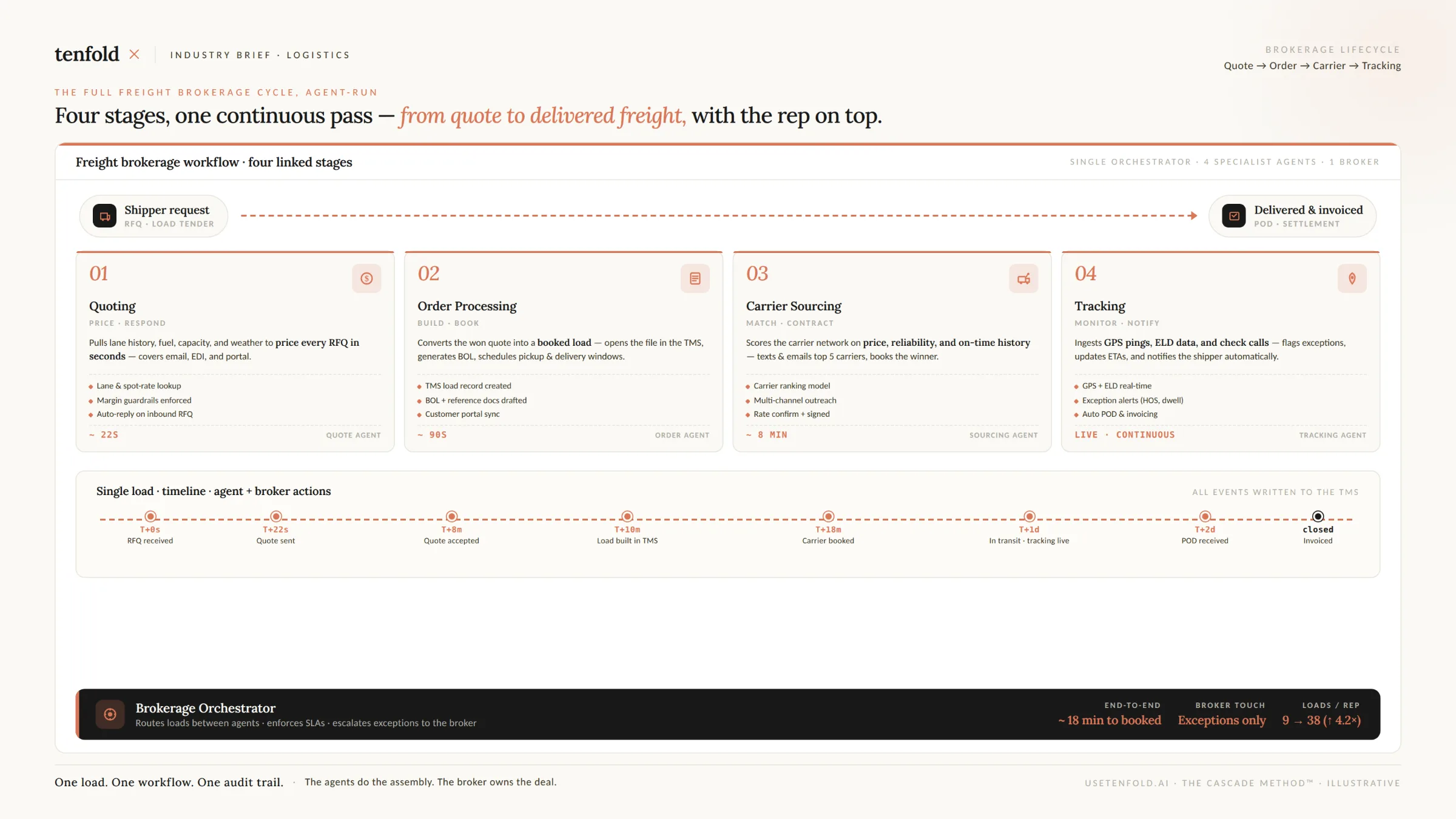
Large language models scan incoming customer emails, extract quote requests, and generate responses in under a minute. According to C.H. Robinson, a quoting process that once took up to 20 minutes manually now completes in an average of 32 seconds. Their AI agents are now delivering over 1 million price quotes — a volume no human team could match without exponentially higher headcount.
According to Tank Transport, one platform now replies to over 2,000 quote requests daily in less than 30 seconds — a process that previously took hours.
2. Load Matching and Carrier Sourcing
Traditional load matching relied on load boards, phone calls, and tribal knowledge. AI systems now analyze millions of historical shipments to identify carriers based on lane patterns, acceptance rates, and timing — and proactively contact them before a broker even posts to a load board.
According to Foreigh.com, AI-enabled carrier sourcing has produced a 62% reduction in time-to-cover and access to carriers who rarely check load boards. Brokers using these systems consistently achieve 3–5% better rates than manual negotiations.
3. Order Processing and Document Handling
Document-heavy workflows — BOLs, PODs, invoices, load tenders — are where broker back offices bleed labor hours. AI document processing systems now extract data from these documents with 98%+ accuracy, validate charges against contracted rates, and flag discrepancies automatically.
According to Ventus AI, InTek Logistics reduced invoice processing time from over 10 hours to just 3 minutes after deploying AI agents — a result that directly translates to lower back-office labor costs and faster cash cycles.
According to Foreigh.com, one brokerage reduced its back-office staff from 5 people to 2 while increasing its load count by 40% after implementing AI document processing.
4. Appointment Scheduling and Shipment Tracking
Check calls and appointment setting are among the most time-consuming — and least value-generating — activities in brokerage operations. According to C.H. Robinson, their Appointments AI Agent now sets over 3,000 appointments daily across 43,000 locations in less than a minute. Their Shipment Tracking Agent responds to customer tracking requests instantly, retrieving SKU-level details without human involvement.
In September 2025 alone, one of C.H. Robinson's AI agents captured 318,000 freight tracking updates from a single type of phone call.
5. LTL Classification and Compliance
Freight classification errors in LTL shipping cause delays, re-invoicing, and disputes — all of which cost time and money. C.H. Robinson's LTL Classifier Agent handles over 2,000 shipments per day. According to C.H. Robinson, over 75% of their LTL orders are now automated — up from 50% before the agent launched.
The Numbers: What Early Movers Are Reporting
The business case for AI agents in freight brokerage is no longer theoretical. Here's what the documented outcomes look like:
C.H. Robinson is the most cited proof point in the industry. According to their official press releases and 2025 annual report, their fleet of 30+ generative AI agents has performed over 3 million shipping tasks. Generative AI was a key driver of the company's 30% productivity increase across 2023 and 2024. According to Kavout, C.H. Robinson managed approximately 29% more LTL volume with 30% fewer employees — headcount dropped from 15,246 at end of 2023 to 11,855 by end of 2025.
Uber Freight launched an LLM-powered network of 30 AI agents for end-to-end shipment execution, according to Tank Transport.
Across the industry, according to MindStudio, companies are cutting logistics costs by 15–30%, improving forecast accuracy by 75%, and reducing emergency expedites by millions of dollars. According to Oliver Wyman, AI solutions targeting SG&A, last-mile delivery, and warehouse management enable logistics firms to target cost reductions between 10% and 25% across operational pools — translating to aggregate EBIT improvements of 1–2% in an industry where average margins are 3–5%.
According to Mordor Intelligence, early adopters of automation in North American freight brokerage report transaction-cost reductions of up to 38%.
At Tenfold, we've worked across logistics and operations contexts long enough to know that the gap between we're piloting AI and AI has reduced our cost per load comes down to one thing: whether the agents are actually embedded in the workflow, or sitting alongside it. The brokers seeing 30%+ cost reductions aren't using AI as a dashboard. They're using it as an operator.
The Five Workflows Where AI Agents Deliver the Fastest ROI
Not all automation pays back equally. Based on industry data and deployment patterns, these five workflows consistently show the highest and fastest returns for freight brokers:
1. Quote generation from inbound email — Highest volume, highest labor displacement. LLMs parse incoming requests and respond in seconds. ROI typically visible within weeks of deployment.
2. Carrier sourcing and outreach — Eliminates the spray-and-pray load board approach. AI identifies the right carrier before a post goes live, improving acceptance rates and compressing time-to-cover by more than 60%.
3. Invoice and document processing — Back-office throughput multiplies without headcount increases. Billing disputes drop. Cash cycles shorten.
4. Appointment scheduling — High-frequency, low-complexity task that consumes disproportionate operations time. Fully automatable with near-zero error tolerance.
5. Shipment tracking and status updates — Eliminates inbound check calls. Agents retrieve and surface live status data on demand, improving shipper satisfaction without adding customer service headcount.
According to Foreigh.com, AI-enabled brokers in 2025 manage 35–50 loads per employee weekly versus 15–20 pre-AI. Brokerages using comprehensive AI solutions handle 2–3× more loads per employee than their traditional counterparts.
According to Foreigh.com, implementing AI solutions typically delivers positive ROI within 45–90 days, making it accessible even for smaller brokerages.
Why Most Freight Brokers Are Still Leaving This on the Table
The data is clear. The proof points are public. So why are most mid-market brokerages still running manual workflows?
According to MindStudio, 74% of businesses report disconnected data silos — and AI needs clean, integrated data to function. Most successful implementations in 2025 focused on narrow, well-defined problems first. Companies that tried to deploy AI everywhere at once struggled. The ones that picked specific pain points saw returns within months.
According to Oliver Wyman, many logistics firms face difficulty realizing the full return on their AI investments. Without deliberate redeployment of capacity, savings generated by AI remain hidden within internal reporting rather than showing as actual cost reductions.
The bottleneck isn't AI capability. It's that most brokerages aren't yet structured to delegate to it. The first step isn't picking a platform — it's mapping the workflows where labor cost per transaction is highest, and building the agent logic around those specific handoffs.
[INTERNAL LINK: How Tenfold Deploys AI Agents for Operations Teams — anchor: Tenfold's agent-first delivery model]
Summary
US freight brokers face a structural cost problem that volume growth alone cannot solve. AI agents — deployed across quoting, carrier sourcing, document processing, scheduling, and tracking — are the mechanism that changes the unit economics. The industry's documented outcomes range from 15% to 38% reductions in transaction costs, with leading operators like C.H. Robinson reporting 30%+ productivity gains and the ability to grow load volume without growing headcount. At Tenfold, we specialize in helping operations leaders move from pilot to production with AI agents that are embedded in real workflows — not demo environments. The proof model is Inforge, our sister company, which runs its entire delivery operation on AI agents. That's not a pitch. It's the baseline we build from.
Frequently Asked Questions
Q: What do AI agents actually do in freight brokerage operations?
A: AI agents handle specific, repeatable logistics tasks end-to-end — generating quotes from inbound emails, sourcing and contacting carriers, processing invoices and documents, scheduling pickup and delivery appointments, and responding to shipment tracking requests. Unlike dashboards or basic automation tools, they adapt to imperfect inputs and execute multi-step workflows without needing a human at each decision point.
Q: How much can AI agents reduce operational costs for a freight broker?
A: Documented industry outcomes range from 15% to 38% reductions in transaction-level costs, with some operators reporting 30%+ productivity gains. The specific impact depends on which workflows are automated and how deeply agents are integrated into the existing TMS and communication stack. The highest returns come from quoting, document processing, and carrier sourcing.
Q: How long does it take to see ROI from AI agent deployment in logistics?
A: Most implementations deliver positive ROI within 45–90 days when focused on high-volume, well-defined workflows. Brokerages that start narrow — one or two pain points — consistently see faster returns than those attempting broad platform rollouts from day one.
Q: Do AI agents require a full TMS overhaul to implement?
A: No. The most effective AI agents are modular and designed to integrate with existing systems — TMS platforms, load boards, email, and CRM — rather than replace them. The priority is connecting agents to live data sources, not ripping out infrastructure.
Q: How are AI-enabled freight brokers different from traditional ones competitively?
A: The core difference is output per employee. AI-enabled brokers manage 35–50 loads per person per week versus 15–20 for traditional operators. They also respond to quotes faster, maintain tighter margins, and can absorb volume spikes without proportional headcount increases — which creates a durable cost and speed advantage in a margin-compressed market.
*Tenfold is an AI Agent implementation consultancy. We help operations leaders in logistics and beyond deploy agent-first workflows that reduce cost, increase throughput, and scale without headcount. The proof is Inforge — our sister company, which delivers full implementations entirely through AI agents. [Get in touch](#) to talk through what that looks like for your brokerage.*
