
AI Agents for Professional Services: Automating Intake, Scheduling, and Client Comms
Professional services firms are at a turning point. Client expectations are rising, talent is expensive and scarce, and the traditional efficiency levers are maxed out. Meanwhile, professional services leads all sectors in AI adoption — McKinsey research shows implementation rates jumped from 33 percent in 2023 to 71 percent in 2024, and the curve is steepening into 2026.
The work being automated isn't the strategic, relationship-driven core. It's the administrative machinery around it: client intake that takes 3 to 5 days, scheduling coordination that eats hours, and the routine status updates and follow-ups that consume professional time without generating insight.
Quick Answer: For most professional services firms, the highest-ROI AI agent deployment targets intake, scheduling, and routine client communication — the customer-facing, repeatable workflows that return value fastest, often within 60 to 90 days. The strategic principle: automate what you can verify, keep what requires judgment.
Key Takeaways:
Firms that automate client intake correctly report cutting new-client onboarding from 3 to 5 days down to under 4 hours.
Engagement-letter and document prep, when agent-assisted, drops from around 45 minutes to under 3 minutes per engagement (attorney still reviews and signs).
According to PwC, 79 percent of executives are adopting AI agents, though only 34 percent are using them in accounting and finance functions — a gap that represents the opportunity ahead.
Automating two or three manual processes — customer follow-up, scheduling, invoice generation — can reclaim 10 to 20 hours of team time per week.
Customer-facing automations like intake and support routing return value fastest, often within 60 to 90 days.
Intake: A Pipeline, Not an Event
Most firms think of intake as a single event — a form submission. It's actually a pipeline of sequential stages, each of which can fail independently: structured capture, validation, routing, engagement-letter generation, e-signature, and payment triggering. The hard part was never collecting the information. It's routing it, validating it, and acting on it without a human touching every step.
An AI agent reads the submission, routes the record to the correct team and fee schedule, populates the engagement letter from captured fields, and sends it for e-signature with a payment link attached — logging every timestamp. Crucially, the firms that fail at this build a form-to-email trigger and call it automation. Those two things are not the same. The difference is whether the agent writes structured records back into your CRM and matter objects, which is where most of the ROI lives.
Scheduling: Stop Losing the First-Response Race
Manual scheduling is a silent productivity killer — HubSpot reports sales reps spend only about 30 percent of their day actually selling, buried in discovery calls and calendar coordination. AI scheduling agents qualify inbound inquiries, check calendar and availability, book the right time across all parties, and send confirmations — so humans spend their energy on high-intent work. Automated 24/7 self-service booking has been shown to increase appointments meaningfully, because clients don't operate on a 9-to-5 schedule.
Client Communication: Consistent, Contextual, Continuous
Routine client comms — status updates, FAQ responses, follow-up reminders — are ideal for agents. They provide real-time project updates, answer routine questions, and escalate issues needing human attention. Meeting summaries get transcribed with action items extracted and distributed; follow-up no longer depends on someone remembering to do it. The agent schedules callbacks, sends confirmations, and flags unresponsive leads automatically.
Sector-Specific Wins
Different professional services verticals adopt at different rates and find different sweet spots. Consulting firms lose 20 to 40 partner hours on every proposal — agents read the RFP and assemble the response, leaving strategy to the team. Law-firm associates spend a majority of their time reviewing documents at high hourly rates — agents cut contract analysis from days to hours. Staffing firms offload job-order intake, resume screening, and submittal tracking. In accounting, over 80 percent of individual tax-return preparation can now be automated.
The Foundation: Clean Data and Narrow Scope
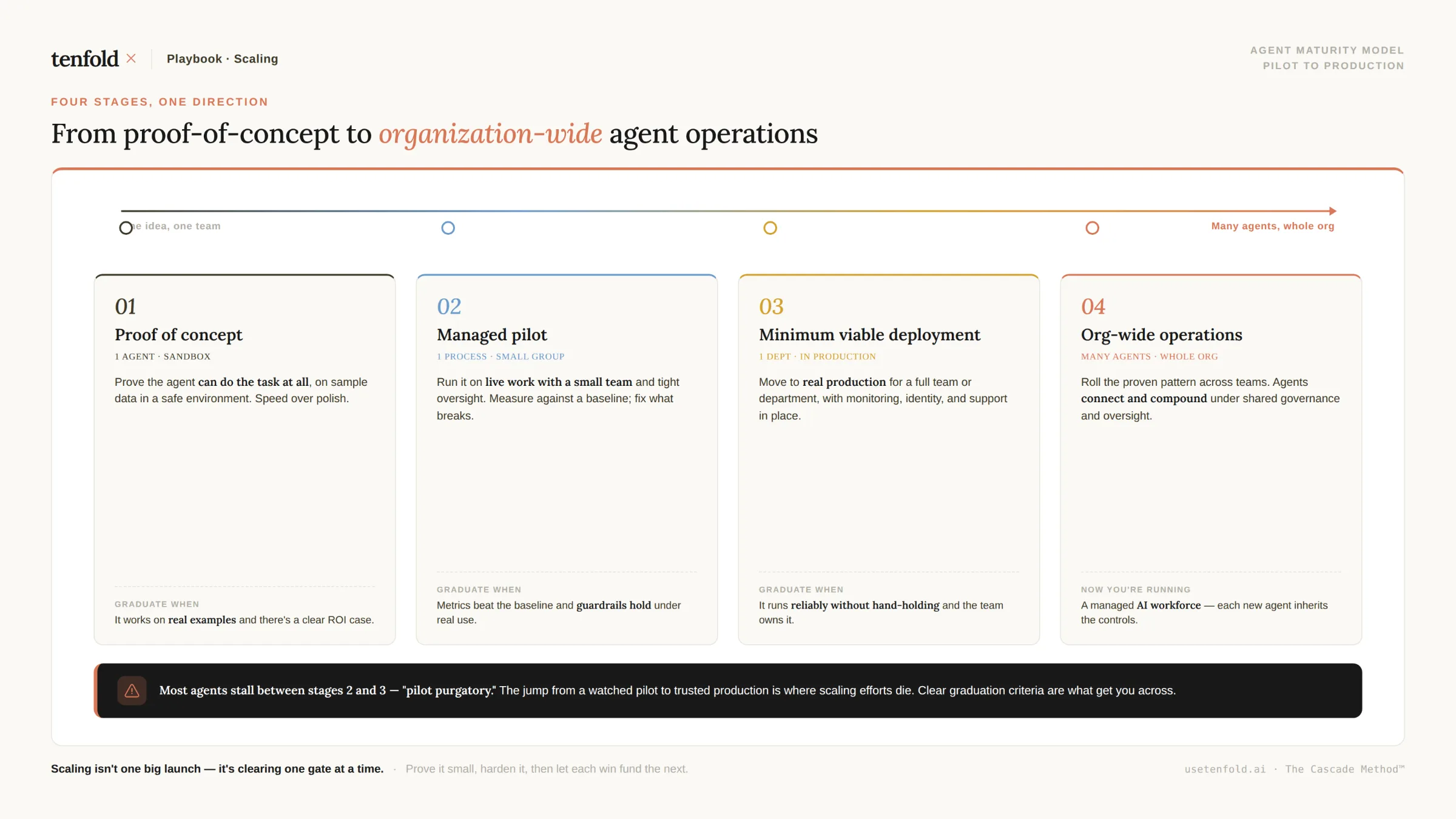
AI agents are only as good as the data and process definitions behind them. Firms that jump to implementation without mapping their intake workflow, cleaning duplicate contact records, and defining what a qualified lead looks like build on a shaky foundation — garbage in, garbage out still applies. And the first deployment should focus on a narrow, high-value slice: qualifying prospects and capturing initial details first, not automating conflict checks, fee agreements, and document collection all at once, which typically stalls the project.
Summary
The professional services firms that thrive in 2026 won't replace people with AI — they'll give their people AI leverage to deliver more value to clients. Start with intake, scheduling, and routine communication; they return value fastest. Map the workflow, clean the data, scope narrowly, and keep the human in the loop for judgment. If you want to identify the highest-ROI automation for your firm, the Tenfold team can help you scope it.
Frequently Asked Questions
Q: What should a professional services firm automate first? A: Customer-facing, repeatable workflows — intake, scheduling, and routine client communication. These return value fastest, often within 60 to 90 days, and reclaim 10 to 20 hours of team time per week.
Q: How much faster can AI make client intake? A: Firms that automate it correctly cut new-client onboarding from 3 to 5 days down to under 4 hours, with engagement-letter prep dropping from about 45 minutes to under 3 minutes per engagement.
Q: Will AI agents replace consultants, lawyers, or accountants? A: No. The model is augmentation — agents handle administrative and repeatable work so professionals focus on judgment, advisory, and relationships. The guiding rule: automate what you can verify, keep what requires judgment.
Q: What's the biggest implementation mistake? A: Trying to automate too much at once and building on messy data. Start with a narrow, high-value slice, map the workflow first, and clean up duplicate records — agents are only as good as the data and process definitions behind them.
