
AI Agents for Professional Services: How to Automate Repetitive Work, Cut Costs, and Scale Without Hiring in 2026
Professional services firms can deploy AI agents in 2026 to automate the document-heavy, research-intensive, and administratively repetitive work that consumes 60–70% of practitioner time — freeing your team to do the work clients actually pay for. The ROI is real, the deployments are proven, and the firms moving deliberately are already pulling ahead of those still running on headcount alone.
Quick Answer: AI agents handle multi-step workflows autonomously — drafting, researching, data processing, client intake, compliance monitoring — without human triggers. Professional services firms deploying them in production report 25–45% cost reductions in targeted functions, time-to-positive-ROI under nine months, and the ability to grow client capacity without growing their headcount.
Key Takeaways:
AI use cases in professional services target the activities that consume 60–70% of practitioner time: document work, research, reporting, and client communication.
Firms deploying agents in high-volume, rules-based workflows see 25–45% cost reductions in those functions.
The average return on AI agent deployments is 171% — but only 39% of enterprises currently report measurable bottom-line impact. Workflow design, not the model, is the deciding factor.
Gartner projects 40% of enterprise applications will embed task-specific AI agents by end of 2026, up from under 5% in 2025.
The bottleneck is not AI capability. It is that most firms are not yet set up to delegate to it.
Why Professional Services Is the Highest-ROI Environment for AI Agents
Professional services firms sell expertise. But most of the hours billed are not expertise — they are the production work that surrounds it: drafting, researching, formatting, cross-referencing, summarizing, and filing.
According to Thomson Reuters, AI will free up nearly 240 hours per legal professional per year — worth roughly $19,000 per head and a combined $32 billion in annual impact across U.S. legal and tax-and-accounting work. That is not a future forecast. That is based on current tooling, at current adoption rates.
The structural case is simple. AI use cases in professional services span document automation, research acceleration, knowledge management, and client insight generation — targeting the core activities that consume 60–70% of professional time in consulting, law, and advisory firms. The raw material of the work — contracts, briefs, workpapers, tax documents, transcripts — is precisely the data that AI agents now handle well.
Consulting, legal, accounting, and financial advisory firms share three structural traits that make them natural early adopters: their highest-cost input is human time, their workflows are document-dense and repeatable, and their margin pressure is constant. AI agents address all three simultaneously.
Where the ROI Actually Is: The Use Cases That Pay
Not all automation is equal. The firms extracting measurable returns are not automating everything — they are deploying agents against specific, high-volume, rules-governed workflows first.
Document Review and Drafting
Contract review, due diligence, compliance documentation, audit workpapers — these workflows involve high document volume and clear acceptance criteria. AI legal research tools can search case law, statutes, and regulatory databases in seconds rather than hours, with attorneys previously spending 20–40% of their time on research alone. Audit teams are reducing document analysis time by 50% or more.
For accounting, automated accounts payable departments process invoices at $2.98 per invoice versus $13.54 manually — a 78% cost reduction (PLANERGY, 2025). The agent does not judge the invoice. It routes it, flags exceptions, and closes the loop.
Client Intake and Qualification
AI agents now handle the initial layer of client intake: responding to inquiries within minutes rather than the typical 24–48 hours, running basic conflict checks, collecting structured intake information, scoring leads by fit and urgency, and scheduling consultations with the right professional. This is work that consumed junior hours and partner patience. Agents absorb it at near-zero marginal cost.
Reporting and Client Communication
Accounting client relationships generate consistent, recurring communication needs: quarterly reports, compliance summaries, advisory updates. AI agents draft these from structured inputs — pulling from client data, applying firm-approved templates, personalizing to the relationship — and free practitioner time for the advisory conversations that deepen client relationships rather than the document production that merely maintains them.
Research and Knowledge Synthesis
Consulting firms report 30–40% reductions in analytical task time using internal AI agents (MindStudio, 2026). The agent does not replace the consultant's judgment. It eliminates the time cost of assembling the inputs that judgment requires: regulatory monitoring, competitive landscape summaries, precedent searches, and market data retrieval.
79% of legal professionals now incorporate AI tools, up from nearly zero just two years ago — and law firms are deploying agents specifically for contract review, eDiscovery, regulatory research, and case analysis.
Financial Close and Compliance Monitoring
For finance functions, AI agents handle accounts payable, spend analysis, and financial close processes, reducing manual FTE hours and accelerating reporting cycles. IBM's AskHR deployment achieved a 40% reduction in HR operational costs, 94% containment rate, and a 75% reduction in tickets — applied to a high-volume, rules-based function that had nothing to do with strategic HR judgment.
The Deployment Playbook: How to Actually Get This Working
This is where most firms fail. Only 34% of organizations successfully deploy agentic AI to full production (Digital Commerce 360, 2025). The reason is not the model. It is the workflow design, the data infrastructure, and the governance framework around it.
Here is what the firms getting to ROI actually do differently.
Step 1: Start Where ROI Is Measurable, Not Where AI Is Exciting
High-volume, rule-governed workflows come first. Tasks your team handles dozens or hundreds of times a day, governed by clear rules rather than judgment calls, are the strongest starting point. The reason is straightforward: measurable inputs and outputs mean you can verify performance, iterate fast, and build stakeholder confidence before expanding to more complex use cases.
For professional services in 2026, the highest-clarity starting points are document-based use cases: research synthesis, first-draft production, compliance monitoring, data extraction, and client intake routing.
Step 2: Scope Tightly Before You Scale
Among 1,800+ executives surveyed in BCG's AI Radar 2026, only 26% report tangible value from GenAI at scale — and ROI leaders concentrate spend on fewer than 10 priority use cases. Firms deploying agents across three or more use cases in production see far higher returns than those running a single isolated pilot — but the discipline is in sequencing, not in deploying everywhere at once.
Agent sprawl is a real risk. Gartner warns that ungoverned deployment creates projects with unclear ROI and high cancellation rates. Treat your agent portfolio like a product roadmap: prioritize, ship, measure, then expand.
Step 3: Design the Workflow Before You Touch the Tool
McKinsey's State of AI 2026 found that only ~21% of enterprises have redesigned workflows for AI — and workflow redesign, not license rollout, remains the single biggest ROI multiplier. You cannot bolt an agent onto a broken process and expect results. The agent will automate the chaos faster.
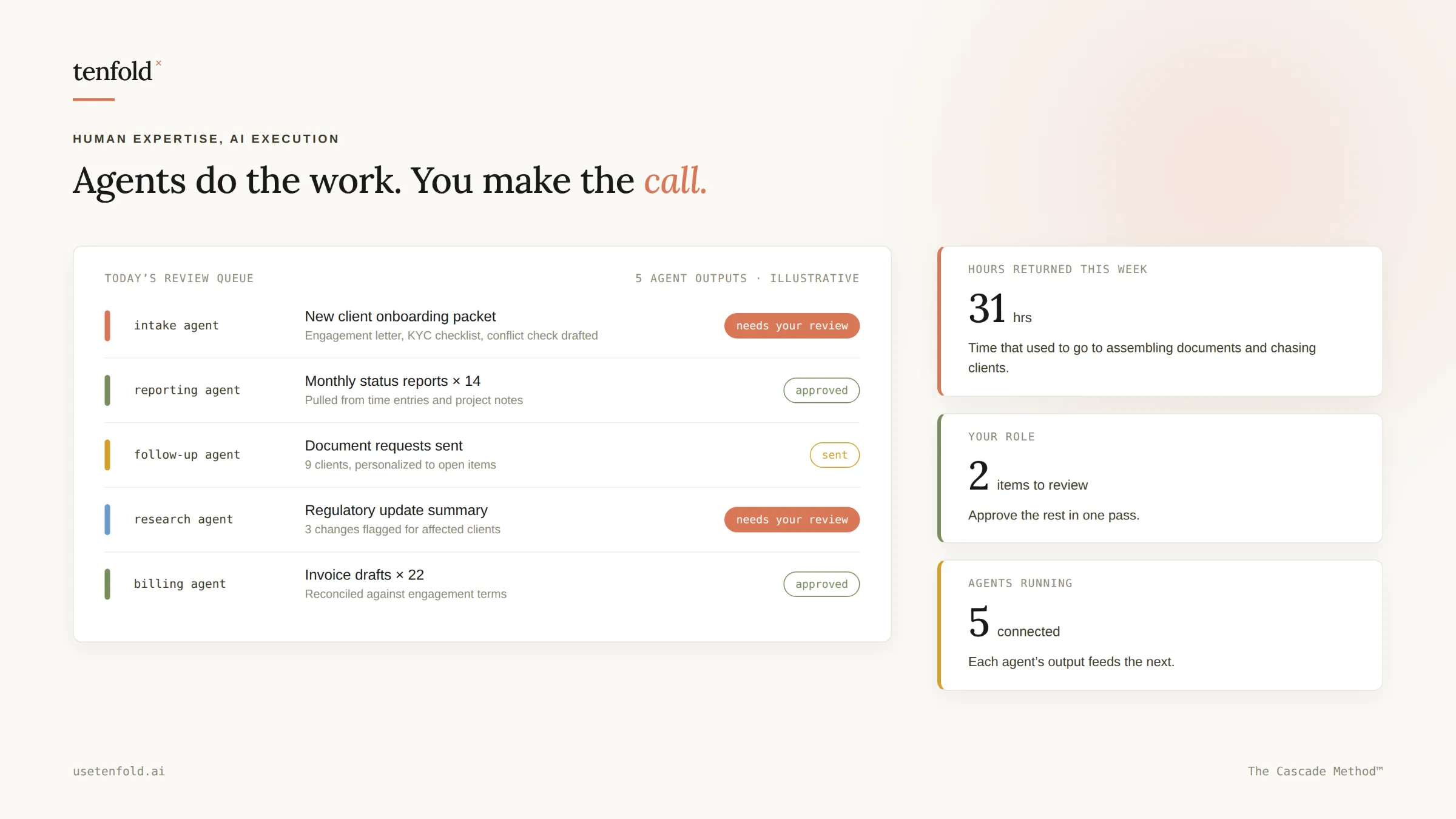
Map the current workflow step by step. Identify which steps require judgment and which require execution. Agents handle execution. Humans handle judgment, exception review, and client relationship. Design the handoff explicitly.
Step 4: Invest in Training Alongside Technology
An empirical study analyzing 200 B2B AI deployments found that companies allocating 25% or more of their total AI project budget to training activities achieved 2.4 times higher median ROI compared to companies making zero investment in training. The agent does not need training. Your team does — specifically in how to supervise, audit, and escalate agent outputs.
This is not optional. It is the difference between a deployment that compounds over time and one that gets quietly shelved.
Step 5: Govern Costs from Day One
Gartner's FinOps for AI research warns that compute and API costs for AI agents frequently exceed projections, eroding the margin gains agents were deployed to create. Set usage budgets, monitor cost-per-task metrics, and treat AI infrastructure with the same financial discipline you apply to any other operational spend.
The Scaling Math: Growing Revenue Without Growing Headcount
This is the outcome that changes how a firm operates.
AI agents cost $0.25 to $0.50 per interaction versus $3.00 to $6.00 for a human agent — an 85–90% per-interaction cost reduction (Ringly.io AI Agent Statistics, 2026). Applied to document processing, intake routing, or compliance monitoring, the arithmetic compounds quickly. A mid-sized firm automating 70% of targeted workflows can save $80,000–$100,000 annually against an agent cost of $5,000–$25,000 per year.
PwC reports that agentic capacity creation can lead to up to 90% time savings in key processes, redirecting up to 60% of a team's time from transactional tasks to higher-value work. That is not headcount reduction. That is headcount redeployment — using the same team to serve more clients at higher margin.
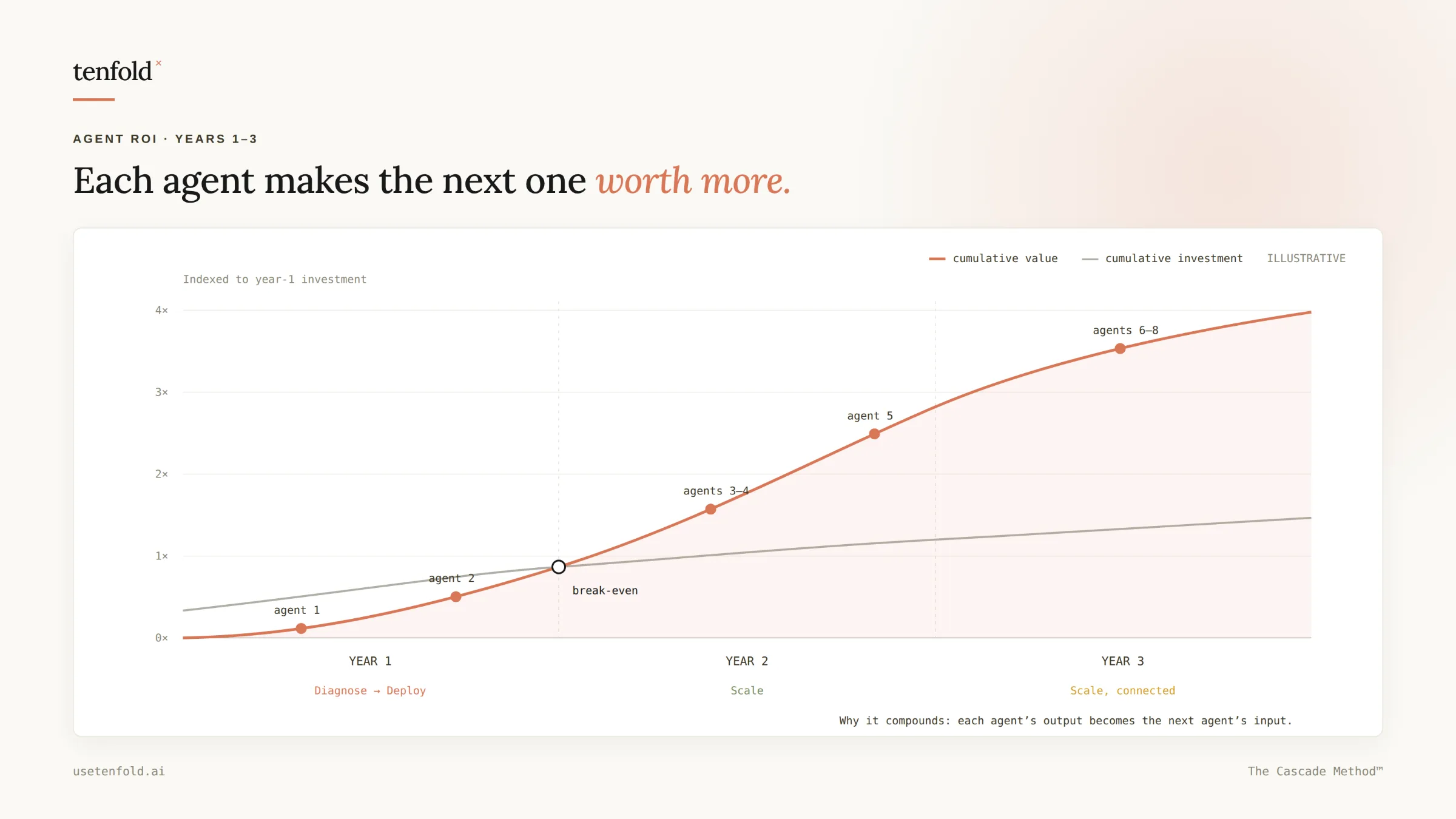
The compounding effect is what matters most. ROI ramps from 41% in year one to 87% in year two to 124%+ by year three — because agents get cheaper and better the longer they run, while your team's ability to supervise and direct them improves in parallel.
At Tenfold, we have seen this play out directly. The Tenfold model — built on the same agent-first delivery infrastructure that Inforge uses to deliver full Salesforce implementations entirely through AI agents — is proof that the model works at the firm level, not just in client engagements. Faster delivery. More consistent quality. A fraction of the cost. That is not a positioning statement. That is the operating model.
What the Firms Getting This Wrong Are Missing
The common failure mode is not skepticism. It is misapplication.
Nearly 80% of companies report no significant bottom-line impact from generative AI despite high adoption (McKinsey, June 2025). The gap between deployment and measurable return is the defining challenge of 2026. The firms on the wrong side of that gap share three patterns:
1. They deploy AI tools, not AI agents. A tool answers a question. An agent executes a workflow. The distinction matters enormously for ROI.
2. They measure with the wrong metrics. Agentic systems require different success measures: tasks automated per hour, error rate reduction, revenue cycle acceleration — not just cost reduction versus project budget.
3. They skip workflow redesign. Dropping an agent into an existing process without redesigning the process around agent capabilities produces marginal gains at best.
The firms pulling ahead are the ones treating agents as an operating model change, not a software purchase.
Summary
Professional services firms have a structural advantage in the AI agent transition: their highest-cost input is human time, and their core workflows are exactly where agents deliver the most measurable value. The data is unambiguous — 25–45% cost reductions in targeted functions, sub-nine-month payback periods, and ROI that compounds year over year. The deployment risk is not the technology. It is poor workflow design, ungoverned sprawl, and the absence of clear success metrics.
Tenfold specializes in exactly this: deploying AI agents inside professional services organizations with the governance, workflow design, and implementation discipline that separates the 34% who get to production from the 66% who do not. The proof is Inforge — a full-service Salesforce consultancy delivering implementations entirely through AI agents, at a fraction of the cost and on a faster timeline than traditional delivery.
If you are evaluating what an agent-first model could look like for your firm, that is the conversation to start.
Frequently Asked Questions
Q: What types of tasks are AI agents best suited for in professional services firms?
A: AI agents perform best on high-volume, rules-governed tasks with clear inputs and outputs — document review and drafting, client intake, research synthesis, compliance monitoring, invoice processing, and reporting. Tasks requiring licensed judgment, complex client relationships, or strategic synthesis remain human-led, with agents providing the research and production inputs.
Q: How long does it take to see ROI from an AI agent deployment?
A: The median time to positive ROI for enterprise AI agent deployments is four to eight months from production launch, according to published industry benchmarks. Firms that scope tightly to high-volume workflows and invest in workflow redesign alongside implementation tend to reach that threshold faster.
Q: Will deploying AI agents mean reducing headcount?
A: The more common outcome in professional services is capacity redeployment, not headcount reduction. Agents absorb transactional and production work, freeing practitioners to serve more clients, take on higher-value engagements, or expand into advisory services. Growing revenue per employee without growing headcount is the typical pattern for firms deploying agents well.
Q: What is the biggest risk in deploying AI agents?
A: Agent sprawl and poor workflow design are the two most cited failure modes. Deploying agents without redesigning the workflows they enter — or without governance over cost and performance — produces unclear ROI and high cancellation rates. Starting with a tightly scoped, measurable use case and building governance from day one significantly reduces this risk.
Q: How is Tenfold different from a standard AI software vendor?
A: Tenfold is an AI agent implementation specialist, not a software vendor. We design and deploy the workflows, governance structures, and agent configurations that turn AI capability into measurable business outcomes. The difference between buying a tool and having an operating model built around agents — that gap is where Tenfold operates.
