
AI Agents for Property Management: How to Handle Every Tenant Request Without Adding Headcount
AI agents can help property management companies handle tenant requests by automating the entire communication and operations loop — intake, triage, dispatch, status updates, and follow-up — without requiring additional staff. The result is faster response times, higher tenant satisfaction, and more units managed per employee.
Quick Answer: AI agents handle tenant requests by responding 24/7 via voice, SMS, email, or chat; triaging maintenance urgency; creating work orders directly in your property management system; dispatching vendors; and keeping tenants informed throughout. This covers roughly 40–70% of all inbound tenant communication without human involvement.
Key Takeaways:
AI adoption in property management jumped from 20% in 2024 to 58% in 2025 — the fastest adoption curve in the industry's technology history.
Studies show AI can autonomously handle up to 70% of repetitive tenant communications, including payment reminders, maintenance intake, and FAQ responses.
Properties using after-hours AI report tenant satisfaction scores improving 15–25% and retention increasing by 15%.
Maintenance request processing has reached 71% AI adoption, with companies reporting 43% faster resolution times.
The bottleneck isn't the technology. It's that most property management companies aren't yet structured to delegate their operations to it.
Why Tenant Requests Are Breaking Property Management Teams
Property managers receive hundreds of routine requests every week. As portfolios grow, handling repetitive tenant conversations manually becomes slower, more expensive, and harder to scale.
The numbers make the problem concrete. According to Layer3 Labs, nearly 49% of calls to apartment leasing offices are never answered, and up to 65% of all inbound calls arrive outside standard business hours. Over 85% of prospective tenants who can't reach someone won't call back — they move on to the next property. Each missed leasing call costs an average of $1,000 in lost rental income.
Meanwhile, AppFolio's 2025 Property Management Benchmark Report found that 48% of property managers are actively looking to reduce year-over-year costs and 42% want to streamline maintenance operations. The manual approach doesn't scale. An AI agent does.
What AI Agents Actually Do With Tenant Requests
An AI agent for property management is a software-driven system that handles tenant messages, maintenance triage, document lookups, and collections — then learns from outcomes to improve over time.
Here's what the workflow looks like in practice:
1. Multi-channel intake (24/7)
AI agents handle tenant inquiries around the clock via chat, SMS, voice, and portal — whichever channel the tenant prefers. According to Baselane's 2026 Property Management Software Trends Report, research indicates AI can handle up to 70% of repetitive communications in property management, including responding to common tenant inquiries, sending payment reminders, and scheduling maintenance.
2. Intelligent triage
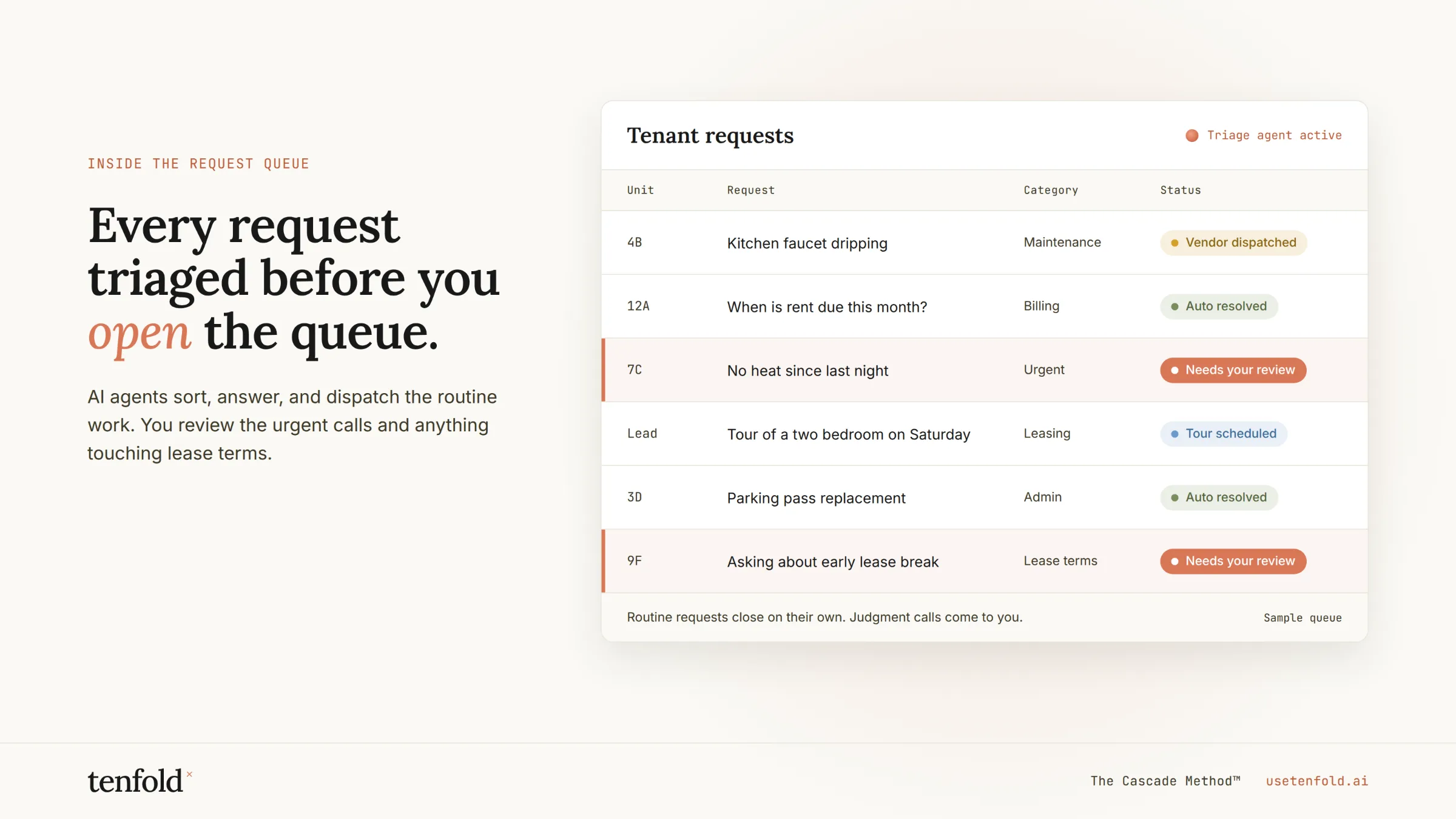
When a tenant reports an issue, the agent doesn't just log it — it uses natural language processing to distinguish a burst pipe from a loose door handle, categorize urgency, and route accordingly. According to Haven AI, this automated triage uses NLP to categorize urgency and distinguishes emergencies from routine fixes in real time, enabling maintenance teams to prioritize accurately without manual review.
3. Automated work order creation
Once triaged, the agent creates and syncs a work order directly into property management platforms like AppFolio, Buildium, or Yardi — no manual data entry required. According to Haven AI's 2026 Maintenance AI Guide, AI agents reduce administrative labor on work order management by up to 80% through direct PMS integration.
4. Vendor dispatch and coordination
For confirmed issues, agents identify the appropriate pre-approved vendor based on trade specialty, current availability, and pricing guidelines, then dispatch the job without delay. The agent simultaneously confirms the appointment window with the resident.
5. Proactive status updates
The resident receives automated updates at each phase — from initial dispatch to final resolution confirmation — eliminating constant check-in calls and giving your team total visibility.
6. Follow-up and feedback capture
AI systems automatically send completion confirmations to tenants, collect feedback ratings, update maintenance records, and flag any issues requiring additional attention. According to osforyour.business's 2026 AI Adoption Report, this systematic follow-up improves tenant satisfaction scores by an average of 23%.
The Numbers Behind AI Agent Adoption in Property Management
This isn't early-adopter territory anymore.
According to Baselane, property manager AI usage surged from 20% in 2024 to 58% in 2025 — representing the fastest adoption curve in property management technology history. By late 2024, 68% of property management companies had implemented some form of AI automation, up from just 15% in 2022.
The most automated workflows tell you where the pain is sharpest:
Tenant screening: 78% adoption
Maintenance request processing: 71% adoption
Rent collection follow-up: 65% adoption
According to osforyour.business, companies implementing AI report average annual ROI of 287% within 18 months of deployment. Labor cost reduction accounts for 43% of that ROI, improved rent collection contributes 31%, and maintenance optimization provides 18%.
And the channel shift is real: according to Layer3 Labs, 78% of renters under 35 prefer reporting maintenance issues via text. AI answering systems accommodate both voice and SMS workflows natively.
The Maintenance Triage Gap — and Why AI Closes It
Maintenance is where most property management teams lose the most time and create the most tenant dissatisfaction.
According to Thoughtly, property managers need AI agents that can triage emergencies, collect clean work-order details, route after-hours issues, and keep tenants updated across voice and SMS — not just a faster way to answer calls.
The practical results back this up:
According to Layer3 Labs, average maintenance response time drops from 4.6 days to under 18 hours within 30 days of implementation.
Livly's AI assistant has reduced after-hours maintenance calls by 35% for a 500-unit portfolio.
MRI Software's chatbot system automatically processes over 60% of routine maintenance requests.
According to EliseAI research, AI adoption in property management increases tenant satisfaction by 5% and retention by 15%, while delivering a 3.7–5.2% average annual increase in portfolio returns.
One maintenance coordinator case study cited by Layer3 Labs showed that 65% of each workday was consumed by routine call handling before AI automation. After deployment, that time was redirected to vendor management and tenant relationships — the work that actually requires human judgment.
According to Haven AI's statistics report, studies show that over 80% of the questions property managers receive are repetitive and procedural. Questions like "How do I pay rent?" or "My sink is leaking" are exactly what AI was built to handle at scale.
Where AI Agents Fit in the Full Tenant Journey
The real opportunity isn't just reactive request handling — it's the entire tenant lifecycle.
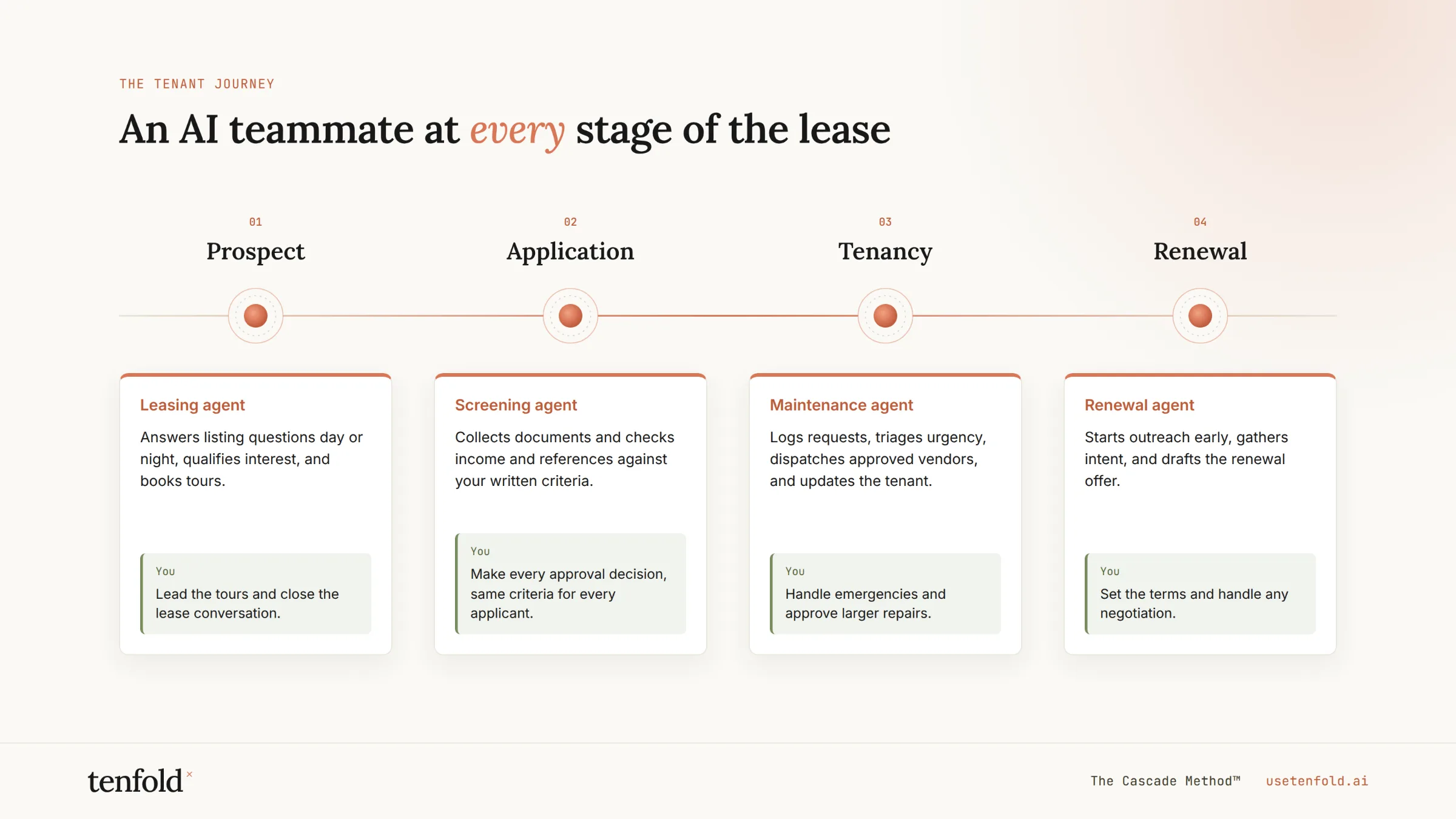
According to Perspective AI's 2026 guide, AI for property management is most valuable not as a maintenance gadget, but as the conversational layer that captures resident intent at every stage of the journey — from the first leasing inquiry to the renewal decision.
Here's the full picture:
Prospect stage: AI leasing assistants qualify inbound leads instantly, schedule tours 24/7, and recover missed calls via SMS. Operators who miss a lead lose it: multifamily operators lose roughly 35% of inbound leads when no one answers fast enough.
Application and lease stage: AI accelerates screening and lease paperwork but hands decisions back to a human for fair-housing compliance. According to Perspective AI, lease abstraction and virtual leasing agents are among the highest-ROI applications in 2026.
Tenancy stage: Maintenance triage and proactive listening. This is where most operators stall — because maintenance speed alone doesn't retain residents. According to Perspective AI, only about one in three renters describes themselves as "extremely satisfied," and the retention lever is staff responsiveness, not another amenity.
Renewal stage: AI flags at-risk residents early and surfaces the real reason behind a renewal hesitation while there's still time to act. According to Perspective AI, highly satisfied residents are about 2.3 times more likely to renew, and operators report renewal rates roughly 7% higher and renewal decisions about 30 days faster when AI drives the renewal process.
What Makes This Different From a Basic Chatbot
This is the distinction most property management companies miss when they evaluate tools.
Legacy chatbots follow scripts and decision trees. When a tenant's message doesn't match a keyword, the bot fails. Modern AI agents use Natural Language Understanding (NLU) — they interpret meaning and context, not just keywords.
According to Haven AI's 2026 implementation guide, the difference is stark:
| Feature | Legacy Chatbot | 2026 AI Maintenance Agent |
|---|---|---|
| Logic Type | Scripted/Decision Tree | Natural Language Understanding |
| PMS Action | Sends transcript via email | Creates/Updates Work Orders via API |
| Emergency Triage | Keyword-based (unreliable) | Contextual Triage (Urgency Scoring) |
At Tenfold, we've found that property management companies that try to patch legacy chatbots onto their operations end up with higher frustration on both sides — tenants who can't get answers, and staff who still field the overflow. The agent-first architecture is what changes the equation.
Summary
AI agents give property management companies the ability to handle tenant requests at scale — 24/7, across every channel, without adding headcount. The technology is mature, the adoption data is clear, and the ROI benchmarks are measurable. The companies building a durable competitive edge right now are the ones treating AI agents as core infrastructure, not an add-on. At Tenfold, we implement AI agent systems for operations teams that are ready to move from experimentation to execution. If you're managing a portfolio and still fielding every maintenance call manually, the cost of waiting is higher than you think.
Frequently Asked Questions
Q: Can AI agents really handle urgent maintenance emergencies, or do those always need a human?
A: AI agents are specifically designed to distinguish emergencies from routine requests. When an emergency is detected — such as active water flow, gas leaks, or no heat in severe weather — the agent triages severity in minutes, identifies and dispatches a pre-approved vendor, and immediately alerts on-call staff. Humans are escalated to only for situations that genuinely require them.
Q: How do AI agents for property management integrate with software like AppFolio, Buildium, or Yardi?
A: Modern AI agents connect via API, meaning they read tenant data, create and update work orders, sync maintenance tickets, and access lease information directly inside your existing PMS — no manual data re-entry required. According to Haven AI, this integration reduces administrative labor on work orders by up to 80%.
Q: What percentage of tenant requests can AI agents actually handle without human involvement?
A: It varies by workflow complexity, but the data consistently shows AI handling 40–70% of inbound tenant communications autonomously. According to Baselane, AI can handle up to 70% of repetitive communications. In 2025, AI-powered platforms autonomously de-escalated nearly 250,000 maintenance requests without human involvement, according to Layer3 Labs.
Q: Will tenants be frustrated talking to an AI instead of a person?
A: Tenant preference has shifted. According to Layer3 Labs, 78% of renters under 35 prefer reporting maintenance issues via text — a channel AI handles natively. Satisfaction scores at properties using AI actually improve: after-hours AI adoption correlates with 15–25% satisfaction score improvements, according to Haven AI. The frustration comes from not getting a response, not from who or what responds.
Q: How long does it take to see ROI from AI agent implementation in property management?
A: According to osforyour.business, property management companies implementing comprehensive AI automation report average annual ROI of 287% within 18 months of deployment. Haven AI's benchmarks indicate an 11-month ROI is now the industry standard for platforms that prioritize autonomous task execution. Maintenance response time alone drops from 4.6 days to under 18 hours within 30 days of implementation, according to Layer3 Labs.
