
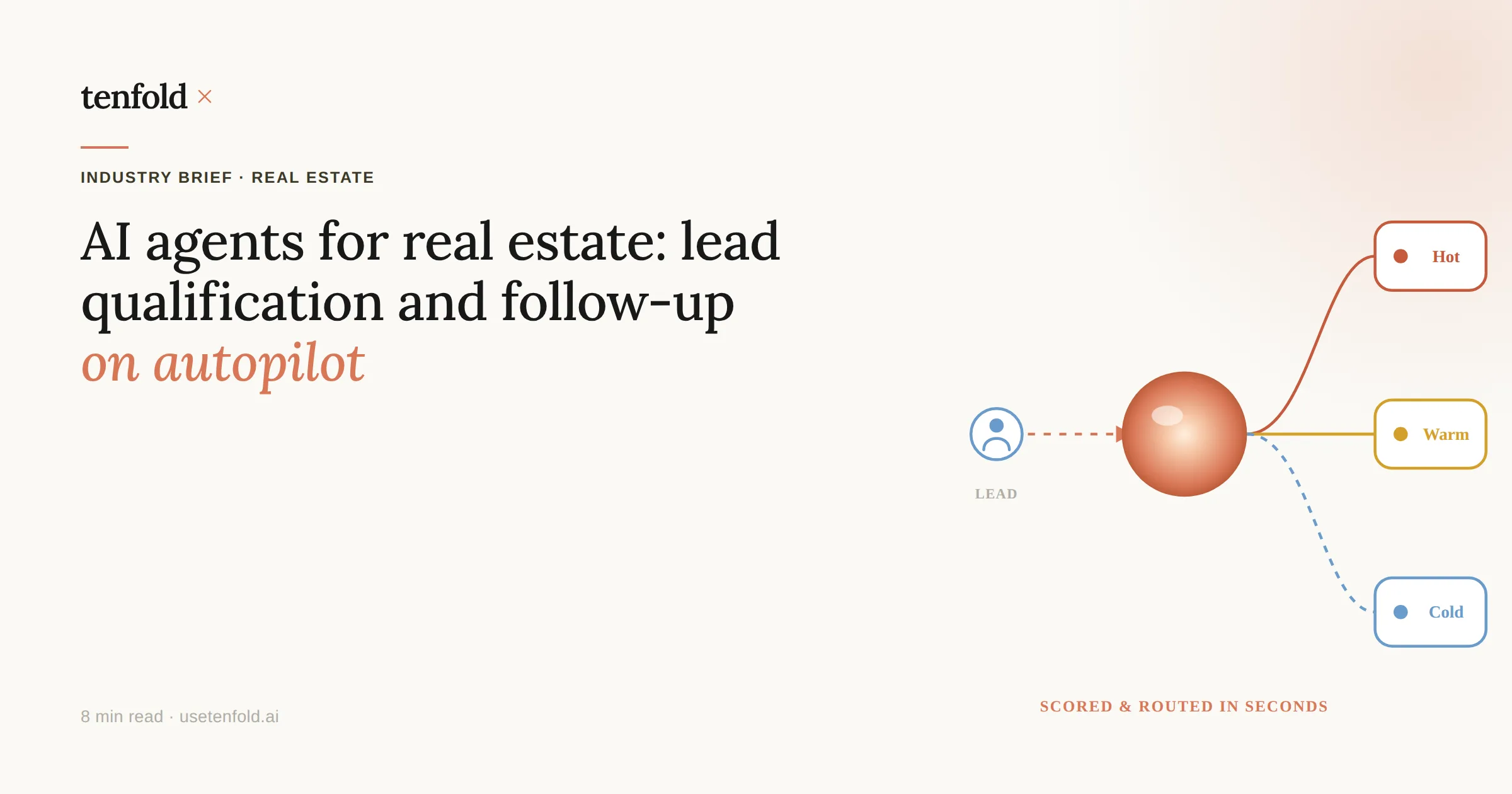
AI Agents for Real Estate: Lead Qualification and Follow-Up on Autopilot
Real estate is a speed game, and the data is merciless. 78 percent of homebuyers and sellers work with the first agent who responds. Responding within five minutes makes you 21 times more likely to qualify a lead. And yet the average agent takes 917 minutes — more than 15 hours — to respond to a new inquiry. That gap between what works and what agents actually do is the single biggest opportunity in residential real estate.
The cost of getting it wrong compounds fast. Agents lose an estimated $427 per missed lead, miss roughly 40 percent of incoming calls, and lose around 65 percent of leads simply because follow-up was too slow or inconsistent. AI agents are built precisely for this problem.
Quick Answer: AI agents solve real estate's speed-to-lead and follow-up problem by responding instantly, qualifying prospects automatically, and nurturing them across weeks of touchpoints — 24/7, at any volume. The result is dramatically faster response, higher-quality pipeline, and recovered commissions that would otherwise walk to a faster competitor.
Key Takeaways:
Agents who respond within 5 minutes are 21 times more likely to qualify a lead — yet the industry average response time is over 15 hours.
Teams implementing AI-driven lead scoring see qualification accuracy jump from around 71 percent to 89 percent, fundamentally changing how agents allocate their time.
Firms using AI for lead generation and follow-up report up to a 300 percent increase in lead volume and conversion gains of around 40 percent.
Most leads need 8 to 12 touchpoints before deciding, and 80 percent of sales require 5+ follow-up contacts — exactly the consistent cadence humans fail to maintain.
Real estate AI adoption hit roughly 97 percent of agents in early 2026, up from 80 percent in 2024 — but only about 17 percent report significant business impact, marking a wide execution gap.
Speed-to-Lead: Win the Race You're Currently Losing
When you're competing against 20 other agents for the same portal lead, answering within five minutes matters more than your marketing budget. AI voice and text agents answer every call and inbound form in seconds — even at 2 a.m., even while you're at a showing. Some platforms trigger an outbound call within 60 seconds of a form submission. Around 70 percent of inquiries arrive outside business hours, and those after-hours leads are pure opportunity if someone answers. The AI does.
Qualification: Sort the Serious from the Browsers
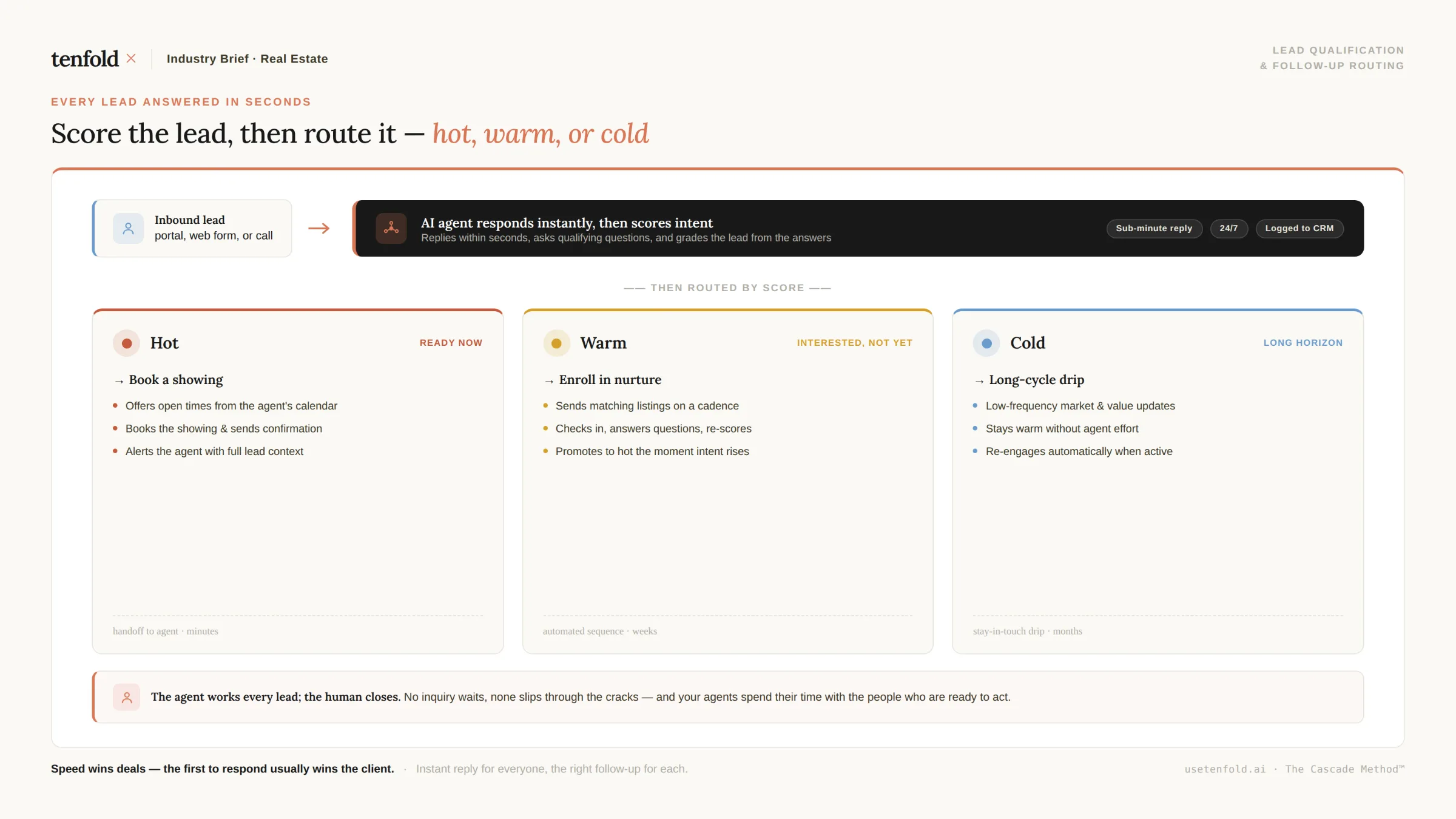
Not every lead deserves equal attention. Traditional scoring based on demographics or gut feel hits only 45 to 60 percent accuracy. AI qualification analyzes hundreds of behavioral data points — which properties a lead viewed, time spent per listing, whether they used a mortgage calculator, whether they looked at school districts — and scores conversion probability in real time. Leads sort automatically into hot, warm, and cold: hot leads (pre-approved, sub-3-month timeline, specific neighborhood) route directly to an agent for immediate contact; warm leads enter nurture; cold leads get periodic check-ins without consuming agent time.
The qualification happens during the conversation. A voice agent covers timeline, budget, pre-approval status, target neighborhoods, and whether the prospect is already working with another agent — feeding each answer into a scoring model and offering a showing or callback for hot leads on the spot. Using a streaming retrieval system, the agent can also answer detailed questions about school districts, HOA fees, and nearby listings without losing credibility or dropping the call.
Follow-Up: The Consistency Humans Can't Match
This is where deals are quietly lost. Most leads need 8 to 12 touchpoints over weeks or months, and manual follow-up fails — agents forget, or they over-contact and annoy. AI maintains the cadence automatically: it follows up when interest appears, eases off when activity drops, schedules callbacks, sends confirmations, and flags unresponsive leads. It paces outreach based on real engagement signals like listing views and saved searches, keeping leads warm without burning them out.
Where Humans Stay Essential
Buyer qualification follows predictable patterns — budget, timeline, financing, location — and automates cleanly. Seller qualification involves nuanced valuation conversations and emotional dynamics that are harder to automate well, so launch with buyer leads first. And every system needs escalation triggers: when a prospect says "I have an offer deadline tomorrow" or "I need to sell first," the agent should transfer immediately to a human with full context rather than continuing to qualify. The high-judgment work that closes deals stays human; the back-office response and nurture get automated.
Mind the Execution Gap
Nearly every agent now "uses AI," but only about 17 percent report significant business impact. The tools exist; the differentiator is implementation — calibrating scoring thresholds to your market (a "hot" lead in a competitive urban market differs from one in a rural market), configuring clean escalation, and connecting the agent to your CRM so nothing falls through the cracks. Speed wins, consistency compounds, and systematic approaches beat ad-hoc effort every time.
Summary
For real estate teams, AI agents turn the two biggest leaks — slow response and inconsistent follow-up — into automated strengths. Respond in seconds, qualify with 89 percent accuracy, and nurture every lead through the full decision cycle without lifting a finger. The agents who internalize the speed-to-lead data and build systems around it will out-convert everyone else. If you want to put lead qualification and follow-up on autopilot, the Tenfold team can help you build it.
Frequently Asked Questions
Q: How fast can an AI agent respond to a new lead? A: In seconds — including outbound calls triggered within 60 seconds of a form submission, 24/7. Given that responding within 5 minutes makes you 21x more likely to qualify a lead, this is the core advantage.
Q: Can AI actually qualify a lead well? A: Yes. AI-driven lead scoring raises qualification accuracy from around 71 percent to 89 percent by analyzing behavioral signals, and it qualifies during the conversation — covering timeline, budget, financing, and location while answering the prospect's questions.
Q: Will AI replace real estate agents? A: No. AI handles instant response, qualification, and nurture; humans handle showings, negotiation, and closing. The data shows productivity gains concentrate in back-office and lead-response work, not the high-judgment work that closes deals.
Q: Why do so few agents see results despite high AI adoption? A: Implementation. About 97 percent of agents use AI but only ~17 percent see significant impact. The winners calibrate scoring to their market, configure clean human escalation, and integrate the agent with their CRM.
