
AI Agents in Freight Brokerage: What's Actually Changing in 2026
AI agents in freight brokerage are fundamentally reshaping how loads get quoted, booked, tracked, and managed — and the numbers are no longer speculative. The largest brokers in North America are running tens of millions of shipment tasks through autonomous software agents right now, and mid-market operators are following fast. The question is no longer whether to adopt AI agents. The question is how quickly your operation can close the gap.
Quick Answer: AI agents in freight brokerage automate the high-volume, repeatable work — quoting, carrier email, check calls, load matching, and document parsing — while human brokers retain ownership of exceptions, pricing logic, and strategic relationships. Brokerages deploying agents in 2026 are seeing quote response times drop from 45+ minutes to under 90 seconds, and productivity gains of 4x to 15x over legacy workflows.
Key Takeaways:
AI agents are now live at scale — C.H. Robinson alone has deployed 30+ agents managing over 3 million shipment tasks.
The biggest ROI wins in 2026 are in email automation, quoting, check calls, and document parsing — not replacing brokers wholesale.
Production deployments at mid-size brokerages are automating 80%+ of inbound carrier emails and cutting quote response from 47 minutes to under 5.
The human role is shifting from transactional intermediary to strategic orchestrator — managing exceptions, relationships, and agent fleets.
Brokerages that don't move in the next 12–24 months will compete against operations running at a fraction of their per-load cost.
What AI Agents Are Actually Doing in Freight Brokerage Right Now
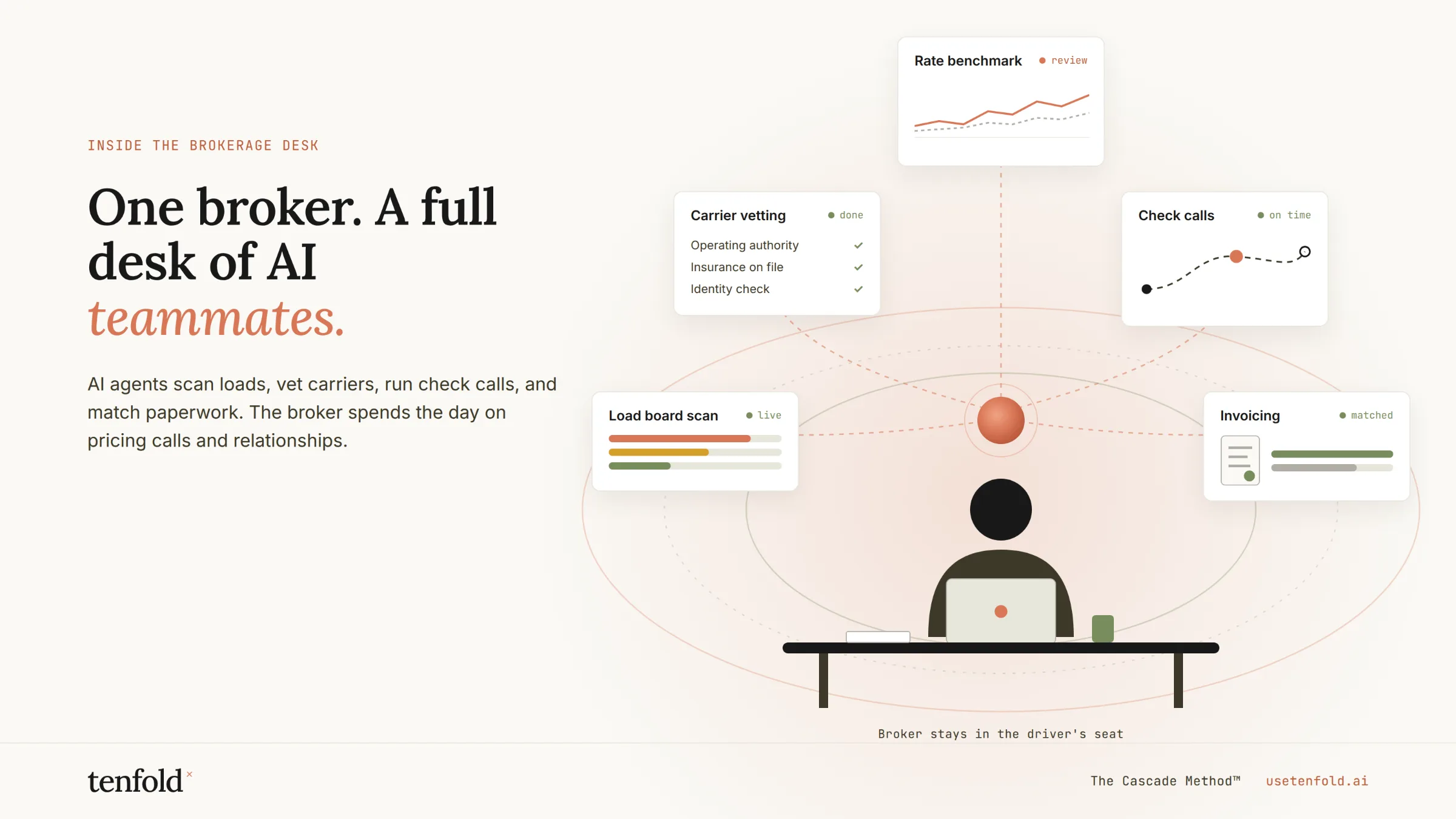
AI agents in freight are autonomous software systems that perceive supply chain data, reason through context, and execute tasks without step-by-step human instruction. This is a meaningful distinction from the rule-based automation that logistics companies have used for the past decade.
According to FreightWaves (April 2025), C.H. Robinson's AI agents had performed over 3 million shipping tasks — covering quoting, load booking, appointment scheduling, and in-transit tracking. One tracking agent alone captured 318,000 freight status updates from carrier phone calls in a single month. The quoting agent replies to roughly 2,600 quote requests per day in approximately 32 seconds. Emailed load tenders become shipment orders in about 90 seconds — a process that previously took up to four hours.
Those are enterprise numbers. But the pattern is replicating at every tier of the market.
According to Kings Research (2025), the global digital freight brokerage market is projected to grow from USD 7.55 billion in 2025 to USD 53.99 billion by 2033, driven primarily by the adoption of AI-powered matching platforms and agentic workflow automation. The AI-based freight matching segment is the fastest-growing platform type in the market.
Uber Freight has deployed 30+ AI agents across the shipment lifecycle, backed by a logistics-specific LLM and a TMS copilot. C.H. Robinson's two agents handling missed LTL pickups now automate 95% of those checks across 11,000 shippers, saving more than 350 hours of manual work per day and reducing unnecessary return trips by 42%.
The Five Workflows Where AI Agents Deliver Real ROI
Not every AI application in freight is created equal. In 2026, the use cases generating measurable payback within 60–120 days cluster around five core workflows.
1. Email and Inbox Automation
Email is the single largest bottleneck most brokerages underestimate. According to a 2025 McKinsey analysis of back-office productivity, logistics workers spend an estimated 2.8 hours per day on email handling alone. At a 500-load-per-week brokerage, that is direct headcount cost attached to inbox triage.
AI email agents classify inbound messages — distinguishing quote requests from status checks, POD requests, and exception alerts — and route or respond automatically. Production deployments in 2026 are reporting 80%+ auto-response rates by week six, with average response times under 90 seconds. In one documented case, email handling labor dropped by approximately 68%, from 2.8 hours to 0.9 hours per rep per day.
2. Quoting
A freight brokerage receives hundreds to thousands of inbound quote requests daily. Every delayed response is a potential lost load. AI quote agents pull live rate data, cross-reference lane history and market conditions, and return a competitive price in under 60 seconds — compared to a 45-minute manual average.
The ROI compounds beyond labor savings. A 22% lift in quote win rate at 300 inbound quote requests per week at $380 gross margin translates to approximately $237K in annualized gross margin — before any headcount changes.
3. Check Calls and Shipment Tracking
Check calls — outbound contacts to carriers asking for ETA and load status — consume an estimated 30% of a dispatcher's day. They are high-volume, low-variance, and perfectly suited for agent automation.
AI check-call agents run the routine status loop by phone, email, and SMS, log the answer directly into the TMS, and surface only genuine exceptions to human dispatchers. Check-call completion rates have been reported climbing from 55% to 92% in brokerage deployments — because software doesn't skip follow-ups the way a fatigued rep does.
4. Load Matching
Traditional load matching relied on load boards, carrier relationships, and manual searching. AI load matching systems analyze thousands of data points — location, trailer availability, route history, time of day, seasonal demand patterns — and identify the optimal carrier for a load in seconds. This reduces empty miles, improves asset utilization, and allows brokers to source capacity proactively rather than reactively.
Using proprietary algorithms trained on 37 million annual shipments, C.H. Robinson's system now predicts truck capacity and lane volatility, improving both tender acceptance and customer satisfaction.
5. Document Processing and Invoice Auditing
Rate confirmation parsing, invoice auditing, and document reconciliation are back-office tasks that slow every brokerage down. AI agents that read inbound rate confirmation PDFs, extract 30+ fields, write directly to the TMS, and kick off document routing have been reported cutting back-office time per load from approximately 12 minutes to under 60 seconds.
Invoice audit agents compare carrier invoices against contracted rates, identify discrepancies, and flag disputes — reducing manual review burden by up to 70% in documented deployments.
What Stays Human — and Why That Line Matters
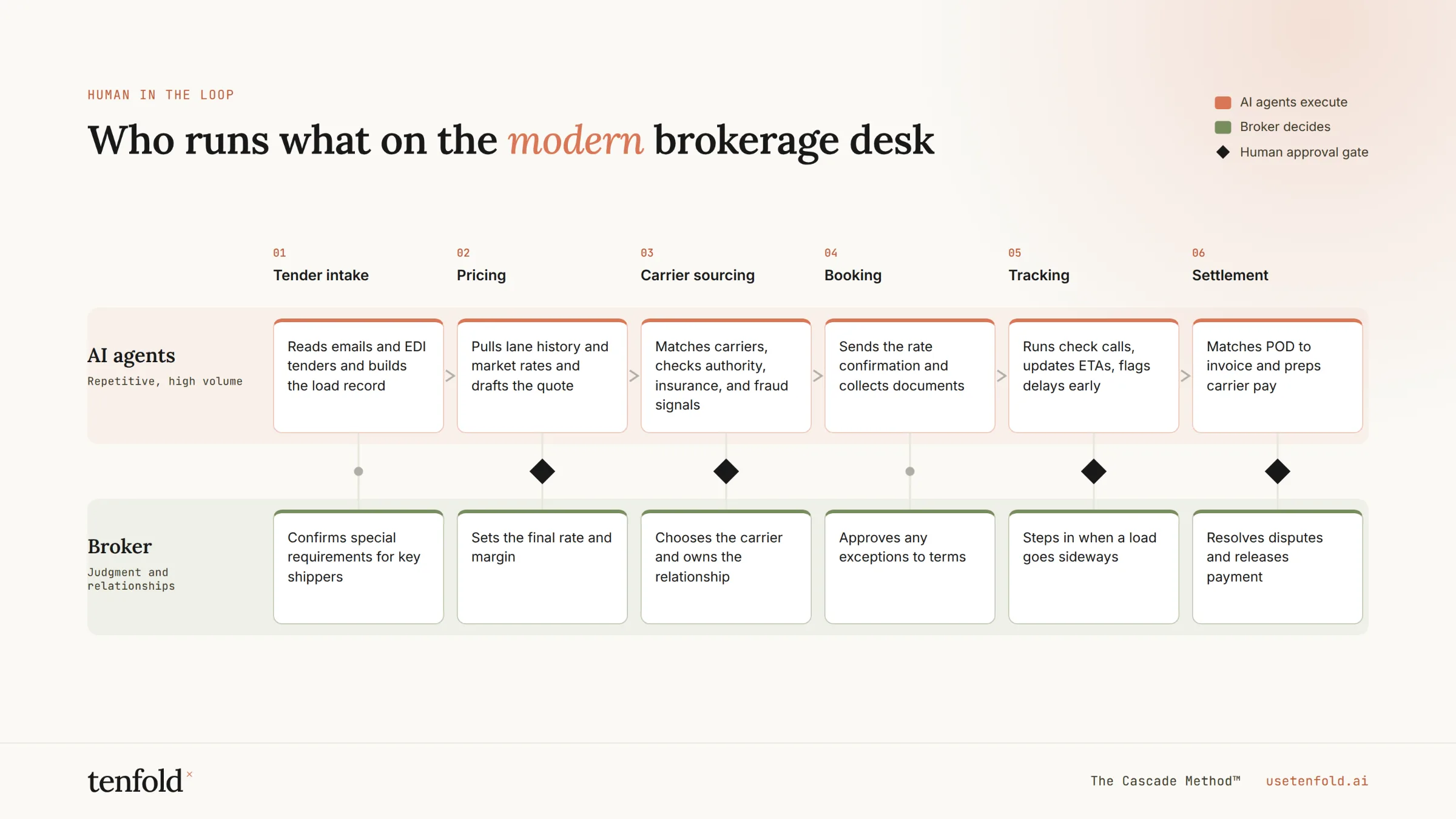
The brokerages performing best in 2026 draw a deliberate line between what agents own and what humans own. Getting that line wrong in either direction is expensive.
Agents own the high-volume, low-variance, well-defined work — roughly 70% to 94% of message traffic in mature deployments, depending on a broker's data discipline, TMS configuration, and operational rigor.
Humans own the long tail where the cost of an autonomous wrong decision is high:
Pricing exceptions outside guardrails. An agent confidently quoting a load $400 under cost will repeat that error hundreds of times before a human notices. Pricing logic, market judgment, and strategic rate decisions stay with experienced brokers.
New carrier relationships. Trust takes time and context. Initial carrier onboarding, vetting for strategic lanes, and relationship development require human judgment that agents don't yet replicate.
Claims, damage, and dispute resolution. These are liability and trust conversations. Dispute resolution over detention, accessorials, or damaged freight requires judgment that current agents are not equipped to handle independently.
Complex customer negotiations. Enterprise shipper relationships, strategic account ownership, and multi-year contract discussions stay fundamentally human.
According to the Truckstop and Bloomberg Intelligence survey (2024), approximately 36% of freight brokers had deployed AI tools, with more than 40% planning to do so in 2026 — while nearly 48% had no plans yet. The gap between adopters and non-adopters is widening into a structural cost and capacity advantage.
The Productivity Gap Is Becoming a Competitive Moat
The economics of freight brokerage are being rewritten in real time. In February 2026, SemiCab published results showing individual operators on its AI-driven platform managing over 2,000 loads annually — versus the traditional benchmark of approximately 500 — a 4x improvement in workforce productivity. Freight Technologies reported 15x domestic efficiency gains for operators closing bookings through its AI-native platform.
This is not incremental improvement. It is a structural shift in what a single operator can cover — and what it costs per load to cover it.
For mid-market brokerages competing against operations running at 4x to 15x the output per headcount, the strategic calculus is clear. The bottleneck isn't AI capability. It's that most operations aren't yet set up to delegate to it.
Setting up to delegate means three things:
1. Clean, accessible data. Agents need consistent, structured data to function. Brokerages with fragmented TMS configurations, inconsistent carrier records, or siloed data layers will see agents fail before they deliver ROI. Data consolidation is not optional — it is the prerequisite.
2. The right integration layer. AI agents need to connect to the TMS, carrier systems, email, and voice channels. The Model Context Protocol is emerging as a standard connector in 2026, with TMS platforms like Shipwell and others publishing production-grade integrations.
3. A clear human-in-the-loop design. Define in advance what agents decide autonomously and what they escalate. Brokerages that fail to draw this line create risk — agents confidently handling exceptions they're not equipped for.
What Operations Leaders Should Do Now
Tenfold works with operations leaders evaluating AI agents for their organizations. The pattern we see repeatedly: the technical capability is available. The barrier is readiness — clean data, clear delegation design, and the right implementation partner to compress the timeline from pilot to production.
Here is a practical starting sequence for freight brokerage operations:
Month 1: Deploy email and quoting agents. This is where the immediate, measurable impact hits. It requires the lowest process redesign, delivers the fastest payback, and builds the organizational confidence to go further.
Month 2: Add check-call automation. Voice and email-based check-call agents integrate cleanly with existing carrier workflows. The productivity gains are immediate and the output — fewer missed follow-ups, better customer visibility — is measurable.
Month 3: Move into load matching and document parsing. These require cleaner data integration but deliver the largest per-load operational savings.
The brokerages that succeed are not the ones with the biggest technology budgets. They are the ones that sequence correctly, start where the data is clean, and treat the human-agent division of labor as a design decision — not an afterthought.
Summary
AI agents are live and delivering measurable results in freight brokerage — from C.H. Robinson's 3 million automated tasks to mid-market deployments cutting quote response from 45 minutes to under 90 seconds. The shift is not about replacing brokers; it's about restructuring what brokers do. The operations that win in the next 24 months are the ones that delegate the volume to agents and redirect human judgment to relationships, exceptions, and strategy. At Tenfold, we help operations leaders build and deploy AI agent systems that are production-ready from day one — not proof-of-concept demos, but live infrastructure that changes the economics of your business.
Frequently Asked Questions
Q: What do AI agents actually do in freight brokerage?
A: AI agents in freight brokerage handle the high-volume, repeatable workflows: reading and responding to carrier emails, generating quotes, running check calls, matching loads to available capacity, and parsing rate confirmation documents. They operate within defined guardrails and escalate exceptions that require human judgment. In production deployments, agents are automating 80%+ of routine carrier communications with payback timelines of 60–120 days.
Q: Will AI agents replace freight brokers?
A: No — and the companies deploying the most AI say so most clearly. AI agents handle volume and routine; human brokers handle exceptions, carrier relationships, pricing logic, and strategic accounts. The role is shifting from transactional intermediary to strategic orchestrator. What's compressing is the headcount required per unit of freight moved — not the need for broker expertise.
Q: How fast can a mid-market brokerage see ROI from AI agents?
A: Documented production deployments show payback in 60 to 120 days for the first agent layer — email and quoting. The first measurable result typically appears within two weeks of deployment: quote response times drop, email handling labor decreases, and processed quote volume increases without adding headcount. The key prerequisite is clean, accessible data in the TMS.
Q: Which freight brokerage workflows should be automated first?
A: Start with email and quoting — these deliver the fastest payback and the lowest process redesign. Follow with check-call automation, then load matching and document parsing. The sequencing matters because each phase builds the data quality and agent trust required for the next.
Q: What is the difference between traditional automation and AI agents in logistics?
A: Traditional rule-based automation requires explicit programming for every possible scenario and breaks when workflows change. AI agents interpret context, adapt to variation, and resolve routine exceptions autonomously — without needing reprogramming for every edge case. Traditional automation handles 50–60% of tasks; agentic AI systems in production are handling 90%+ of targeted workflow volume.
