
AI Agents in Manufacturing: The Real Benefits Ops Leaders Need to Know
AI agents in manufacturing are delivering measurable outcomes — reduced downtime, lower maintenance costs, and faster production cycles — not at some point in the future, but on factory floors right now. The question for operations leaders isn't whether AI agents work in manufacturing. It's whether your organisation is set up to capture those gains before your competitors do.
Key Takeaways:
AI-driven predictive maintenance reduces unplanned downtime by up to 45% and cuts maintenance costs by 25–40%.
The global AI in manufacturing market is projected to grow from $34.18 billion in 2025 to $155.04 billion by 2030 — a 35.3% CAGR.
78% of production facilities using AI report measurable waste reduction.
Manufacturing firms that adopt AI outperform non-adopting peers in both productivity and market share over a four-year horizon.
The bottleneck isn't AI capability. It's that most manufacturers aren't yet structured to deploy and delegate to it at scale.
Quick Answer: AI agents in manufacturing are autonomous software systems that monitor equipment, optimise production schedules, manage supply chain data, and execute multi-step operational workflows — without constant human intervention. The primary benefits are lower downtime, reduced maintenance costs, improved quality control, and supply chain resilience.
The Market Has Already Moved — Has Your Operation?
Manufacturing is no longer debating whether AI works. The market data makes the case plainly. According to research published via Yahoo Finance and MarketsandMarkets, the global AI in manufacturing market is projected to grow at a 35.3% CAGR, rising from $34.18 billion in 2025 to $155.04 billion by 2030. That rate of investment doesn't happen without results.
Yet adoption isn't uniform. According to McKinsey's State of AI 2025, 88% of organisations now use AI in at least one business function — but only about one-third have scaled AI across the enterprise. In manufacturing specifically, AI is delivering cost savings and revenue improvements at the use-case level, even where enterprise-wide EBIT impact remains modest.
The gap between pilot and production is where most manufacturers lose ground. Scaling is the competitive advantage — and AI agents are the mechanism for closing that gap.
What AI Agents Actually Do on the Factory Floor
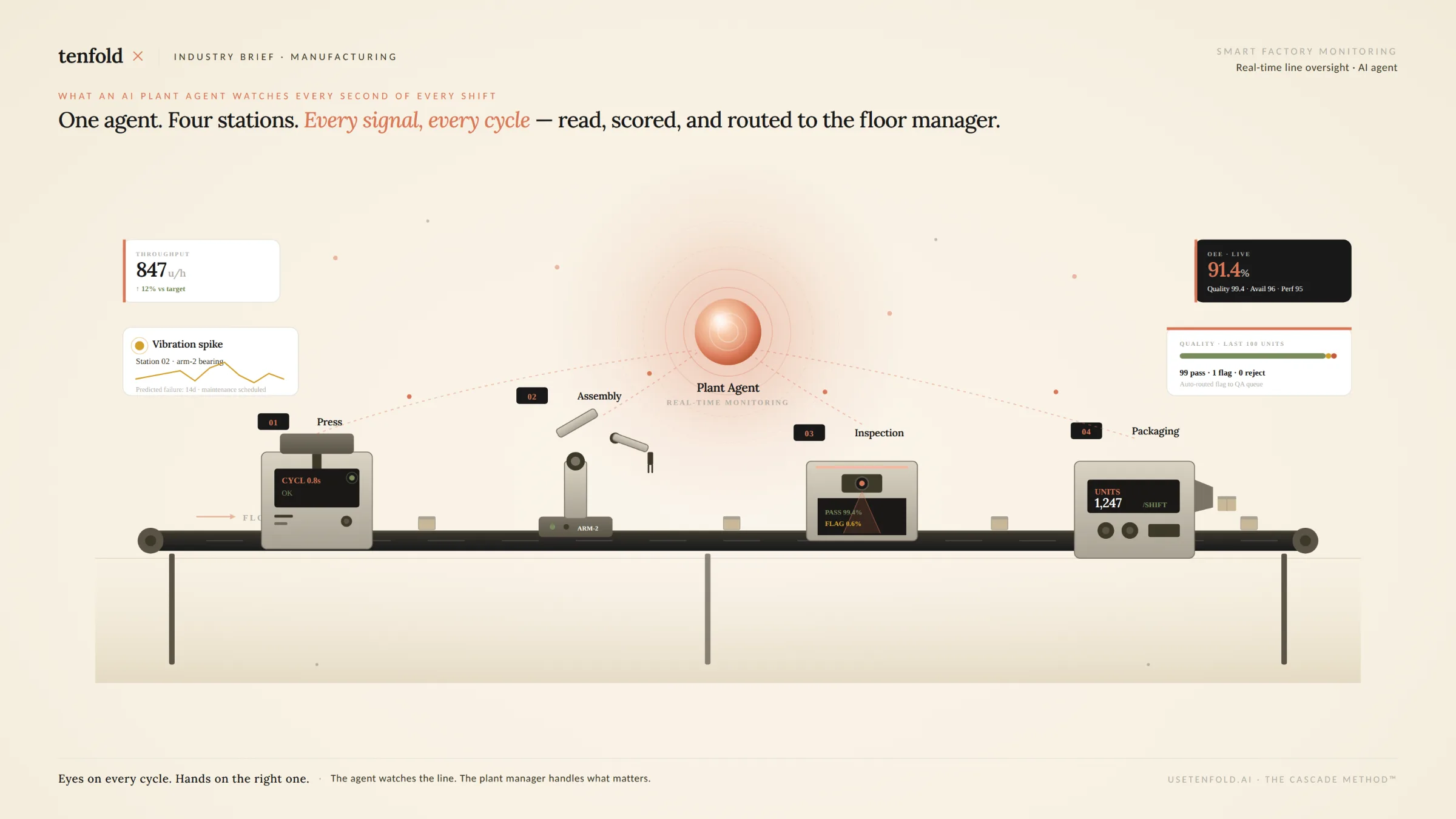
AI agents in manufacturing aren't a single tool. They're autonomous systems connected to your operational data — sensors, MES platforms, ERP systems, supply chain feeds — that monitor conditions, make decisions, and take actions continuously.
The core use cases where agents deliver the clearest ROI:
Predictive Maintenance
AI-enabled predictive maintenance can decrease unexpected downtime by as much as 45%, keeping production lines running and revenue flowing, according to data compiled by WorkInsiders. The same research shows maintenance cost reductions of 25–40% and equipment uptime improvements of up to 20%, alongside a reduction in breakdowns of up to 70%. These aren't marginal gains — they represent a structural change in how facilities manage assets.
Quality Control and Defect Detection
AI vision systems analyse product images in real time, identifying defects that human inspectors miss. BMW's implementation of AI-based image recognition achieves 90% defect detection accuracy, significantly reducing production waste. According to AllAboutAI's manufacturing statistics, 60% of industrialists now use AI for quality monitoring — enabling them to detect 200% more supply chain disruptions than traditional methods.
Supply Chain Optimisation
41% of manufacturers are leveraging AI to manage supply chain data, enhancing efficiency and responsiveness in an era of global disruption. The leading investment areas for AI in manufacturing are supply chain management (49%) and big data analytics (43%), reflecting where operational leaders see the sharpest need.
Production Scheduling and Workflow Automation
According to IDC's 2026 Manufacturing Industry FutureScape, more than 40% of manufacturers will adopt AI tools for scheduling systems in the near term, with planning and resource management driven by real-time data on machine statuses, workforce availability, and supply variability. Hitachi's deployment of its Lumada AI platform at its Omika Works facility demonstrates the ceiling here: AI-driven dynamic routing reduced lead times for core products by 50%.
The Numbers Operations Leaders Should Know
Decision-makers need numbers, not narratives. Here's what the data says:
Downtime reduction: AI-driven predictive maintenance has reduced downtime by 40% in manufacturing sectors, according to HSO (2024) data cited across multiple industry reports.
Maintenance cost savings: AI can lower manufacturing maintenance costs by 25–40%, per tech-stack.com's 2025 AI adoption analysis.
Waste reduction: 78% of production facilities utilising AI reported a waste reduction, and AI-driven energy management systems achieved an average energy savings of 12%.
Productivity: Some manufacturers scaling smart technologies are reporting 10–20% improvements in production output and up to a 20% gain in employee productivity, according to Deloitte's 2025 Smart Manufacturing and Operations Survey.
ROI timeline: Experienced companies report an average ROI of 4.3% with a typical payback period of just 1.2 years on their AI investments.
Revenue impact: Businesses adopting AI can expect a revenue increase of 6–10%, with measurable financial returns beyond operational efficiency.
At Tenfold, we focus on the implementation architecture that makes those numbers reproducible — not as one-off results, but as baseline expectations.
The J-Curve: Why Early Movers Win
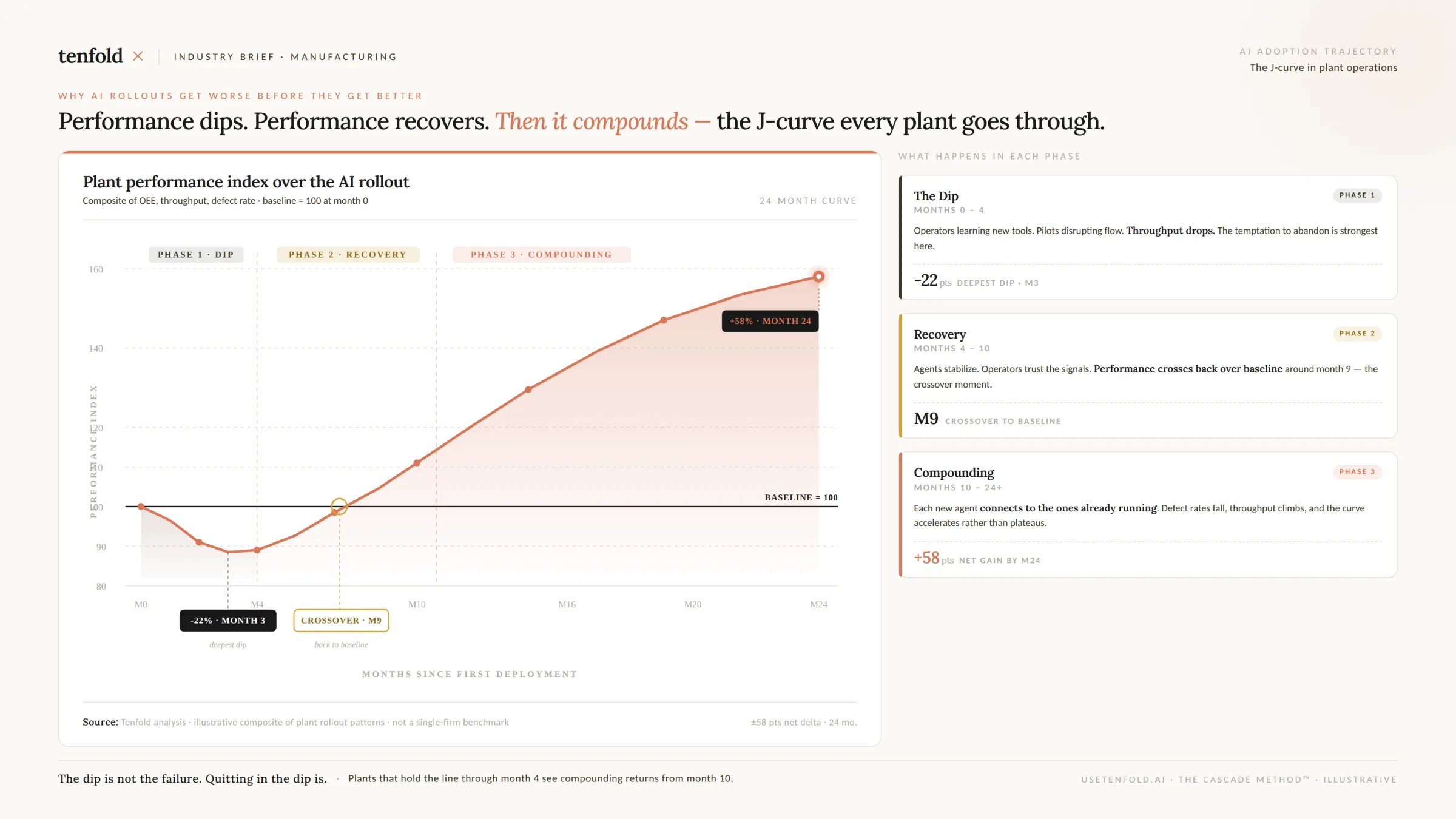
MIT Sloan research on AI adoption in U.S. manufacturing firms reveals an important pattern: AI introduction frequently leads to a measurable but temporary decline in performance, followed by stronger growth in output, revenue, and employment. This J-curve dynamic explains why some manufacturers experience early friction — and why it shouldn't stop them.
The firms that see the strongest gains are those that were already digitally mature before adopting AI. And critically, manufacturing firms that adopted AI tended to outperform their non-adopting peers in both productivity and market share over a four-year horizon.
The implication is direct: the cost of waiting compounds. Every quarter spent in deliberation is a quarter your competitors spend on the upswing.
AI Agents vs. Traditional Automation: The Distinction That Matters
Traditional automation executes fixed rules. AI agents reason, adapt, and act.
Where a conventional automated system triggers an alert when a sensor threshold is crossed, an AI agent analyses the pattern leading up to that threshold, cross-references historical failure data, schedules a maintenance window that minimises production impact, updates the ERP, and notifies the relevant team — autonomously.
According to Gartner, by 2028, 33% of enterprise software applications will include agentic AI, up from less than 1% in 2024 — a 33-fold increase in four years. This isn't a future state. It's an infrastructure shift already in motion.
For manufacturers, the practical question is: which workflows in your operation are currently bottlenecked by humans doing tasks that agents could handle faster, more consistently, and at lower cost?
Summary
AI agents in manufacturing are delivering real, measurable value — from 40% downtime reductions to 50% faster lead times — and the market is scaling rapidly. The evidence is clear: manufacturers that adopt and scale AI outperform those that don't, both in productivity and market share. Tenfold specialises in the implementation work that turns that evidence into outcomes for your operation — with the same agent-first approach that powers every Inforge Salesforce delivery.
Frequently Asked Questions
Q: What do AI agents actually do in a manufacturing environment?
A: AI agents in manufacturing are autonomous systems that connect to operational data — sensors, ERP platforms, MES systems — and execute multi-step workflows without human intervention. Common applications include predictive maintenance, quality inspection, supply chain management, and production scheduling.
Q: How much can AI reduce downtime in manufacturing?
A: According to multiple industry sources, AI-enabled predictive maintenance can reduce unexpected downtime by up to 45% and cut maintenance costs by 25–40%. Equipment uptime can improve by up to 20%, with breakdowns reduced by as much as 70%.
Q: Is AI in manufacturing delivering real ROI or is it still theoretical?
A: The ROI is real and measurable. Experienced manufacturers report an average 4.3% ROI with a payback period of just 1.2 years. Deloitte's 2025 Smart Manufacturing Survey shows 10–20% production output improvements and up to 20% employee productivity gains at facilities scaling smart technologies.
Q: What's the difference between traditional automation and AI agents?
A: Traditional automation executes fixed, pre-programmed rules. AI agents reason across data, adapt to changing conditions, and take multi-step actions autonomously — such as diagnosing a potential equipment failure, scheduling maintenance, updating systems, and alerting teams, all without human prompting.
Q: How do we get started with AI agents in our manufacturing operation?
A: Start with high-ROI use cases where data already exists — predictive maintenance and quality control have the shortest payback periods and the most measurable outcomes. The 60% of manufacturers who have created dedicated AI strategies are positioning themselves for long-term competitive advantage. A structured implementation partner accelerates time to value significantly.
