
AI Agents vs. Traditional Automation: What Businesses Actually Need to Deploy in 2026
Most enterprise automation decisions in 2026 are being made with the wrong question. Leaders are asking "should we replace our automation with AI agents?" The correct question is: "which of our workflows require reasoning, and which just require execution?" Get that distinction right, and your deployment strategy becomes obvious. Get it wrong, and you'll either over-engineer stable processes or under-equip the ones that actually need intelligence.
Key Takeaways:
AI agents and traditional automation (RPA) are not competitors — they are architectural layers built for different problem types.
Traditional automation excels at structured, deterministic, high-volume tasks. AI agents handle ambiguity, unstructured data, and multi-step decisions.
According to Gartner, 40% of enterprise applications will embed task-specific AI agents by end of 2026 — up from under 5% in 2025.
The organizations generating the strongest returns in 2026 run both in a hybrid architecture, not one or the other.
The bottleneck isn't AI capability. It's that most orgs haven't mapped their process portfolio against what each technology is actually built to do.
Quick Answer: AI agents and traditional automation solve fundamentally different problems. RPA delivers perfect, auditable execution on predictable workflows. AI agents handle the processes where inputs vary, data is unstructured, or judgment is required. In 2026, the winning architecture uses both — and knowing which to use where is the only decision that matters.
Why the "AI Agents vs. Automation" Framing Is Wrong
The "replace vs. keep" debate misses what's actually happening on the ground. Traditional automation is not being retired — it's being embedded inside AI-powered orchestration systems as the reliable execution layer. As Blue Prism, one of the companies that invented RPA, publicly stated: the future isn't retiring RPA, it's fusing it with AI agents.
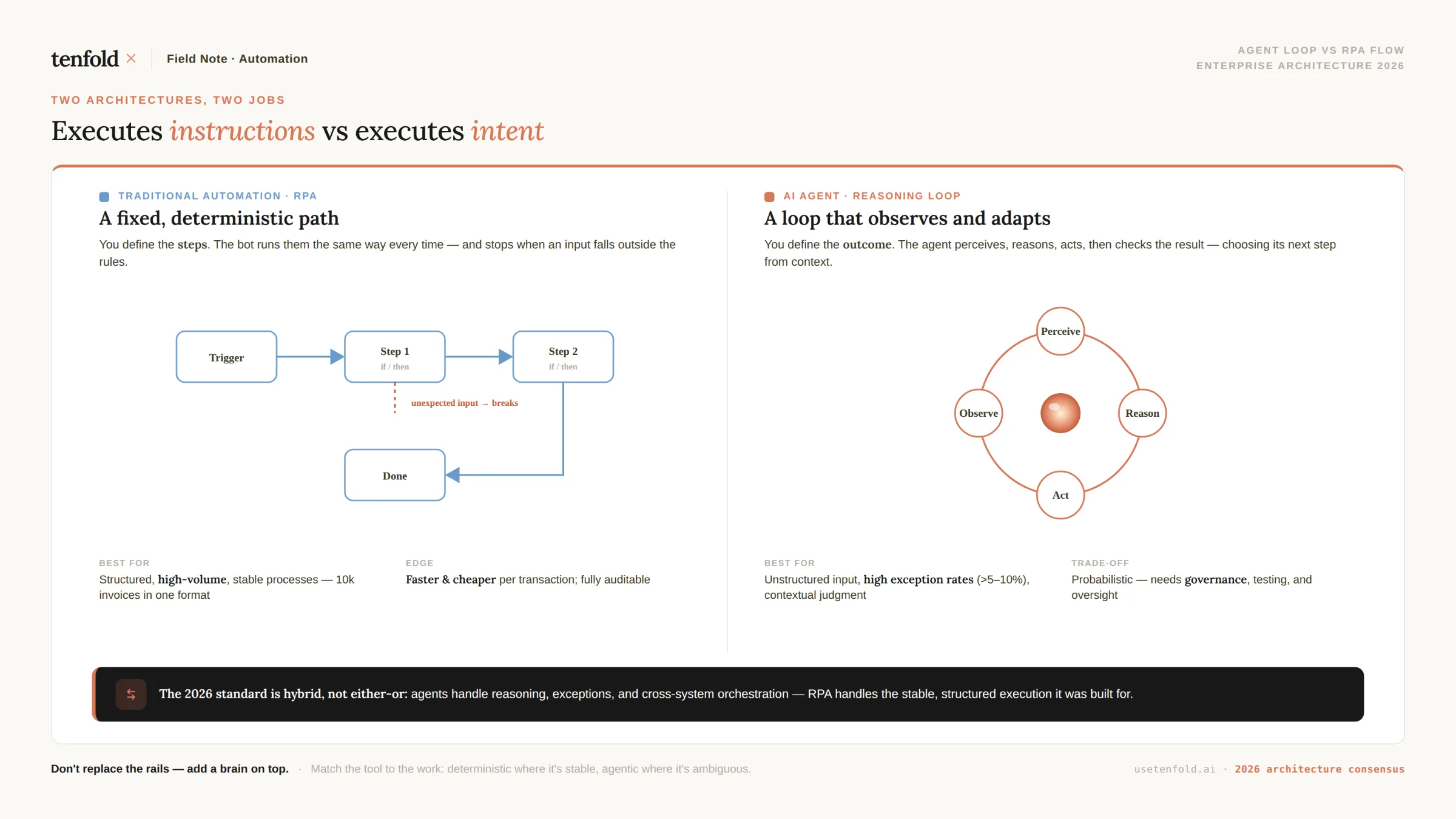
Here's what that looks like in practice: an AI agent handles the reasoning layer — parsing intent, evaluating context, deciding what needs to happen. An RPA bot handles the execution layer — calling pre-built automation flows reliably, at scale, with a full audit trail. Neither does the other's job well.
The architectural difference is the reasoning and adaptation loop. An RPA bot executes Step 1, Step 2, Step 3 regardless of what Step 1 returned. An AI agent executes Step 1, observes the result, and determines whether Step 2 in the original plan is still the right next action — or whether a different path makes more sense given the outcome. That capacity for mid-task adjustment is what allows agents to handle the long tail of cases that fall outside any fixed ruleset.
According to Salesmate's 2026 AI Agent Adoption report, enterprises are prioritizing task-specific, governed AI agents that integrate with real business systems — not broad autonomous experimentation. Clear ROI, observability, and human-in-the-loop controls now determine whether AI agent initiatives scale or stall.
What Traditional Automation Is Actually Built For
RPA and workflow automation have a strong, defined role in 2026. That role is not shrinking — it's clarifying.
Rule-based automation excels at structured, high-volume, deterministic tasks: processing payroll entries, transferring files between systems, generating reports from structured queries, updating records across databases. These processes don't benefit from reasoning, don't require natural language understanding, and don't involve unstructured data. RPA handles them efficiently, reliably, and at a low cost per transaction.
Mature RPA programs routinely achieve 92–97% straight-through processing rates for well-scoped tasks like form entry and ticket triage, according to internal benchmarks reported by Wadline's 2026 enterprise automation analysis. That's a number AI agents — which introduce probabilistic reasoning — cannot match on those same tasks.
Where RPA fails is just as clear. According to research cited by Neomanex, 30–50% of RPA projects fail to meet their intended objectives, and maintenance consumes 70–75% of total automation budgets. The culprit is almost always the same: the process being automated wasn't as rule-bound as it looked, or the operating environment changed faster than the scripts could be updated.
RPA tools interact with software at the UI level. Interface updates cause RPA failures. Policy changes break workflows. When inputs vary — emails with non-standard formats, contracts with ambiguous clauses, customer communications without structured templates — RPA stalls and hands off to humans. That handoff cost is exactly where AI agents earn their place.
What AI Agents Are Actually Built For
AI agents are autonomous software systems that take a goal as input and figure out how to reach it. Unlike scripted automation, they interpret intent, break tasks into steps, and adapt when conditions change.
The use cases where agents are delivering measurable results in 2026 share a common profile: unstructured inputs, high exception rates, or multi-step decisions where each step determines the next action. According to analysis from Salesmate, AI agents in customer service are saving small teams 40+ hours monthly. Finance and operations teams running agentic automation are accelerating close processes by 30–50%. Sales and marketing deployments are producing 2–3x improvements in pipeline velocity.
The ROI case is hard to ignore. According to Landbase's 2026 agentic AI statistics, companies report average returns of 171% from agentic AI deployments — roughly three times traditional automation ROI. U.S. enterprises specifically report 192% returns. Those numbers reflect the difference between automating a task and automating a decision.
According to Google Cloud's ROI of AI 2025 Report, 74% of executives deploying AI agents report achieving ROI within the first year. Among those seeing productivity gains, 39% report productivity at least doubling. These are not projections — they're reported outcomes from the 52% of surveyed executives already deploying agents in production.
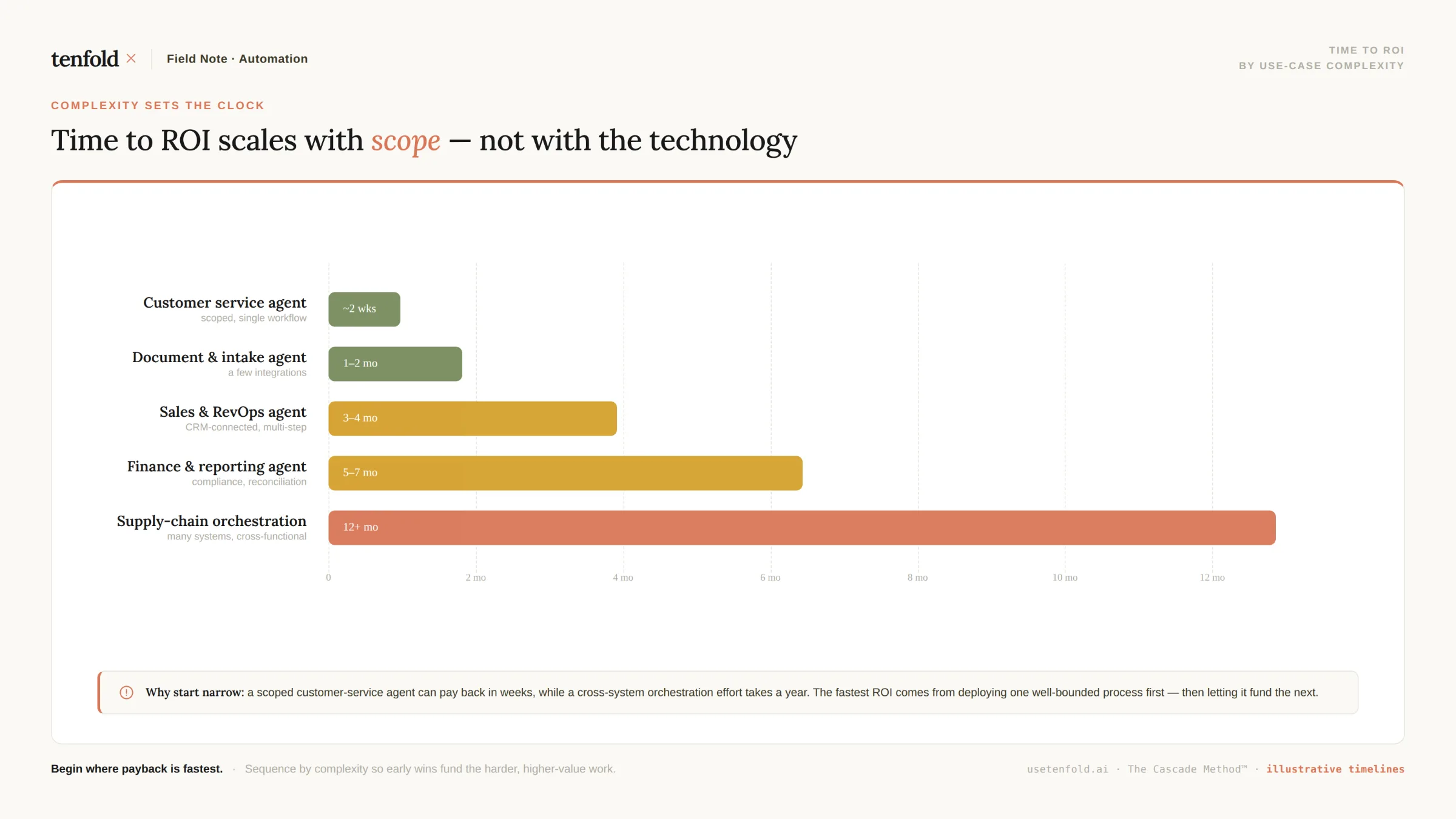
The key insight from those deployments: speed of ROI correlates directly with how measurable the baseline was before deployment. When a performance metric already exists — average handle time, cost-per-transaction, cycle time — an agent's impact shows up within weeks, not quarters.
The Deployment Decision Framework for 2026
The choice between AI agents and traditional automation comes down to one diagnostic question: does this process require judgment, or just execution?
Use traditional automation when your workflow involves structured data, predictable inputs, deterministic outcomes, compliance-heavy tasks that need auditability, or high-volume repetitive execution where deviation from the script is never acceptable. Financial reconciliation, bulk data migration, scheduled report generation, and regulatory-mandated process trails are all traditional automation's domain.
Deploy AI agents when your process involves unstructured data — PDFs, emails, contracts, freeform text — has an exception rate above 5–10% of cases, requires contextual judgment, or involves adaptive multi-step decisions where each step determines the next. Exception handling, intelligent document processing, multi-system customer resolution, and complex approval routing are agent territory.
Where both apply, build the hybrid. The AI agent handles reasoning and exception routing. The RPA layer handles structured execution within each decision branch. The most successful enterprise automation programmes in 2026 deploy these as complementary layers in a single process architecture — neither technology achieves alone what the combination delivers.
At Tenfold, we've seen this pattern consistently: the orgs that struggle with AI agent deployments are the ones that jumped to agents for processes that RPA already handles well. The orgs generating outsized returns started by mapping their process portfolio — identifying where variability was killing RPA performance — and deployed agents precisely there.
Why Most Deployments Still Stall — And How to Avoid It
The adoption numbers look aggressive: according to the 2026 Gartner CIO and Technology Executive Survey, only 17% of organizations have deployed AI agents to date, yet more than 60% expect to do so within the next two years — the steepest adoption curve among all emerging technologies tracked. The ambition is real. But ambition and execution are not the same thing.
According to Gartner, over 40% of agentic AI projects are at risk of cancellation by 2027 if governance, observability, and ROI clarity are not established. The technical capability is there. The organizational readiness often isn't.
The failure pattern is consistent across the deployments that stall:
No baseline metrics. If you can't measure the process before the agent, you can't prove it improved after.
Governance gaps. AI agents make non-deterministic decisions. That introduces explainability requirements that RPA never had. Who owns the outcome when an agent auto-denies a support ticket that becomes a compliance incident?
Tool sprawl without orchestration. Agents operating in silos produce modest productivity gains that fall short of projections. The breakthrough comes when agents coordinate — and that requires an orchestration layer most orgs haven't built yet.
Premature scaling. Deploying across 10 processes before one is proven is how 40% of budgets get consumed with nothing to show for it.
According to McKinsey's State of AI 2025 report, only 23% of organizations are currently scaling agentic AI in at least one business function, despite 62% experimenting. The gap between experimentation and production isn't technical. It's structural.
The path out is straightforward: start with one high-value process where RPA already struggles. Deploy an agent. Measure against the baseline you defined before go-live. Prove the value, build the governance model, then scale.
Summary
The AI agents vs. traditional automation debate is settled — not by picking a winner, but by understanding that these are different tools solving different problems. In 2026, the orgs moving fastest are the ones that mapped their processes first, identified precisely where variability was limiting RPA performance, and deployed agents at those specific failure points. The rest is execution discipline: clear baselines, governance from day one, and hybrid architecture that lets each layer do what it was built for.
At Tenfold, we specialize in exactly this: building agent-first delivery models for organizations that are done piloting and ready to produce. We've already proven the model internally — our sister company Inforge delivers full Salesforce implementations entirely through AI agents, not headcount. If you want to understand where agents fit in your stack and what it takes to get from experiment to production, that's the conversation we're built for.
Frequently Asked Questions
Q: Will AI agents replace RPA in 2026?
A: No. RPA remains the right technology for structured, deterministic, high-volume processes — and IDC projects RPA spending to more than double between 2024 and 2028. AI agents complement RPA by handling unstructured data, exception reasoning, and adaptive multi-step decisions that rule-based bots cannot manage. The 2026 enterprise standard is a hybrid architecture that uses both.
Q: What types of processes should I deploy AI agents for first?
A: Start with processes that have a high exception rate (above 5–10% of cases falling outside the ruleset), involve unstructured inputs like emails or documents, or require contextual judgment across multiple systems. Customer service resolution, intelligent document processing, and complex approval routing consistently deliver the fastest time-to-ROI for first-agent deployments.
Q: What's causing AI agent projects to fail in 2026?
A: According to Gartner, over 40% of agentic AI projects risk cancellation by 2027. The primary causes are governance gaps, lack of observability, unclear ROI metrics before deployment, and premature scaling before a single use case is proven. The fix is straightforward: define measurable baselines before deploying, build governance into the architecture from day one, and prove one process before expanding to ten.
Q: How long does it take to see ROI from AI agents?
A: It depends on the use case and how well the baseline was measured. Customer service deployments with pre-existing metrics — average handle time, CSAT, resolution rate — can show ROI within two weeks. Supply chain orchestration deployments can take 12+ months. The fastest path to ROI is always the process where you can measure performance before and after go-live.
Q: How is agentic AI different from traditional AI or automation?
A: Traditional automation follows explicit, pre-defined rules — if this, then that, the same way every run. Traditional AI tools generate insights but depend on humans to act on them. Agentic AI operates on intent: you define the goal, and the agent reasons about how to reach it, uses tools across multiple systems, adapts when conditions change, and executes end-to-end without per-step human approval. That autonomy is what separates it from everything that came before.
*Ready to move from pilot to production? Tenfold works with enterprise operations and C-suite leaders to design and deploy AI agent architectures that deliver measurable outcomes — not experiments. [Talk to us about your automation stack.]*
