
AI Automation for Accounting Firms: Cutting Manual Work in Close and Reconciliation
AI automation for accounting firms is no longer a future-state aspiration — it's a production reality. Firms deploying AI agents in their close and reconciliation workflows are compressing 10–15 day close cycles down to 3, cutting reconciliation errors by up to 90%, and redirecting staff toward the advisory work that actually grows revenue. The bottleneck has never been talent. It's been the sheer mechanical weight of manual processes that AI can now carry instead.
Key Takeaways:
AI-powered reconciliation delivers up to 85% faster processing and 95% fewer errors compared to manual methods
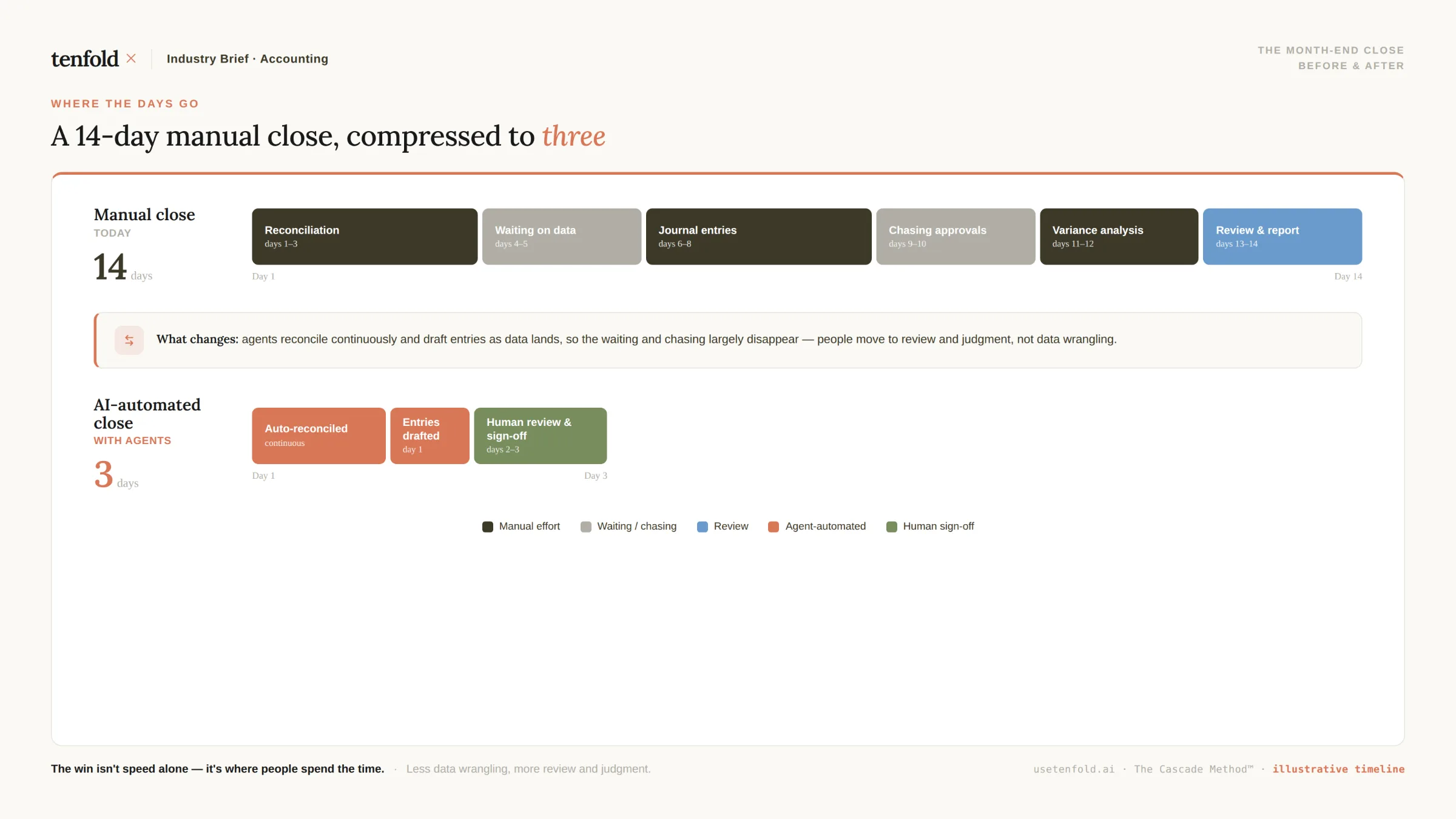
Month-end close cycles shrink from 10–15 days to as few as 3 days with agentic AI deployment
AI adoption in accounting firms jumped from 9% to 41% in a single year (Wolters Kluwer, 2025)
The firms winning in 2026 use AI to free 15–20 hours per accountant per week, then reinvest that capacity into advisory
Agentic AI — not just automation tools — is what drives end-to-end close ownership without human handholding
Quick Answer: AI automation cuts manual work in accounting close and reconciliation by deploying AI agents that independently match transactions, post journal entries, detect anomalies, and escalate only genuine exceptions to human review. The result: faster closes, fewer errors, and accountants freed from mechanical processing to focus on judgment-intensive advisory work.
Why the Manual Close Is Still Breaking Accounting Firms in 2026
The month-end close remains one of the most time-intensive and operationally painful processes in accounting. Despite years of ERP upgrades and workflow tools, most firms haven't solved the core problem: humans are still doing the mechanical work.
According to a 2025 Ledge benchmarks report, cash reconciliation alone takes finance teams 30+ hours each month — and if even one data source is delayed, it pushes back the entire close. That's not a process problem. That's a structural design flaw.
The data is damning. The Institute of Management Accountants found that finance teams spend roughly 30% of their time correcting errors introduced by manual processes. Not finding insights. Not advising clients. Fixing mistakes that automation would have prevented in the first place.
Four compounding problems define the manual close:
1. Fragmented data sources. Finance teams manually extract information from ERP systems, general ledgers, payment processors, and spreadsheets, creating accuracy risks and time bottlenecks that compound across the entire close cycle.
2. Reconciliation as the kill switch. Reconciliation isn't just tedious — it's often the single bottleneck that delays everything downstream. One senior accountant at a healthcare firm described it plainly: *"We're still exporting data from three systems just to match it in Excel. It's painful."*
3. Error cascades. Manual data entry carries a 1–4% error rate. Those errors compound. Each discrepancy discovered during reconciliation requires investigation before the close can proceed — and that investigation is done by the same team already under deadline pressure.
4. Talent drain. When your best accountants spend 14 days a month on close processing, they have no bandwidth for analysis, planning, or client advisory. The good ones eventually leave. The ones who stay get stuck in survival mode.
According to a Trintech survey, only 8% of finance professionals are satisfied with their visibility into their own financial close process. That number alone tells you how broken the status quo is.
What AI Automation Actually Does in the Close and Reconciliation Workflow
AI automation in the close and reconciliation context isn't a chatbot. It's a set of purpose-built agents that own specific workflows end-to-end, execute without waiting for prompts, and escalate only what genuinely requires human judgment.
Here's what that looks like in practice across the core close tasks:
Transaction Matching and Bank Reconciliation
AI agents ingest data from banks, ERPs, payment processors, and card systems simultaneously. They apply matching logic learned from historical cycles — so low-risk items never reach a human desk. According to HighRadius, agentic AI reduces matching time by up to 90% and achieves approximately 99% accuracy using pattern-based logic. Exceptions that can't be auto-cleared are escalated with full context attached.
The contrast with manual is stark. A controller at a mid-market distributor might spend three days per cycle manually sorting 1,200 flagged exceptions. An AI agent learns from past decisions, auto-matches similar patterns, and resolves 80% of those issues before any human intervenes.
Journal Entry Automation
Recurring entries — accruals, depreciation, allocations — are prepared, routed for approval, and logged with full audit trails by AI agents. The agent knows when a month-end accrual is due, prepares a draft entry based on historical inputs, and submits it for review. No one has to build it from scratch each cycle.
Companies using agentic AI-led financial close software report an 86% drop in manual journal entries, according to HighRadius data.
Anomaly Detection and Exception Handling
AI doesn't just process clean data — it catches what's wrong before it compounds. AI-powered reconciliation systems flag outlier journal entries, unusual vendor payment patterns, and data quality issues in real time. That means discrepancies are found during the cycle, not after the books are supposedly closed.
According to recent implementation data, AI-powered reconciliation cuts financial errors by up to 90% while improving visibility into financial data by 95%.
Close Orchestration
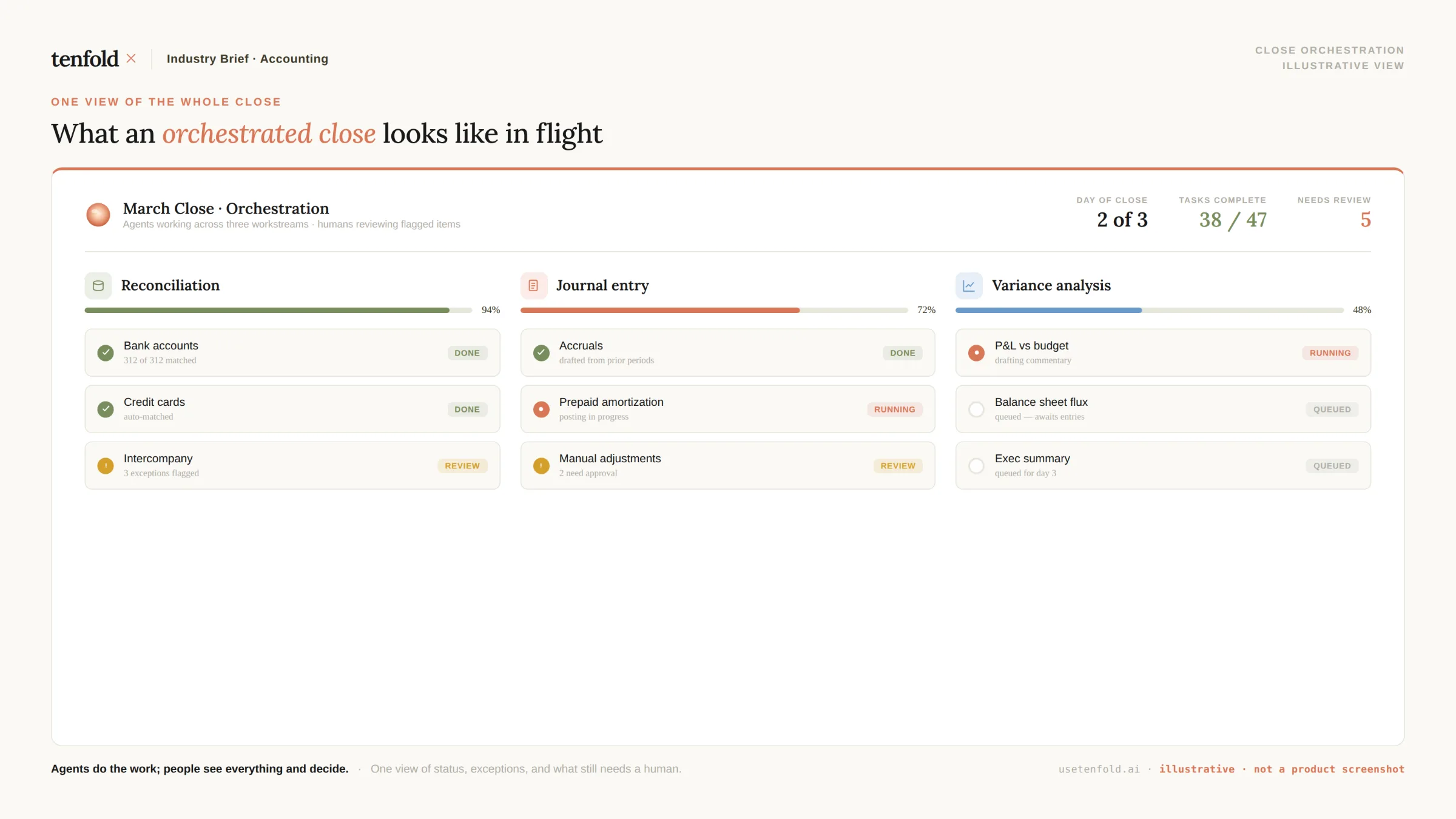
This is where agentic AI diverges sharply from standard automation. Most automation tools move data faster. Agents run the entire process. A close task manager agent assigns and tracks activities in real time, automatically triggering dependent tasks when upstream work is complete. No team lead manually checking a 40-item checklist. No email chains chasing sign-offs.
Leading accounting teams using continuous close and agentic automation are closing the books in 3 days or less, compared to traditional 10–15 day cycles.
The Numbers Behind the ROI
Skepticism about AI ROI is reasonable. The accounting industry has absorbed a lot of vendor promises. But the 2025–2026 data from actual deployments makes the case without embellishment.
Adoption has crossed the tipping point. According to the 2025 Wolters Kluwer Future Ready Accountant Report, AI adoption in accounting firms jumped from 9% in 2024 to 41% in 2025 — a more-than-fourfold increase in a single year. Separately, 46% of accountants now use AI tools daily, up from 18% in 2023.
The close cycle compression is real. Industry data shows firms making advanced use of AI are achieving monthly financial closes 7.5 days faster on average. At the high end, AI-powered finance operations report a 55% faster monthly close, and leading teams have compressed a 12-day close to 3 days after deploying agent-driven reconciliation.
The error reduction is documented. Businesses implementing automated reconciliation systems see a 70% reduction in data entry errors. AI-powered bank reconciliation tools achieve matching rates of over 95%. And according to Intuit's 2025 survey of 700 U.S. accounting professionals, 46% use AI daily — with 98% reporting improvements in accuracy.
The advisory revenue lift is measurable. Firms using AI report 30% faster month-end close and 25% more advisory revenue. For a small firm with $500K in annual revenue, automating bookkeeping and close processes frees 600–800 hours per year — worth $90,000–$160,000 in reallocated billable time.
The talent argument alone justifies the investment. The AICPA projects a shortage of 340,000 CPAs by 2030. AI fills the capacity gap without adding headcount. The firms winning in 2026 use AI to free 15–20 hours per accountant per week, then redirect that capacity into cash flow forecasting, tax strategy, and business planning — advisory work that commands 40–60% higher rates than compliance.
The Difference Between Automation and Agentic AI — and Why It Matters
Most accounting firms have some automation. Few have agentic AI. The distinction is the difference between a tool that helps someone do a task and a system that owns the task entirely.
Standard automation — RPA, rule-based matching, scheduled reports — moves data faster. But it doesn't resolve what it doesn't understand. Exception queues pile up. Controllers still spend days manually clearing what automation flagged but couldn't fix. The close still requires humans holding it together.
Agentic AI is different in kind, not just degree. An agent doesn't complete a step and wait. It plans, executes, validates, and handles exceptions across a full workflow without a human in the loop for every action. In accounting, that means running the complete reconciliation process: ingesting data from CRM, billing system, and ERP; matching records; surfacing discrepancies; and producing a workpaper — without a single analyst opening a spreadsheet.
The practical implication: automation was designed for efficiency. Agentic AI is designed for ownership. Close management software tracks that your team completed the reconciliation. An agent runs the reconciliation and tells you what it found.
According to a January 2026 Deloitte study, 63% of finance organizations have fully deployed AI in their operations, and nearly 50% of CFOs report having fully integrated AI-driven agents into parts of the finance function. The question for accounting firms is no longer whether to adopt — it's whether the adoption is shallow (tools) or structural (agents).
A real-world example makes this concrete. One mid-sized accounting firm built an AI-driven digital worker — an RPA bot with AI — that logs into over 100 investment accounts, pulls data, consolidates it, reconciles it to the general ledger, flags anomalies, and produces an audit trail report automatically. According to CPA Trendlines, this saved approximately 500 hours of manual work each year — time their audit staff now spends on risk assessment and investigating issues rather than data gathering.
How to Deploy AI Automation in Your Accounting Firm's Close Process
Deployment isn't a single project — it's a sequenced build. Firms that try to automate everything at once usually end up with disconnected point solutions that create new handoff problems. The ones that succeed map their highest-friction workflows first and deploy agents there.
Step 1: Identify your actual close bottlenecks. Not where you assume friction is — where the data shows it. Track close cycle time, number of manual journal entries, reconciliation aging, and hours spent per task category. The 20% of tasks consuming 80% of close time are your first targets.
Step 2: Start with reconciliation. Bank reconciliation is the highest-impact, lowest-risk entry point for most firms. It's repetitive, rule-based, data-heavy, and well-suited to AI pattern matching. Bank reconciliation is considered 90%+ automatable by most current AI systems.
Step 3: Layer in journal entry automation. Recurring entries are the next logical step. Accruals, depreciation, allocations — agents can own these with full audit trails, freeing human review time for genuinely complex or non-standard entries.
Step 4: Move to close orchestration. Once transactional tasks are automated, deploy a close task manager agent that coordinates dependencies across the full checklist. This is where the 3-day close becomes achievable.
Step 5: Build continuous close capability. The goal isn't a faster month-end close — it's eliminating month-end chaos entirely by processing transactions and reconciliations daily or weekly. Leading teams aren't closing faster at month-end. They're barely noticing month-end because the work is continuous.
At Tenfold, we've found that firms underestimate how quickly this sequence can be implemented. The technical infrastructure exists. The agents are ready. The real work is governance: defining what gets escalated, what gets auto-posted, and what requires sign-off. That's a policy decision, not a technology problem.
Summary
The manual close is a structural problem, not an effort problem. Accounting firms running 10–15 day closes aren't doing it wrong — they're doing it with tools designed for a world before AI agents existed. The data from 2025–2026 deployments is unambiguous: AI automation compresses close cycles to 3 days, cuts reconciliation errors by 90%+, and frees accountants to do the advisory work that commands higher rates and builds deeper client relationships. The firms that treat this as a tooling upgrade will fall behind the ones treating it as an operational redesign. Tenfold specializes in exactly that redesign — building agent-first workflows that don't just automate tasks but take ownership of processes end-to-end.
Frequently Asked Questions
Q: How much can AI actually reduce month-end close time for an accounting firm?
A: Firms deploying agentic AI for financial close are compressing traditional 10–15 day cycles to 3 days or fewer. On average, AI-advanced firms achieve closes 7.5 days faster. The results depend on how deeply agents are integrated — firms using AI for close orchestration, not just individual tasks, see the largest gains.
Q: What's the difference between RPA and agentic AI for accounting reconciliation?
A: RPA (robotic process automation) executes predefined rules on structured data — it moves fast but breaks when inputs change. Agentic AI plans, executes, and self-corrects across multi-step workflows without requiring fixed rules. For reconciliation, this means an agent handles exceptions it hasn't seen before by learning from context, not just matching against a lookup table.
Q: Is AI automation for accounting close compliant with audit requirements?
A: Yes, when implemented correctly. Modern agentic AI platforms are built with audit trails, exception escalation logs, and reasoning traces that document what the agent saw and why it acted. Compliance depends on governance design — firms need clear policies on what agents can auto-post versus what requires human sign-off before close.
Q: How long does it take to deploy AI automation in an accounting firm's close process?
A: For targeted deployments — bank reconciliation, recurring journal entries — firms typically see working automation within weeks. Full close orchestration with continuous close capability takes longer, typically 2–4 months depending on ERP complexity and integration scope. The firms reporting fastest deployment times are those with clean chart-of-accounts structures and well-documented existing workflows.
Q: Will AI automation replace accounting staff?
A: The data says no — and the talent math supports that position. The AICPA projects a shortage of 340,000 CPAs by 2030. AI fills capacity gaps and removes mechanical work, but accounting judgment, client relationships, and advisory interpretation remain human work. The firms winning today use AI to move accountants up the value chain — away from data entry and into strategy. That's not replacement. That's leverage.
