
AI Consulting Pricing Models Explained: Project-Based vs. Retainer vs. Outcome-Based
Pick the wrong AI consulting pricing model and you can burn months of runway before the first working feature ships. The structure you choose determines who carries the risk, how incentives align, and whether you have cost certainty or open-ended exposure. And the models vary enormously: hourly rates alone span $75 to $1,000+ depending on the firm. The good news is that the choice isn't mysterious — each of the four main models fits a specific situation, and matching the model to your stage is one of the highest-leverage decisions in the whole engagement.
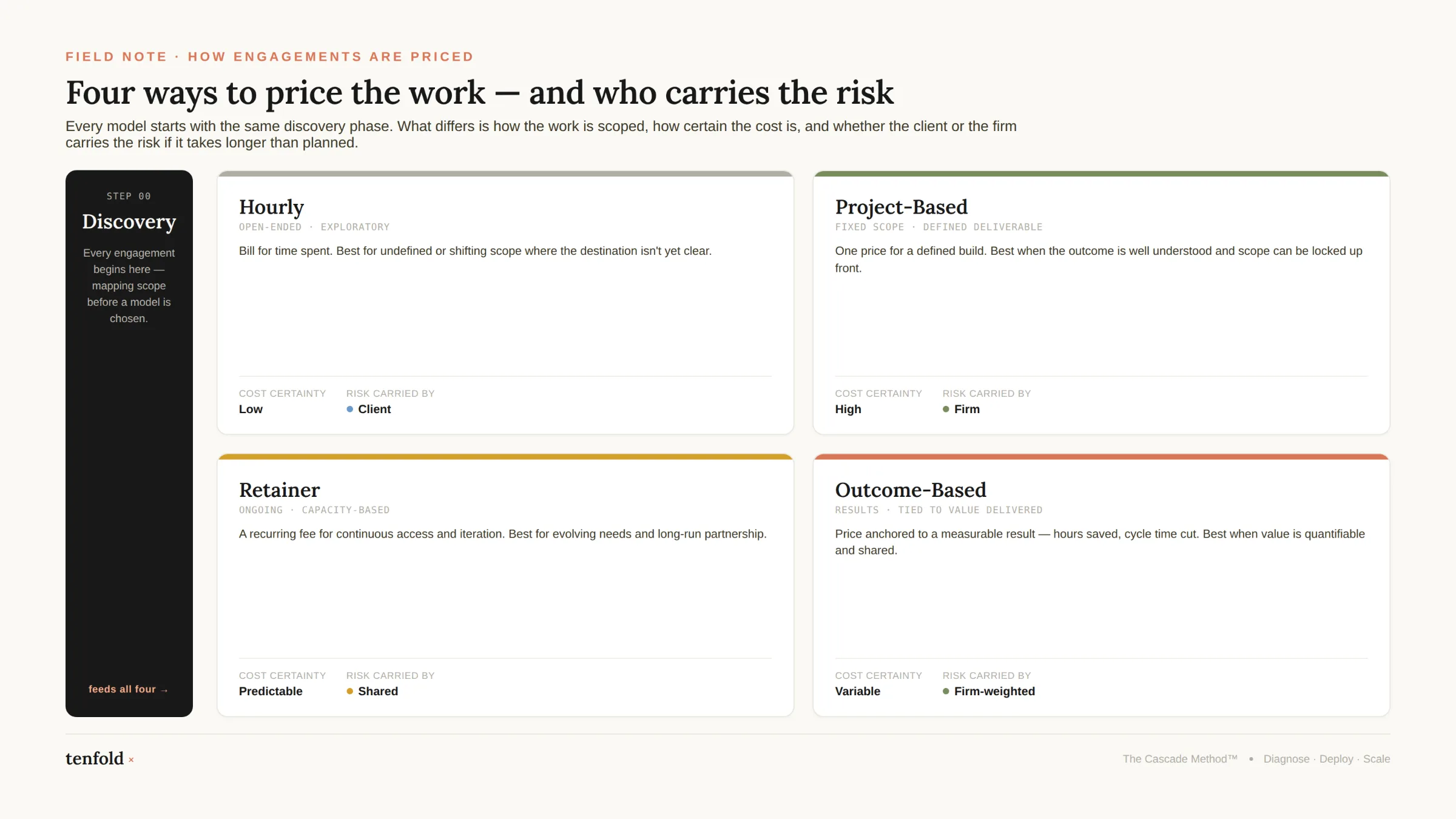
Quick Answer: There are four main AI consulting pricing models in 2026. Hourly ($150–$500/hr) fits short, exploratory, undefined work. Project-based/fixed-fee ($10,000–$500,000+) fits well-defined deliverables and gives you cost certainty. Retainers ($2,000–$50,000/month) fit ongoing development, monitoring, and iteration. Outcome-based (fees tied to results, often 10–25 percent of gains) aligns incentives when clear ROI metrics exist. For most defined build work, fixed-fee or outcome-based models deliver 20–40 percent lower total cost than hourly, because hourly incentivizes extending the engagement.
Key Takeaways:
The four models map cleanly to situations: hourly for one-time audits or undefined scope; project-based for building a specific feature; retainer for shipping AI work continuously; outcome-based when you have a measurable ROI goal.
Fixed-fee shifts delivery risk to the consultant — a $150,000 fixed-fee engagement with a written scope is often a better investment than a $100,000 time-and-materials engagement that grows to $250,000 with no performance guarantee.
73 percent of consulting clients now prefer pricing tied to outcomes over time-based billing, and outcome-aligned pricing reportedly delivers 2.3x higher satisfaction — but it requires solid baseline data to measure against.
Retainers commonly run in three tiers: essential advisory ($2,000–$5,000/mo for 5–10 hours), standard support ($5,000–$15,000/mo for 10–25 hours), and comprehensive partnership ($15,000–$50,000/mo for 25+ hours).
A short paid discovery (often ~$3,500) that produces a technical brief, risk map, and pricing path is the single best way to avoid choosing the wrong model — many firms require it before any build.
Hourly (Time and Materials)
You pay for time spent. Rates run roughly $150–$500/hour (higher at the Big Four and elite firms). Hourly is the right fit for genuinely undefined work — an initial audit, a code review, a feasibility study — where the scope can't be pinned down up front. Its weakness is the incentive: hourly billing rewards extending the engagement, which is why it's the wrong model for open-ended builds. A 10-week hourly engagement at $250/hour for 20 hours/week runs about $50,000; the same scope on a fixed-price contract often runs $25,000–$35,000. If you use hourly, insist on a weekly cap and a clear ceiling.
Project-Based (Fixed-Fee)
You agree a total price for a defined scope. Ranges span $10,000–$75,000 for focused features, $25,000–$250,000 for proofs of concept and single use cases, and $100,000–$500,000+ for enterprise programs. Fixed-fee is the superior choice when deliverables are well defined and the budget is fixed, because it creates natural accountability — the consultant's profitability depends on delivering efficiently within scope, so delivery risk sits with them, not you. The critical requirement is a written scope of work: "AI automation project" is not a scope. Get the scope documented before signing, or fixed-fee just becomes a fight about what was included.
Retainer
You pay a fixed monthly fee for ongoing access — development, monitoring, optimization, and iteration. The three common tiers are essential advisory ($2,000–$5,000/mo, 5–10 hours), standard support ($5,000–$15,000/mo, 10–25 hours), and comprehensive partnership ($15,000–$50,000/mo, 25+ hours). Retainers are the right structure when the work is continuous rather than a one-time build — which describes most AI agent work after launch, given the tokens, maintenance, tuning, and evaluation an agent needs to stay accurate. For SMBs, a retainer typically cuts AI support cost 30–60 percent versus a full-time hire, because you're renting a team's expertise instead of one salary. A useful variant ties retainer payments to milestone acceptance rather than paying regardless of output.
Outcome-Based
Fees are tied to measurable business results — often 10–25 percent of the gains, or a fixed fee with an ROI guarantee. This is the fastest-growing model in 2026 because it aligns the consultant's incentives directly with yours and transfers risk to the vendor. It's the right fit when clear ROI metrics exist and you have the measurement infrastructure to track outcomes against agreed benchmarks. It fails when outcomes are fuzzy, timelines are uncertain, or the work can't credibly be connected to revenue or cost savings. When it fits, it delivers the highest satisfaction of any model — but both parties need solid baseline data and a longer-term commitment.
How to Choose
Match the model to your situation. One-time audit or exploratory work → hourly. Building a specific, well-defined AI feature → project-based. Shipping and maintaining AI work continuously → retainer. A measurable ROI goal with good baseline data → outcome-based. Don't know what you need yet → start with a short paid discovery, then scope. That discovery step — commonly around $3,500, producing a technical brief, a risk map, and a pricing path — is the best insurance against choosing wrong, which is why many firms require it before any build. And when comparing proposals, evaluate total cost, timeline, and risk allocation — not just the headline rate. The cheapest proposal is rarely the best value; a fixed-fee engagement with a guarantee usually beats a low hourly rate with open-ended exposure.
Summary
The four AI consulting pricing models each fit a different stage and shift risk differently: hourly for the undefined, project-based for the defined, retainer for the continuous, and outcome-based for the measurable. Match the model to your situation, insist on a written scope, and start with a short discovery if you're unsure. Get the structure right before you sign — in 2026 the wrong model wastes more than money, it wastes runway. If you'd like help scoping an engagement and matching it to the right model for your stage, the Tenfold team is happy to walk through it.
Frequently Asked Questions
Q: What are the main AI consulting pricing models? A: Four: hourly ($150–$500/hr) for exploratory work; project-based/fixed-fee ($10,000–$500,000+) for defined deliverables; retainers ($2,000–$50,000/month) for ongoing work; and outcome-based (often 10–25 percent of gains) when clear ROI metrics exist.
Q: Which model is cheapest? A: For well-defined build work, fixed-fee and outcome-based models typically deliver 20–40 percent lower total cost than hourly, because hourly billing incentivizes extending the engagement while fixed-fee and outcome-based reward efficient delivery.
Q: When does outcome-based pricing make sense? A: When clear ROI metrics exist and you have the data infrastructure to measure results against agreed benchmarks. It aligns incentives and delivers the highest client satisfaction, but fails when outcomes are fuzzy or can't be credibly tied to revenue or cost savings.
Q: How do I avoid choosing the wrong model? A: Start with a short paid discovery (often around $3,500) that produces a technical brief, risk map, and pricing path. It's the best insurance against a mispriced engagement — and when comparing proposals, weigh total cost, timeline, and risk allocation rather than just the headline rate.
