
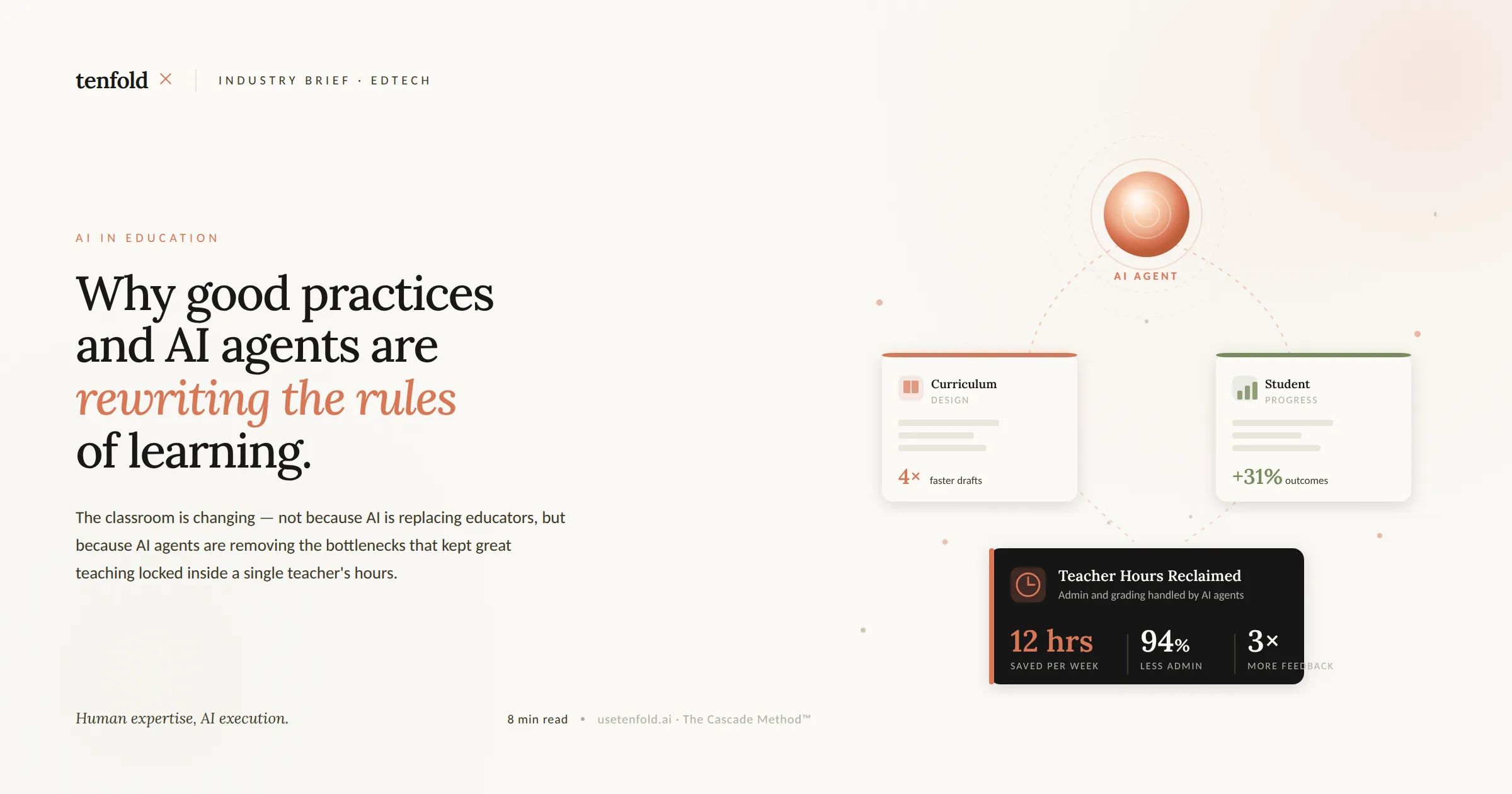
AI in EdTech: Why Good Practices and AI Agents Are Rewriting the Rules of Learning
AI in EdTech is already delivering measurable outcomes — better student performance, fewer hours lost to administration, and learning experiences that adapt in real time to the individual. The question isn't whether AI belongs in education. It's whether your institution is using it with the discipline and structure to make it count.
Quick Answer: AI in EdTech improves learning outcomes through personalized adaptive pathways, automates administrative burdens that consume educator time, and — when deployed as autonomous AI agents — can run continuous, context-aware support across the entire student lifecycle without human bottlenecks.
Key Takeaways:
The global AI in education market was valued at $5.88 billion in 2024 and is projected to reach $32.27 billion by 2030 — this is infrastructure-level investment, not experimentation.
Teachers who use AI tools weekly save an average of 5.9 hours per week — the equivalent of six full school weeks per year.
AI agents in EdTech don't just automate tasks. They assess, adapt, respond, and guide — functioning as always-on support systems for students and institutions alike.
Good AI practice in education means human-centered design first. The technology serves the learning goal. Not the other way around.
The gap isn't capability. It's deployment structure — most institutions have the tools, but not the agent-first operating model to extract the full value.
The EdTech Market Has Already Made Its Bet on AI
This isn't a pilot program conversation anymore. According to Enrollify, the global EdTech market is projected to reach $404 billion by 2025 — a 16.3% compound annual growth rate representing more than 2.5x growth from 2019. That capital is increasingly concentrated in AI.
According to Tutorbase, the AI in education market specifically is growing at a CAGR of 31.2% from 2025 to 2030, driven by demand for personalized learning at scale. Between the 2023–24 and 2024–25 school years, the share of K-12 teachers using generative AI for work doubled from 25% to 53%.
The adoption signal is clear. The institutions pulling ahead aren't waiting for consensus — they're building AI into their operating model now and adjusting as they go.
At Tenfold, we've seen this dynamic play out across verticals: the organizations that move first with a structured, agent-first deployment model consistently outperform those still running one-off pilots with no operational backbone.
What "Good AI Practices" Actually Means in EdTech
Good AI practice in EdTech isn't a checklist. It's a design philosophy. Here's what it looks like in execution:
1. Learning Goals Drive the Technology — Not the Other Way Around
According to KnowledgeWorks, AI in education is most impactful when educators focus first on what students should know and be able to do, and then use AI to support — not drive — the selection of activities, materials, and instructional strategies. This sounds obvious. In practice, most implementations get it backwards: they adopt a tool and then retrofit pedagogical rationale.
The correct sequence: define the learning outcome → identify where AI creates leverage → deploy with human oversight built in.
2. Personalization That Responds in Real Time
Static curricula fail the same students every cycle. AI-driven adaptive learning changes that. According to a systematic review published in ScienceDirect, AI has been shown to enhance student engagement, motivation, and performance by providing adaptive learning pathways, real-time feedback, and tailored content.
The data backs the model: the AI-powered platform Korbit showed 2.5 times higher scores compared to a non-adaptive course, according to research cited in arXiv. That's not a marginal improvement. That's a structural advantage.
3. Automate the Overhead — So Educators Can Teach
According to Carnegie Learning's State of AI in Education data reported by EdTech Magazine, 42% of teachers who use AI found it reduced time spent on administrative tasks, and 25% reported benefits in personalized learning support.
Teachers who use AI tools at least weekly save an average of 5.9 hours per week — equivalent to six weeks over the school year, according to Tutorbase. That's six weeks of instructional bandwidth recovered per educator, per year.
The best AI implementations in EdTech don't just improve the student experience. They give educators the operational headroom to do the work that AI can't: building relationships, designing learning culture, and intervening with judgment.
4. Data Governance and Bias Auditing Are Non-Negotiable
Good AI practice means running regular audits and continuous performance monitoring. According to Leobit, to prevent misleading AI model outputs in EdTech, it is essential to focus on data organization and curation so that ML models base their responses on credible and reliable data. Bias left unchecked doesn't just produce bad outputs — it produces inequitable outcomes at scale.
Privacy, transparency, and equitable access aren't compliance requirements. They're table stakes for building AI systems that students and educators will actually trust and use.
Why AI Agents Are the Real Leap Forward for EdTech
Most of the AI deployed in education today is reactive: a chatbot answers a question, a tool grades a paper. That's useful. It's not transformative.
AI agents are different. They are autonomous software systems that execute multi-step workflows, assess context, trigger actions, and adapt over time — without requiring a human prompt at every step.
In EdTech, this means:
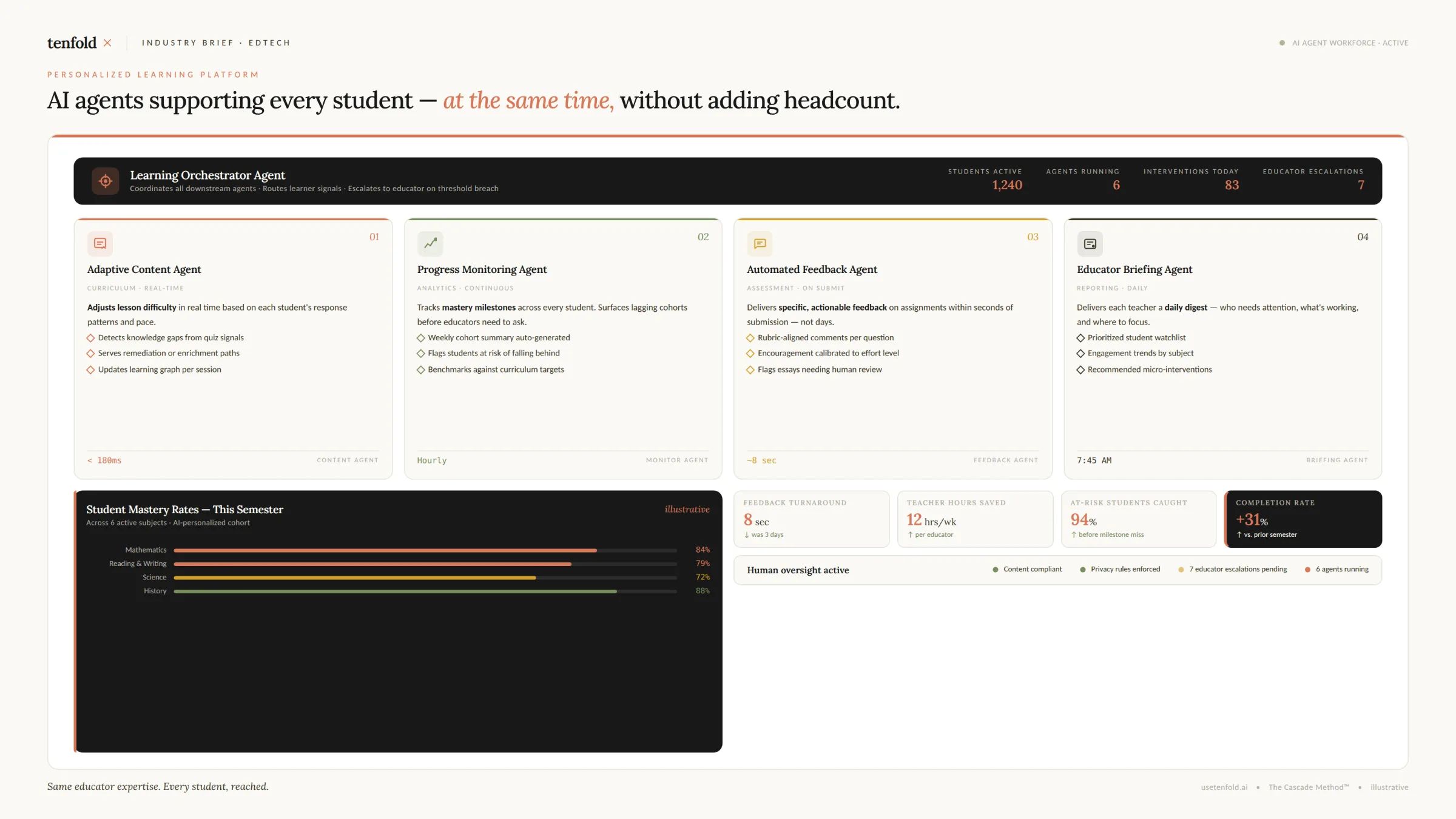
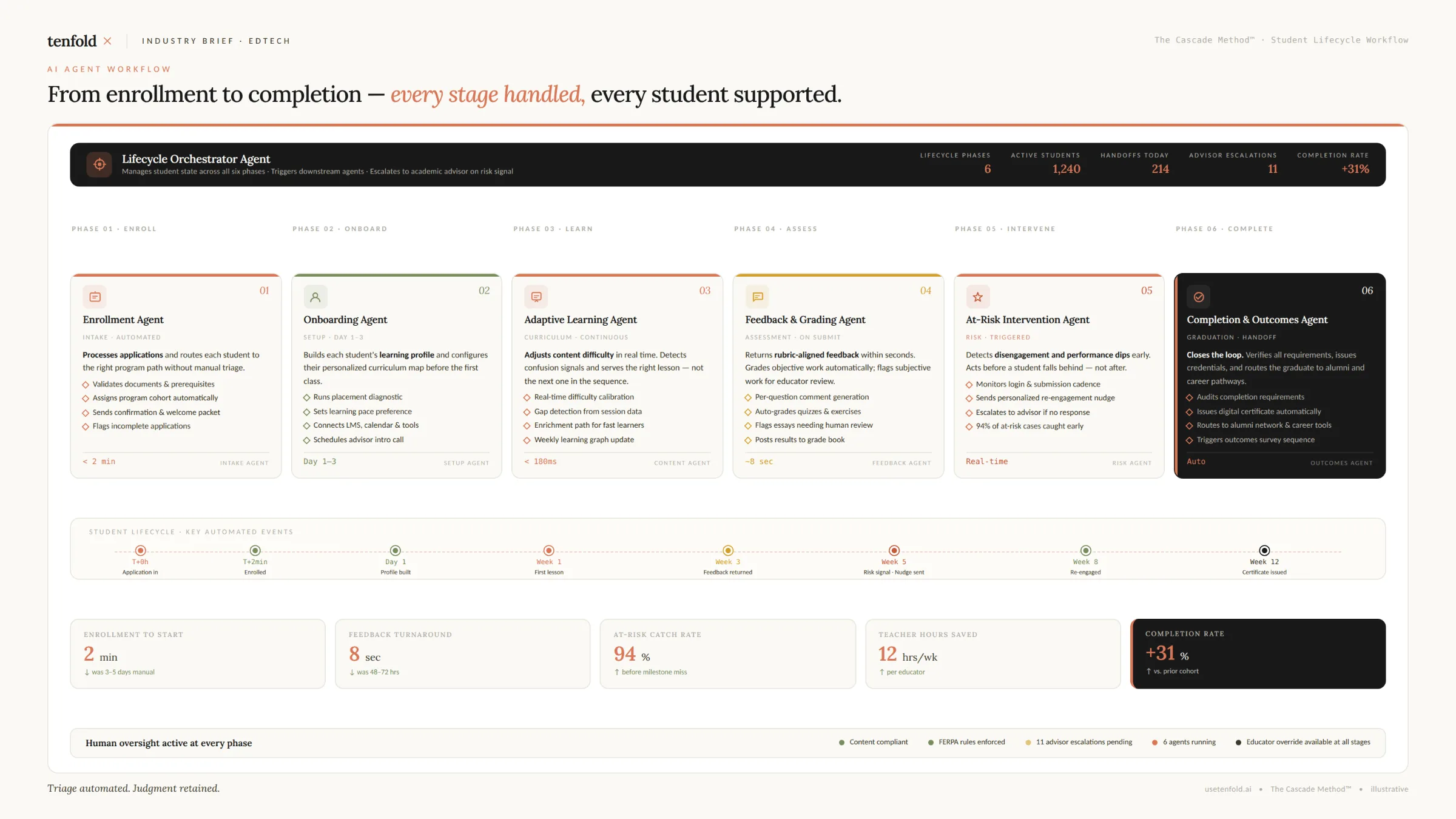
Student support agents that monitor engagement signals, identify students falling behind, and proactively escalate or intervene before they disengage entirely.
Admissions and enrollment agents that handle thousands of concurrent inquiries. According to Enrollify, AI agents are already helping colleges automate responses to thousands of prospective student inquiries — from application deadlines to financial aid questions — instantly and accurately, freeing admissions staff for higher-value outreach.
Learning management agents that sit inside LMS platforms and deliver individualized learning paths continuously. According to Springs, the integration of AI agents into LMS platforms allows for significant personalization, where students receive tailored content and support based on their performance — and these agents assess student progress, offer instant feedback, and guide learners through complex subjects.
Administrative agents that automate routine functions like grading, scheduling, and attendance, so that institutions benefit from data-driven insights into student performance without adding headcount.
The bottleneck isn't AI capability. It's that most EdTech organizations aren't yet structured to delegate to it. Building an agent-first operating model — with clear decision boundaries, human escalation logic, and continuous feedback loops — is what separates institutions that extract full value from AI from those still running expensive point solutions.
At Tenfold, this is exactly the model we implement. Not tools layered on top of broken workflows. Agents designed around the outcome, with the operational architecture to sustain them.
The Responsibility Layer: What Good AI Adoption Requires
Speed without structure breaks things. The institutions building lasting AI advantage in EdTech are doing three things consistently:
Training educators, not just licensing software. According to Tutorbase, roughly half of U.S. school districts provided AI training to teachers by fall 2024 — but 68% of teachers still said they didn't receive training on how to use AI tools. Licensing a platform is not an implementation. Educator readiness is a deployment requirement.
Building human-in-the-loop review into high-stakes decisions. According to 8allocate, while AI grading of essays yields comparable results to human grading, AI still struggles with assessing creativity and nuance — meaning human-in-the-loop review remains essential for complex evaluation. The same principle applies to any AI output that directly affects student outcomes.
Establishing ethical frameworks before scaling. According to a ScienceDirect systematic review, several challenges persist — most notably data privacy and ethical concerns, technological infrastructure constraints, and educator readiness — and the field requires ethical frameworks and robust teacher training to support sustainable, human-centered AI learning ecosystems.
Summary
AI in EdTech is past the inflection point. The market, the adoption data, and the outcome research all point in the same direction: institutions that build structured, agent-first AI operating models — grounded in clear learning goals, responsible data practices, and educator enablement — will define the next decade of education. At Tenfold, we don't just advise on AI strategy. We build and deploy the agent infrastructure that makes that strategy operational. If your institution is ready to move beyond pilots and into production-grade AI, that's where we start.
Ready to move from AI tools to AI agents in your EdTech org? [Talk to Tenfold.](/contact)
Frequently Asked Questions
Q: What is the difference between AI tools and AI agents in EdTech?
A: AI tools respond to individual prompts or tasks — a chatbot answers a question, a platform grades a quiz. AI agents are autonomous systems that execute multi-step workflows over time without requiring a human trigger at each step. In EdTech, agents can monitor student engagement, adapt learning paths, handle enrollment inquiries, and flag at-risk learners continuously — not just when someone asks.
Q: What are the most important AI best practices for EdTech organizations?
A: Start with the learning outcome, not the tool. Define what success looks like for students and educators, then identify where AI creates leverage. Build in data governance and bias auditing from day one, train educators on the systems they'll use, and maintain human-in-the-loop review for any AI output that directly affects student outcomes.
Q: How much time can AI actually save educators?
A: According to verified research compiled by Tutorbase, teachers who use AI tools at least weekly save an average of 5.9 hours per week — the equivalent of six full school weeks per year. That time, when reinvested in instruction and student relationships, is where measurable outcome improvement compounds.
Q: Is the ROI on AI in EdTech proven?
A: Yes, across multiple dimensions. Adaptive AI platforms have shown 2.5x higher student scores compared to non-adaptive courses. Automated grading platforms report 80% reductions in grading time. MagicSchool AI reports teachers saving 7–10 hours per week. The ROI is measurable — the variable is whether the implementation is structured to capture it.
Q: What should EdTech leaders prioritize when deploying AI agents?
A: Three things: clear decision boundaries for what the agent handles versus what escalates to a human; educator and staff training so the systems are actually used; and a continuous feedback loop that lets the agent's performance be monitored and improved over time. Deployment without governance is how good AI goes wrong.
