
Build vs Buy AI Agents: Which Path Makes Sense for Your Business
The build vs buy AI agents decision is one of the most consequential your organization will make in the next 12 months — and most leadership teams are approaching it with the wrong frame. The answer isn't purely about cost. It's about where your competitive edge actually lives, how fast you need to generate value, and whether your internal team is genuinely equipped to build production-grade AI infrastructure.
Quick Answer: For most enterprises, buying or partnering with an AI agent specialist is the faster, lower-risk path to measurable ROI. Building in-house only makes sense when the agent itself constitutes core intellectual property or requires sovereign control over highly regulated data. Everything else is a build trap.
Key Takeaways:
According to Gartner, 40% of enterprise applications will include task-specific AI agents by the end of 2026 — up from less than 5% in 2025. The window to act is narrow.
Forrester predicts 75% of companies that attempt to build their own agentic systems in-house will fail, citing the complexity of multi-model stacks, RAG infrastructure, and niche expertise requirements.
Most enterprise teams underestimate the true total cost of building AI agents by 40–60% — and the ROI clock doesn't start until agents reach production.
The build vs buy debate has a third option: partnering with a specialist. At Tenfold, we've seen this model outperform both pure-build and off-the-shelf approaches for mid-market and enterprise organizations.
The bottleneck isn't AI capability. It's that most organizations aren't yet set up to operationalize it at scale.
Why the Build vs Buy AI Agents Decision Is Different This Time
Every technology generation triggers this same debate. CRM systems, HR platforms, collaboration tools — organizations argued about whether to build or buy all of them. AI agents are different, and the difference isn't incremental.
According to Gartner, 40% of enterprise applications will be integrated with task-specific AI agents by the end of 2026, up from less than 5% in 2025. That's an eightfold increase in 12 months. No other technology category has moved this fast.
The stakes are also different. AI agents don't sit inside one workflow. They touch every workflow in your company — customer operations, sales execution, compliance monitoring, data processing. A bad decision here doesn't just slow one team down. It compounds across the organization.
And the failure data is already in. According to Gartner, over 40% of agentic AI projects will be canceled by the end of 2027 — not because the models fail, but because organizations struggle to operationalize them. Escalating costs, unclear business value, and inadequate risk controls are the primary culprits. These are organizational problems, not technology problems. And they show up whether you build or buy if you don't have a clear strategy.
The Real Cost of Building AI Agents In-House
The build impulse is understandable. You have engineers. You have specific requirements. You've shipped internal tools before. Why not build your AI infrastructure too?
Because production-grade AI agent development is not an internal tool project.
Most enterprise teams underestimate the true total cost of building AI agents by 40–60%. That gap — between what gets budgeted and what the project actually costs — is where AI initiatives quietly die. Not with a cancellation announcement, but with a gradual loss of momentum as the real expenses surface.
Here's what drives that gap:
The Hidden Cost Layers
Data preparation: Industry research indicates that data preparation alone accounts for 60–75% of total project effort in AI and analytics initiatives. It's the most time-consuming and most underestimated component of any agent deployment. Your data isn't as clean, centralized, or accessible as your engineers assume.
Integration engineering: AI agents need to reach across Slack, Salesforce, your ERP, your ticketing system, your knowledge repositories — and every integration requires custom development, testing, and ongoing maintenance. Each connector is a liability without a dedicated team to own it.
Permission architecture: Traditional user permissions break down when an AI agent needs access to documents that general employees can't see directly. You need an entirely new permission model — one that most internal teams have never built.
Model flexibility: The AI landscape changes monthly. New model providers emerge. Capabilities shift. The infrastructure you build today may need to be partially rebuilt in six months. Building means owning that upgrade path permanently.
Governance and compliance: In regulated industries, agents must be auditable, explainable, and documented. These requirements don't add themselves. They require dedicated engineering, legal review, and ongoing monitoring.
Put it together: moving from prototype to production — handling edge cases, building governance, ensuring reliability across thousands of interactions, integrating with multiple enterprise systems — stretches to 6–12 months. Sometimes longer. During that time, the business problem the agent was supposed to solve is still being handled manually. Every month of development is a month of value left on the table.
When Building Makes Sense
Building isn't always wrong. There are legitimate reasons to develop AI agents in-house. The decision just deserves more rigorous analysis than most teams give it.
Build when:
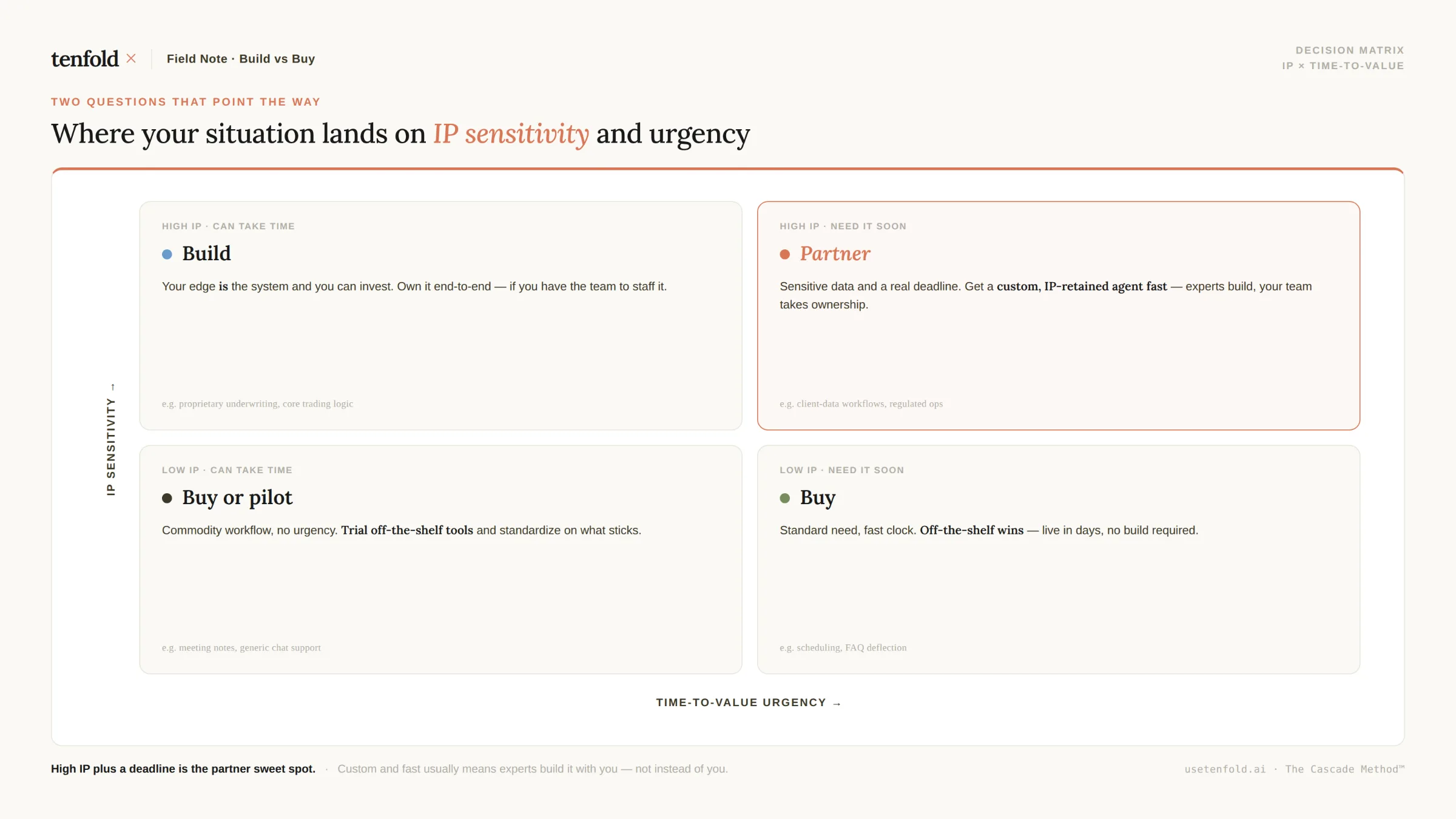
The agent IS your product or IP. If the agent's logic, behavior, or proprietary training data constitutes your core competitive advantage — and competitors replicating it would materially damage your market position — build it. This is rare, but it's real.
You require sovereign data control. In certain regulated industries (defense, government, specific financial services contexts), data cannot leave your environment. Build where sovereignty is legally mandated, not just preferred.
Your use case genuinely doesn't exist in the market. If you've evaluated the vendor landscape and no platform accommodates the specific logic, integrations, and decision-making patterns that define your workflow, a custom build may be the only path.
You have a dedicated, senior AI engineering team already in place. Not engineers who want to learn agentic AI. Engineers who have shipped production AI systems — with governance, observability, and maintenance built into their delivery model.
If none of these conditions apply, the build case is thinner than it looks on the whiteboard.
When Buying — or Partnering — Makes Sense
Buying works. The question is what you're buying.
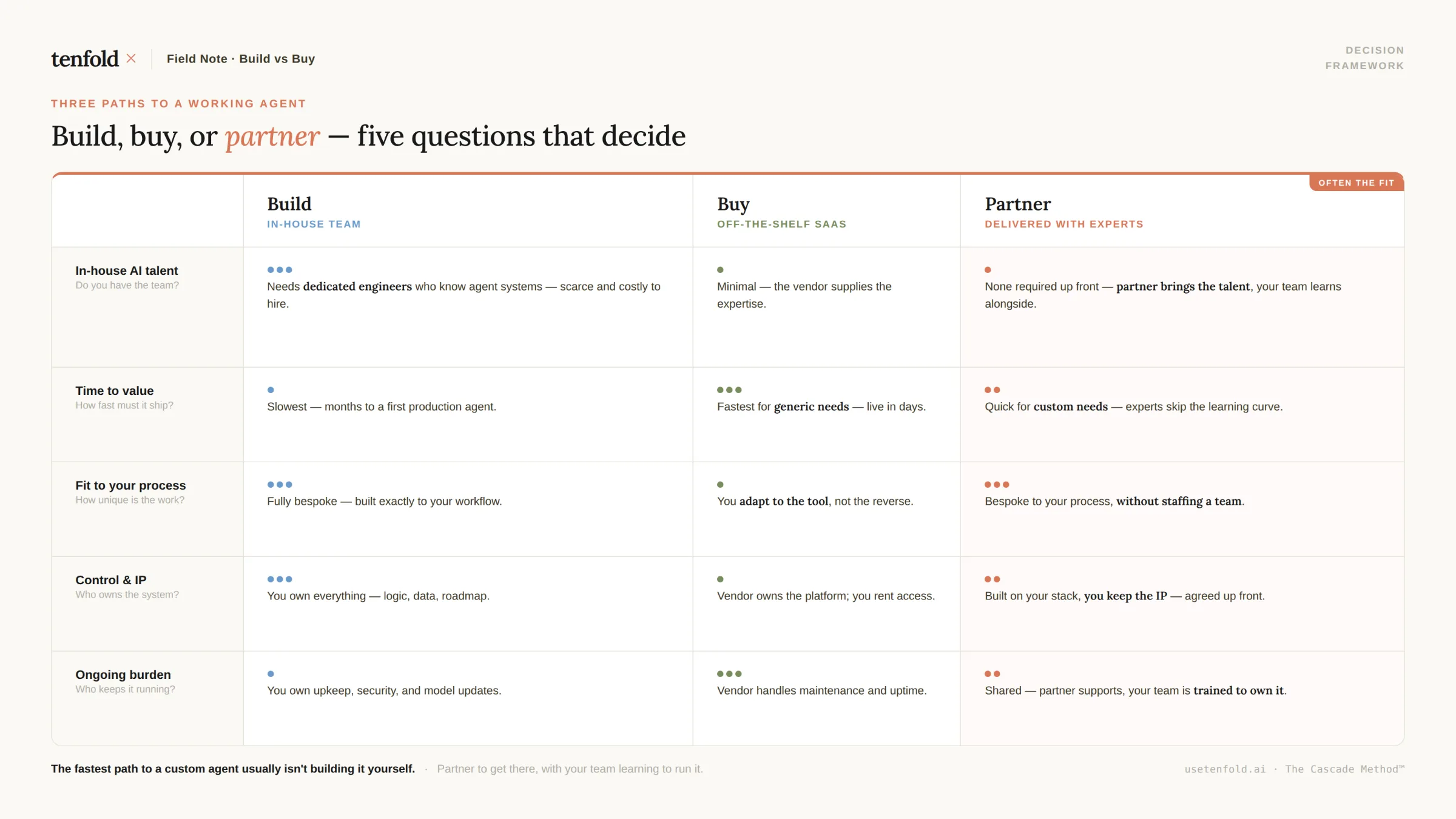
Off-the-shelf AI agents embedded in your existing platforms (Salesforce Agentforce, Microsoft Copilot, Zendesk AI) are optimized for narrow, system-specific tasks. They deploy fast and require minimal internal resources. But they come with real constraints: confined scope, standard performance that competitors can replicate, and limited extensibility for workflows that don't match the vendor's design assumptions.
Buying works well when the job is narrow, quick, and system-specific. If your goal is to reduce support ticket volume inside one platform, a pre-built agent is a reasonable choice.
But if your goal is enterprise-wide workflow transformation — multi-system orchestration, proprietary decision logic, agents that span your full operational stack — a pre-built agent won't get you there.
This is where partnering with an AI agent specialist changes the calculation entirely.
The Partner Model: Speed Without Sacrifice
A specialist implementation partner gives you what building can't deliver on timeline, and what buying can't deliver on depth:
Production deployment in weeks, not quarters. A platform or specialist partner who has already solved the integration, governance, and reliability problems can compress your timeline dramatically. The ROI clock starts faster.
Pre-built governance and security frameworks. You're not starting from scratch on compliance. You're inheriting a tested architecture.
Model flexibility without maintenance burden. When the AI landscape shifts — and it will — your partner's infrastructure adapts. You don't rebuild.
Proven patterns from real deployments. At Tenfold, we've productized the agent-first delivery model that our sister company Inforge runs internally — delivering full Salesforce implementations entirely through AI agents. That's not a product pitch. That's proof that agent-first delivery at enterprise scale is operational, not theoretical.
According to a PwC survey, 73% of respondents believe that their use of AI agents will provide a significant competitive advantage in the next 12 months. The organizations that capture that advantage fastest won't be the ones that waited 12 months to finish an internal build.
The Decision Framework: Four Questions to Guide Your Choice
Before committing to a path, every operations leader and C-suite executive should answer these four questions honestly:
1. Does this agent constitute core IP?
If the answer is yes — and you can articulate exactly why — build it. If the answer is "we want control," that's a governance problem, not a build problem. Governance can be enforced through a partner model.
2. What is your realistic time-to-production?
Not your target. Your realistic timeline, accounting for data preparation, integration complexity, governance requirements, and your team's actual AI engineering depth. If that number exceeds six months, every additional month is competitive ground ceded to organizations that moved faster.
3. What does your team actually know how to maintain?
Building an agent prototype is a different skill set from maintaining a production AI system — handling model drift, integration failures, governance audits, and performance optimization at scale. Be honest about which skill set your team has today.
4. Where does your competitive advantage actually live?
For most organizations, competitive advantage lives in domain expertise, customer relationships, operational execution, and proprietary data — not in AI infrastructure. If AI infrastructure isn't your moat, treating it like one wastes the resources that should be defending the moat that actually matters.
[IMAGE: A 2x2 matrix mapping build vs buy decision against IP sensitivity and time-to-value requirements]
The Hybrid Reality: Most Enterprises End Up Here
The build vs buy framing is useful for initial orientation, but most mature enterprise AI strategies land somewhere in the middle.
A growing consensus among enterprise AI practitioners points to a roughly 80/20 principle: 80% of AI needs are best served by purchased or partner-delivered solutions; 20% warrant custom builds where deep integration or unique IP is critical. Some industries skew this ratio — regulated sectors may lean closer to 60/40 — but the underlying principle holds. Purchasing AI solutions for routine applications frees up the budget and talent to build strategically where it truly matters.
In practice, this looks like: buying pre-built agents for IT support, HR automation, and standard customer service workflows — while building or partnering on the agents that touch proprietary pricing logic, competitive deal analysis, or workflow patterns unique to your operating model.
The organizations that succeed with AI agents won't be the ones that only build or only buy. They'll be the ones that allocate correctly across both — and move fast enough to compound their early advantage.
Summary
The build vs buy AI agents decision isn't a procurement question. It's a strategic one. Most organizations underestimate the true cost and timeline of building in-house, overestimate their internal AI engineering depth, and underestimate how much production-grade governance and integration complexity will slow them down. For the majority of enterprise use cases, partnering with a specialist delivers faster time-to-value, lower total cost of ownership, and better production reliability than an internal build. At Tenfold, we've operationalized this model — and the proof is in the delivery, not the pitch.
If you're evaluating AI agents for your organization and want a clear picture of which path actually fits your context, [get in touch with the Tenfold team](#).
Frequently Asked Questions
Q: How long does it realistically take to build AI agents in-house?
A: Moving from prototype to production typically takes 6–12 months for enterprise-grade AI agents — and often longer. The initial prototype comes together in weeks, but handling edge cases, building governance, ensuring reliability across thousands of interactions, and integrating with multiple enterprise systems is where the timeline extends. During that window, the business problem the agent was supposed to solve is still being handled manually.
Q: What is the total cost of building AI agents in-house?
A: Most enterprise teams underestimate the true total cost of ownership by 40–60%. In 2026, development costs alone range from $25,000 for structured MVP deployments to $300,000+ for enterprise-grade multi-agent systems. Add integration engineering, data preparation, governance infrastructure, compliance layers, and ongoing maintenance — and the actual Year 1 cost is significantly higher than initial budgets reflect.
Q: When does buying AI agents make sense vs. building them?
A: Buying — or partnering with a specialist — makes sense when speed to production matters, when the agent isn't core IP, and when your use case fits within established patterns (customer support, IT service management, sales automation, HR workflows). Building makes sense when the agent constitutes proprietary IP, requires sovereign data control, or involves workflows so unique that no existing platform accommodates them.
Q: What is the biggest risk of building AI agents in-house?
A: The biggest risk is pilot purgatory — agents that never reach production. According to Gartner, over 40% of agentic AI projects will be canceled by the end of 2027, primarily due to escalating costs, unclear business value, and inadequate risk controls. Most of these failures aren't technology failures. They're planning and operationalization failures that a specialist partner is specifically equipped to avoid.
Q: What does a hybrid build vs buy AI agent strategy look like in practice?
A: Most mature enterprise AI strategies use pre-built or partner-delivered agents for standard workflows (support, ITSM, HR, basic sales automation) while reserving custom builds for agents that touch proprietary logic or require deep integration with legacy systems unique to the business. A practical starting framework: 80% of AI needs are best served by existing platforms or specialist partners; 20% warrant custom development where IP or data sovereignty is genuinely at stake.
