
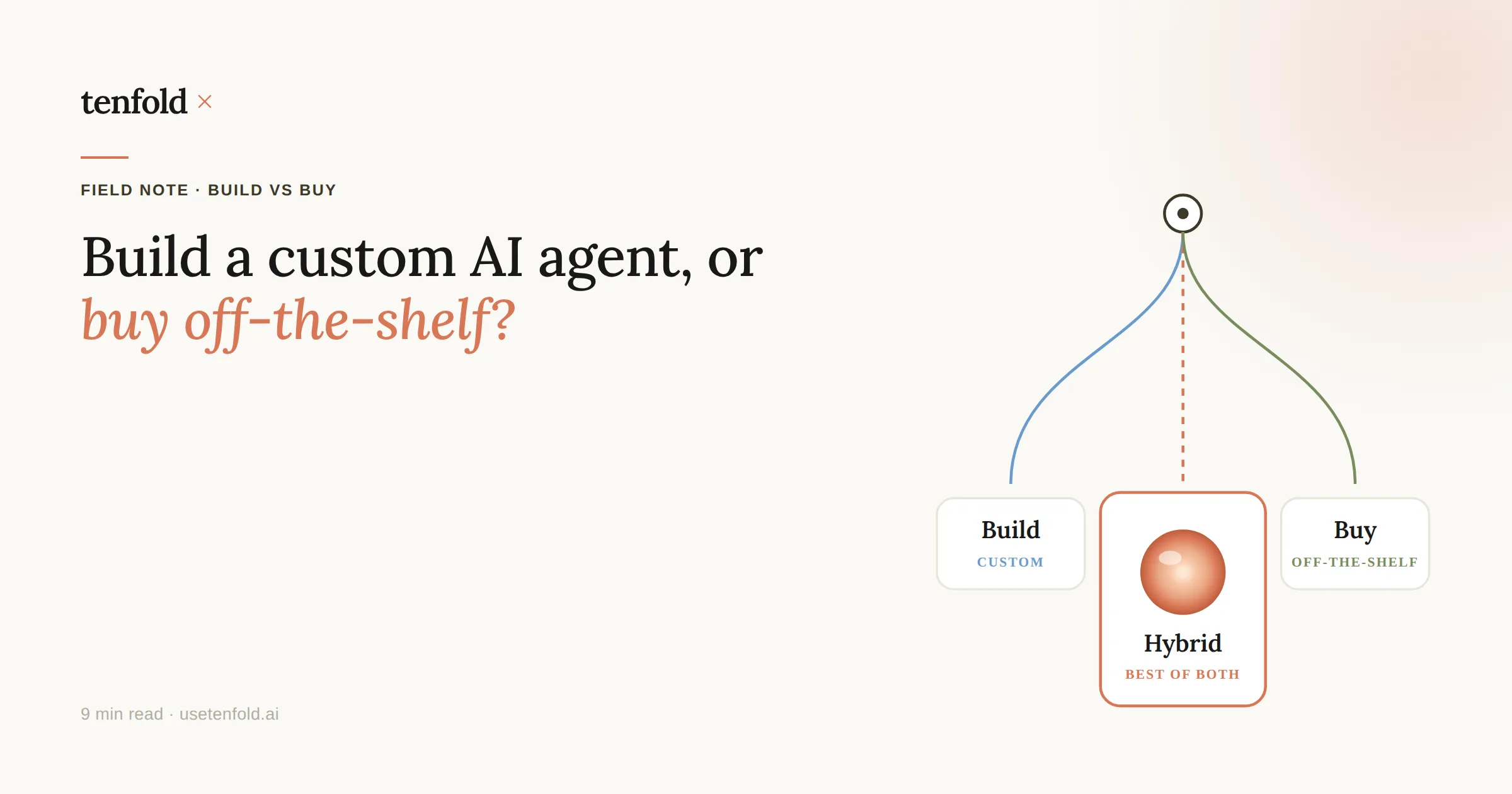
Build vs Buy: Should You Build a Custom AI Agent or Use Off-the-Shelf Tools?
Most organizations frame this as a procurement decision. It isn't. Whether you build a custom AI agent or buy an off-the-shelf tool is one of the most consequential strategic choices you'll make in the next 12 months — and the majority of companies are getting it wrong.
The wrong answer doesn't just waste budget. It costs you months of internal momentum, strains engineering teams, and frequently results in an agent that runs in a silo, disconnected from the workflows where it was supposed to deliver value.
Here's the direct answer: if your workflows are standard and your goal is speed, buy. If your workflows are proprietary, your data is sensitive, or you're building a durable competitive advantage, build — but do it with a partner who has already solved the production-grade challenges you haven't encountered yet.
Key Takeaways:
Only 11% of organizations have AI agents successfully running in production — the gap between pilot and production is where most build decisions collapse.
Off-the-shelf tools deploy in days; custom builds typically take 6–12 weeks minimum, often longer without the right implementation partner.
The real cost of building isn't the upfront engineering spend — it's the permanent operational burden: maintenance, model drift, security hardening, and on-call rotations.
Most enterprises eventually land on a hybrid approach: buy for common workflows, build (or partner to build) where differentiation is the goal.
The build vs buy decision matters far less than whether your agents can function inside governed, observable, and resilient business processes.
Why the Standard Build vs Buy Logic Breaks Down for AI Agents
The calculus that applied to traditional enterprise software doesn't apply here. With conventional SaaS, building internally meant slower delivery but more control. With AI agents, that tradeoff is significantly more complex.
According to Gartner, 40% of enterprise applications will feature task-specific AI agents by 2026, up from less than 5% in 2024. That pace of change is precisely what makes the decision so consequential — and so easy to get wrong.
The field evolves fast. The talent required is specialized and scarce. And the gap between a working prototype and a production-grade enterprise deployment is wider than most teams estimate. According to a survey of over 1,000 enterprise technology leaders, 86% of enterprises need upgrades to their existing tech stack to deploy AI agents — and 62% of practitioners cite security as their top challenge.
Building production-grade AI agents requires specific expertise that most internal engineering teams don't yet have: prompt engineering, model evaluation, guardrail design, hallucination management, agent orchestration, and decision traceability. These skills are different from building a web application or maintaining an ERP integration. The learning curve adds months, and the mistakes made along the way can be expensive in a production environment.
The result? Only 11% of organizations have AI agents successfully running in production. The rest are stuck in pilots, paralyzed by cost overruns, or quietly shelved.
The Real Cost of Building Custom
When companies estimate the cost of building a custom AI agent, they typically calculate: engineer salaries + infrastructure costs + model API costs. That's just the beginning.
Custom AI development costs range significantly depending on scope. A Proof of Concept runs $8,000–$25,000. An MVP lands at $30,000–$80,000. A full production system can reach $100,000–$500,000 or more. According to Clutch's 2025 AI Development Pricing Report, the median mid-market custom AI project cost $87,000 in total — and ongoing maintenance typically runs 15–25% of the original build cost annually.
Then there's the hidden cost that finance teams consistently miss: a University of Michigan, MIT, and Stanford study found that agents consume up to 3,500 times more tokens than simple chat prompts — with wildly different costs every time the same agent runs the same task. The "build" decision doesn't end at deployment. That's where the real cost begins.
In 2023, the gap between frontier model releases was measured in years. In 2025 alone, OpenAI, Google, Anthropic, and Meta each dropped multiple major releases within single-digit months. Every time a major model updates, a custom-built agent may need to be re-evaluated, re-tested, and in some cases partially rebuilt. That's an indefinite engineering cycle most operations teams haven't budgeted for.
For businesses under competitive pressure to automate, this timeline gap is often the deciding factor. Companies that need automation running this quarter cannot afford a 6-month build cycle.
The Real Cost of Buying Off-the-Shelf
Buying is almost always cheaper in the short term. Managed AI platforms can be deployed in days, with monthly subscription costs ranging from a few hundred to a few thousand dollars depending on usage. There's no hiring cycle, no model evaluation overhead, no infrastructure to maintain.
Off-the-shelf tools win on speed and upfront cost. According to Gartner's 2025 Technology Adoption Report, 68% of mid-market companies that deployed off-the-shelf AI tools reported measurable productivity gains within 90 days, compared to only 31% of companies that attempted custom builds without a clear AI strategy first.
But the math changes at scale — and the limitations emerge at process boundaries.
Agents confined to a single application struggle when business processes span multiple systems or require coordinated oversight. Decision logic within domain-specific agents remains localized. Context does not travel easily across the broader process. Without orchestration, purchased agents enhance discrete tasks but rarely influence overall business outcomes.
There's also the vendor lock-in risk. If your workflows require deep customization that vendor platforms can't support, you'll end up building anyway — making the earlier buy decision a sunk cost. And because off-the-shelf tools are available to every competitor in your market, they offer zero differentiation. Your competitors have access to the same functionality on day one.
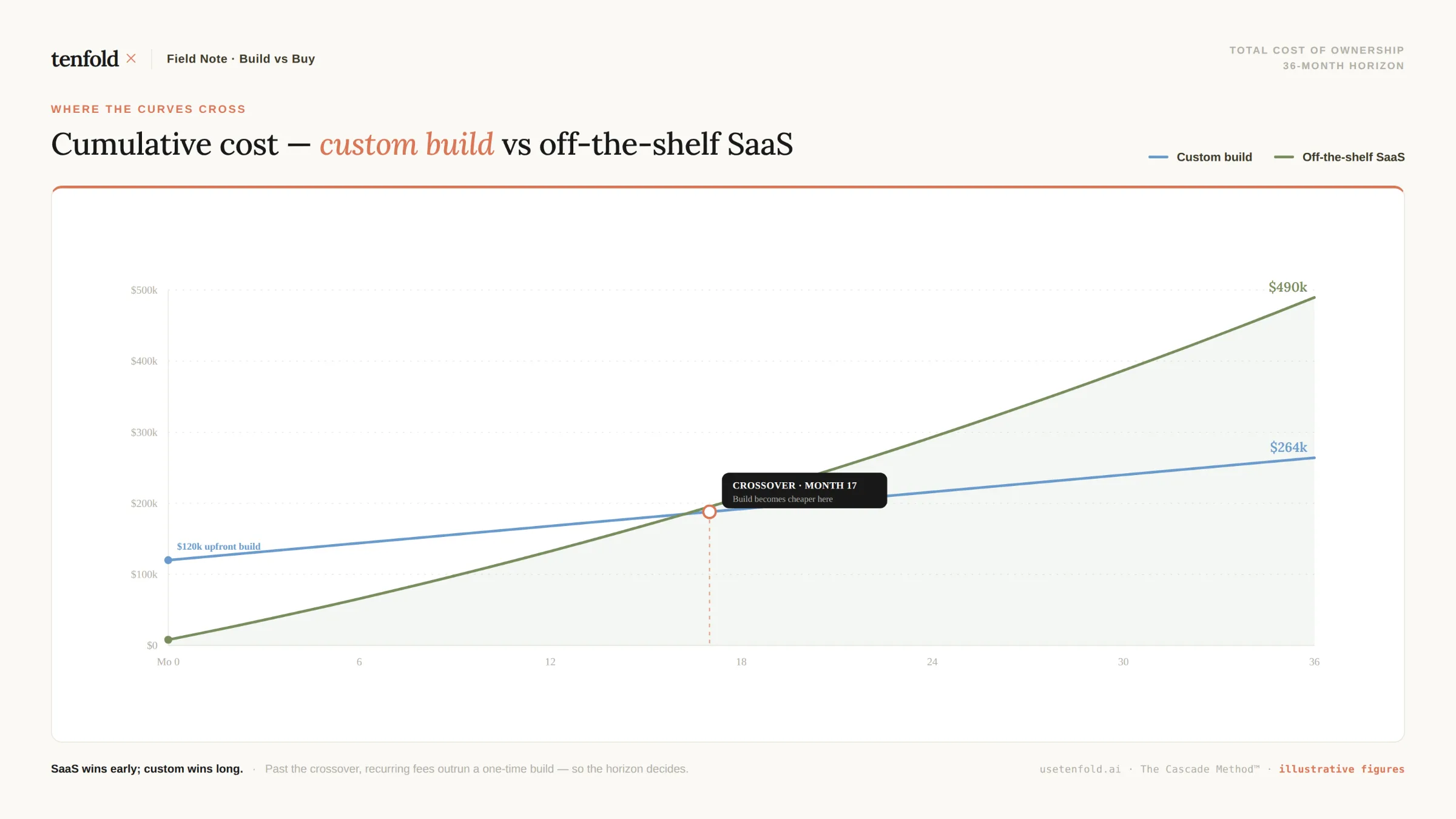
Licensing, integration fees, user limits, and customization overages often add up over time, making off-the-shelf solutions more expensive than they initially appear. A 200-user SaaS tool at $200/seat costs $480K over two years — a well-scoped custom build often breaks even within 18–24 months.
When to Build: Four Clear Signals
Building gives you flexibility and ownership. It's how enterprises create agents that drive competitive advantage. But it's the right call only in specific circumstances.
Build when:
1. Your Workflows Are Proprietary
If your competitive edge lives in how you operate — your sales process, your delivery model, your customer logic — a generic agent won't reflect it. A model trained on your data and tuned to your workflows will always outperform a general-purpose tool in those specific contexts.
2. Your Data Is Sensitive
Regulated industries — healthcare, finance, insurance, legal — often cannot legally or safely send sensitive data to third-party SaaS platforms. Custom agents, deployed in your own infrastructure, give you control over data residency, access governance, and audit trails.
3. You're Crossing System Boundaries
Off-the-shelf agents operate within a parent system. If your workflows span CRM, ERP, support platforms, and proprietary databases, purchased agents will hit hard limits fast. Custom agents can connect across multiple systems — not just one.
4. The Agent IS the Product
If the AI capability itself is what you're selling or what creates your market advantage, building is justified. But only with the talent, time, and governance maturity to support it — and ideally, an implementation partner who's already navigated the production challenges.
When to Buy: Four Clear Signals
Buying typically involves adopting prebuilt copilots or domain-specific agents embedded within a specific platform. For standardized tasks, this demonstrates value relatively quickly.
Buy when:
1. Your Use Case Is Standard
Customer service routing, IT ticketing, document summarization, scheduling — these are solved problems. Buying a proven platform gets you to production faster and at a fraction of the cost of building from scratch.
2. Speed Is the Priority
If you need automation running this quarter, a managed AI platform is the only realistic path. Buying gets you live in days to two weeks. Building takes months minimum — and that's before the production hardening phase.
3. Your Engineering Team Is Needed Elsewhere
Every engineer hour spent building AI infrastructure is an hour not spent on your core product. The question isn't whether your team can build AI infrastructure. It's whether that's the best use of their time.
4. You're Validating Before Committing
Pre-built agents let you validate whether AI actually solves your problem before you've sunk significant costs into a custom build. Start with off-the-shelf, prove the ROI, then invest in the custom layer where differentiation matters.
The Third Path: The Hybrid Model Most Enterprises Land On
The binary framing — build or buy — hides a deeper issue. For most enterprises, the decision doesn't resolve cleanly in one direction. It evolves into a blended strategy shaped by regulatory exposure, process criticality, and internal capability.
Most enterprises buy AI infrastructure foundations and build proprietary orchestration layers on top. Buy for common workflows — IT support, HR automation, standard customer service. Build (or partner to build) for industry-specific, high-value tasks where differentiation is the goal.
This isn't compromise. It's architecture.
At Tenfold, this is exactly the model we implement with clients. We use proven foundational infrastructure where it accelerates delivery — and build purpose-specific agent logic where your workflows require it. The proof is in Inforge, our sister company, which now delivers full Salesforce implementations entirely through AI agents. Not as an experiment. As the standard operating model, every day.
The lesson every company we've worked with that chose to buy has learned: their competitive advantage wasn't AI infrastructure. It was their product, their customers, their domain expertise. The infrastructure is the means. The business outcome is the point.
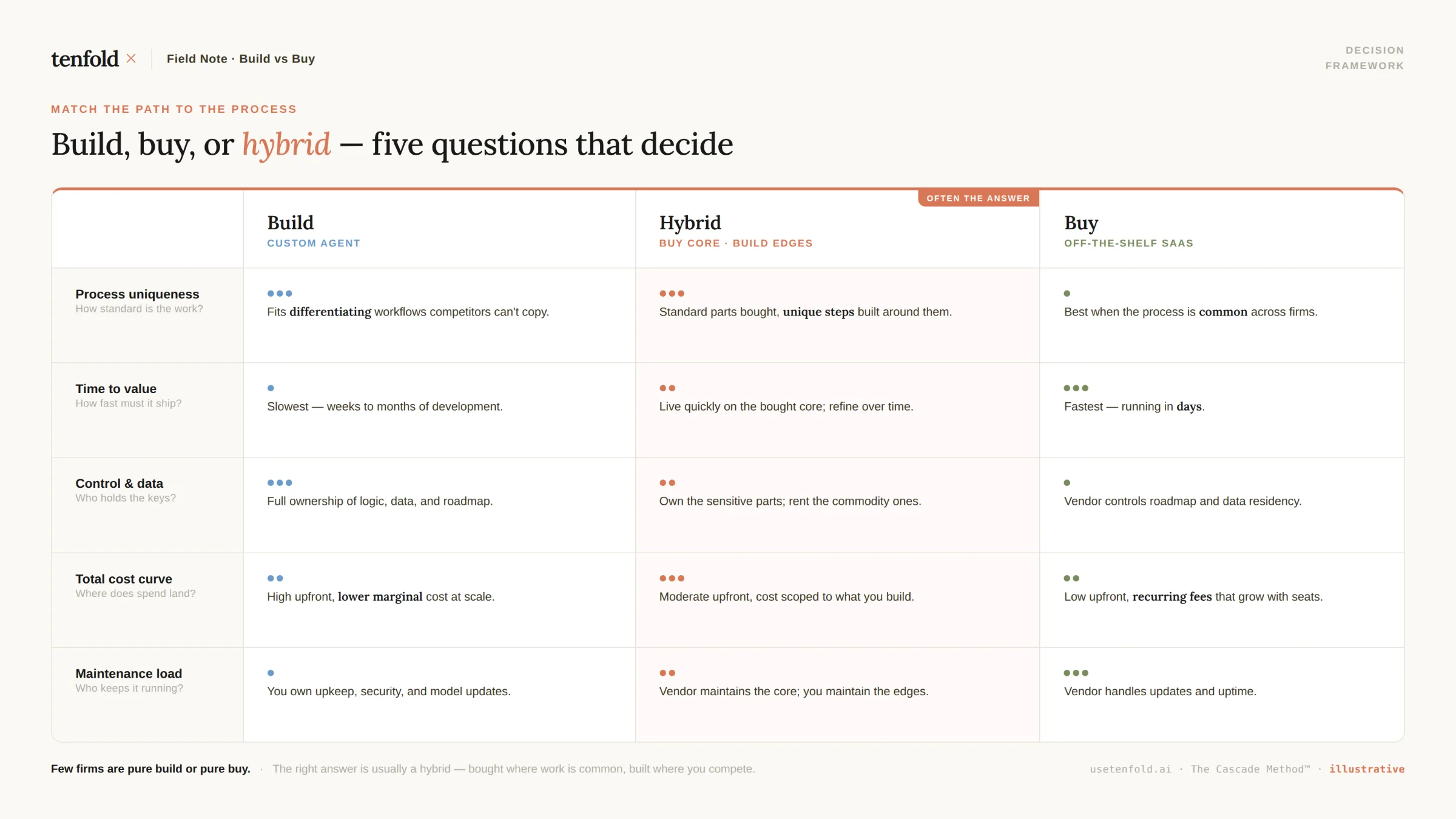
A Decision Framework: Five Questions Before You Commit
Before choosing a path, answer these five questions honestly:
1. Is the agent's function core to how we differentiate — or just something we need done efficiently? If it's the latter, buy.
2. Do our workflows span multiple systems, or are they confined to one platform? Multi-system workflows need custom orchestration.
3. What is our actual engineering capacity right now — and what is the opportunity cost of redirecting it? Be honest about this one.
4. Are we in a regulated industry where data residency and audit trails are non-negotiable? If yes, build with governance baked in from day one.
5. Do we need this running in weeks or quarters? If weeks, buy. If quarters, a custom build is viable.
According to MIT's July 2025 study, 95% of enterprise AI investments move no revenue needle at all. Only 5% deliver measurable P&L impact. The gap between that 5% and the rest is mostly about the strategic decisions made up front — build, buy, or partner — not the technology itself.
Summary
The build vs buy AI agent decision is not a technology question. It's a strategic one. Off-the-shelf tools win on speed and upfront cost for standard workflows. Custom agents win on differentiation, data control, and long-term ROI for proprietary or regulated use cases. Most enterprises land on a hybrid — and the ones that get it right start with a clear problem, not a tool.
At Tenfold, we've built our entire delivery model around agent-first implementation. We don't sell AI experiments. We deliver production-grade agent systems — and the proof is Inforge, where full Salesforce implementations are delivered entirely through AI agents, faster and at a fraction of traditional cost. If you're evaluating where to start, we'll give you a direct answer, not a pitch.
Frequently Asked Questions
Q: How long does it take to build a custom AI agent vs buying off-the-shelf?
A: Off-the-shelf AI platforms deploy in days to two weeks. A focused custom AI agent typically takes 2–6 weeks for a basic build and 3–6 months for a full production-grade system. The timeline difference is one of the most common reasons organizations default to buying — and then rebuild custom later when the limitations surface.
Q: What does a custom AI agent actually cost to build?
A: Custom AI agent development costs range from $8,000–$25,000 for a proof of concept, $30,000–$80,000 for an MVP, and $100,000–$500,000+ for a full enterprise deployment. Ongoing maintenance runs 15–25% of the original build cost annually. Off-the-shelf tools range from $500–$5,000/month for most mid-market use cases.
Q: Can't we just have our engineering team build it internally?
A: Most enterprise engineering teams are strong software engineers — that doesn't automatically make them strong AI engineers. Building reliable, production-grade AI agents requires specific expertise: prompt engineering, model evaluation, guardrail design, hallucination management, and agent orchestration. The learning curve adds months, and mistakes in a production environment are expensive. The more important question is whether that's the best use of your engineering capacity right now.
Q: What's the biggest risk of buying off-the-shelf AI agent tools?
A: Three risks dominate: vendor lock-in (if your workflows outgrow the platform, you're rebuilding anyway), lack of differentiation (your competitors have access to the same functionality), and agent silo risk (purchased agents rarely work across system boundaries, limiting their impact on end-to-end business outcomes).
Q: Is a hybrid approach actually viable, or is it just a compromise?
A: It's not a compromise — it's the architecture most high-performing enterprises use. Buy proven foundational infrastructure for standard workflows. Build purpose-specific agent logic for the processes where your competitive advantage lives. The key is having an implementation partner who can design the orchestration layer that makes both work together.
