
Building AI Agents That Actually Integrate With Your CRM: A Practical Guide for Fintech and Hospitality
Most AI agent projects in fintech and hospitality don't fail because the AI isn't capable enough. They fail because the CRM was never ready to work with it. Fragmented data, legacy system gaps, and bolt-on integrations mean your agent is flying blind — making decisions on incomplete customer records and writing back to fields that don't map to anything actionable.
The good news: CRM-integrated AI agents that actually work follow a repeatable pattern. Fix the data layer first, define the agent's authority, connect it bidirectionally to your CRM, and scope the first pilot to one trigger and one outcome. That's the whole playbook — and it applies whether you're running a neobank compliance workflow or a hotel revenue desk.
Key Takeaways:
The bottleneck isn't AI capability. It's that most orgs aren't yet set up to delegate to it — fragmented CRM data is the primary reason agent pilots stall.
Fintech and hospitality face distinct CRM integration challenges: compliance-grade data requirements in fintech, and multi-system property stacks (PMS, POS, CRM) in hospitality.
A phased implementation — one data trigger, one automated action, one measurable outcome — produces production-grade agents faster than big-bang deployments.
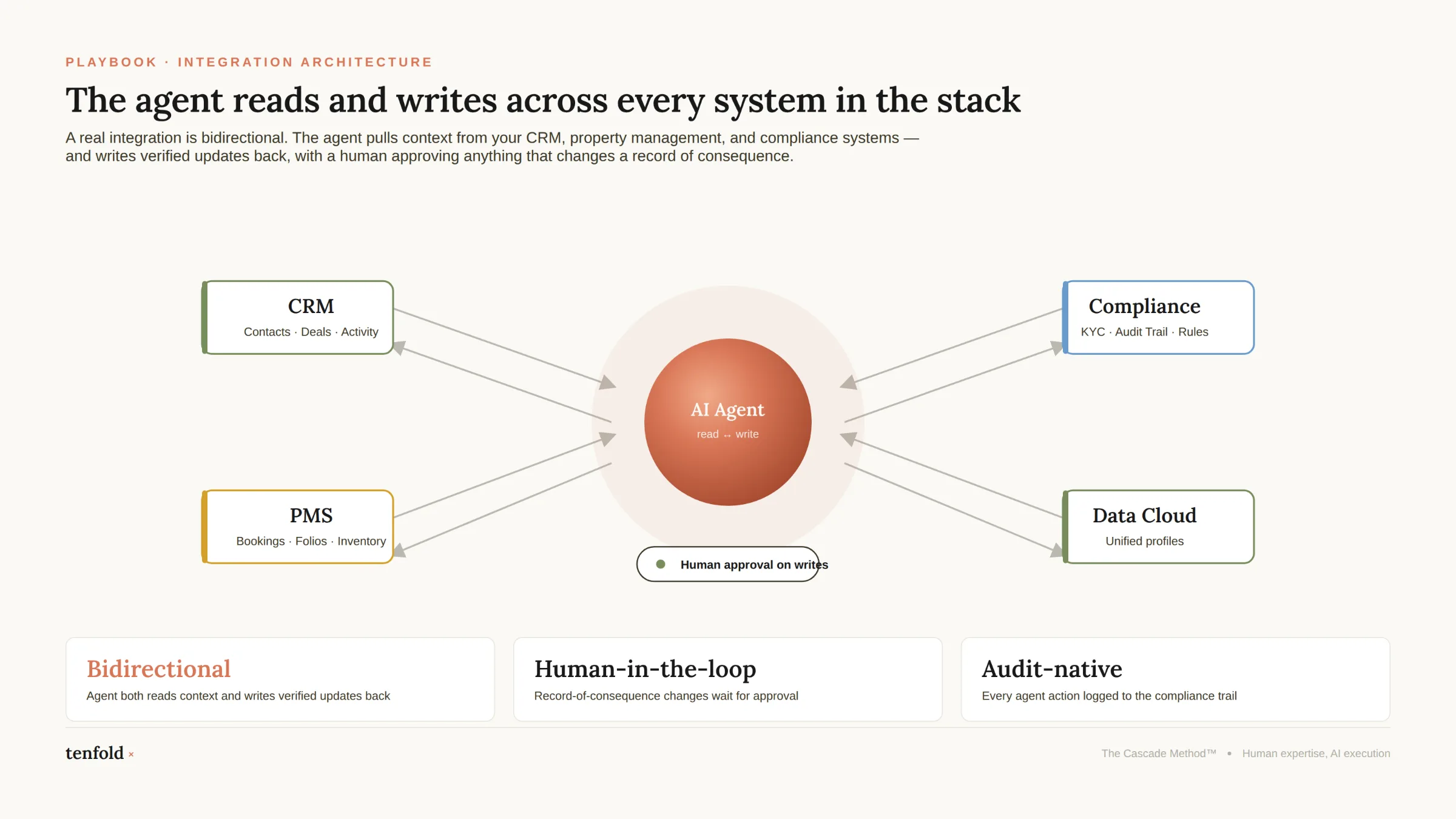
Bidirectional CRM sync is non-negotiable. An agent that reads but doesn't write back creates information asymmetry your team will spend months correcting.
According to Salesforce's State of Sales, sales reps spend only 28–30% of their time actually selling, with 70% consumed by administrative tasks — exactly the work agents should own.
Why CRM Integration Is the Hard Part (Not the AI)
AI agents in CRM are autonomous software routines that execute multi-step workflows — creating records, routing leads, triggering follow-ups, and surfacing compliance flags — without human input at each step. The technology is mature. The integration is where projects break down.
According to CMSWire's 2025 State of Digital Customer Experience report, 28% of businesses cite siloed systems, technology integration challenges, and fragmented customer data as a top-three barrier to effective AI deployment — nearly as significant as budget constraints. That number tracks with what we see in practice: organizations spend enormous effort on model selection and prompting, then discover their CRM data is too inconsistent for the agent to act on reliably.
The pattern is predictable. Duplicate records within CRM systems reach up to 20%, creating confusion in customer records and impeding operational efficiency. Meanwhile, 65% of companies still rely on manual methods such as spreadsheets to scrub their data — a gap that surfaces immediately the moment an AI agent tries to read or write structured records at volume.
The fix isn't a new CRM. It's a data-readiness audit before any agent is deployed — and a clear architecture for what the agent is authorized to read, update, and escalate.
The Fintech CRM Integration Challenge: Compliance Is the Constraint
In fintech, the CRM isn't just a sales tool. It's a compliance surface. Every customer record carries KYC status, risk tier, transaction history, and regulatory flags — and any AI agent operating in this environment needs bidirectional access to all of it.
The traditional approach to KYC — manual reviews, rule-based routing, periodic check cycles — is structurally incompatible with modern volumes. According to a McKinsey report, traditional KYC processes can cost financial institutions $60M–$500M annually. AI agents represent the only scalable path out of that cost structure.
The architecture that works in fintech looks like this: a data mediation agent reads CRM records, enriches them with third-party identity and risk data, and writes structured compliance records to the KYC platform in real time. Bidirectional sync agents then propagate adverse findings back to CRM records as risk flags, preventing relationship managers from acting on stale customer profiles.
This is not speculative. By 2026, industry projections estimate that 70% of new account onboarding will be fully automated — with AI agents handling document verification, risk scoring, and CRM record creation as a single orchestrated workflow.
The governance layer matters just as much as the technical layer. The OCC expanded its examination scope in late 2025 to include AI model risk management. The EU AI Act classifies certain high-risk AI applications in financial services and — while it does not address agentic systems specifically — the trajectory is clear: regulators want explainability, audit trails, and human oversight mechanisms built in from the start, not retrofitted after deployment.
The fintech organizations that are deploying agents well treat the human-in-the-loop not as a workaround for AI limitations, but as a deliberate design choice. Agents handle volume. Humans make calls that require judgment — and they review enough of the agent's work on a sample basis to catch model drift before it becomes a compliance problem.
Three non-negotiable CRM integration requirements for fintech AI agents:
1. Bidirectional sync — risk flags written by the compliance agent must surface in the CRM record the relationship manager sees next time they open the account.
2. Audit trail by default — every agent action needs a timestamped, readable log. Regulators will ask for it.
3. Permissioned write access — the agent should only update fields it owns. Write access to unrelated record types is a governance liability.
The Hospitality CRM Integration Challenge: You Have Four Systems, Not One
Hospitality teams face a different structural problem. The CRM isn't the only system of record — it competes with the property management system (PMS), the point-of-sale (POS), the central reservation system (CRS), and a half-dozen channel managers. Guest data is fragmented across all of them.
According to industry analysis, operators using AI tools integrated with their PMS showed 30–50% faster task completion. But integration is the prerequisite. An AI agent that can't read booking history from the PMS or upsell preferences from the POS will produce generic interactions that undermine the personalization promise entirely.
The revenue management angle is where CRM-integrated agents deliver the most measurable ROI in hospitality. A unified system architecture — where the revenue management system, CRM, and PMS share real-time data — eliminates data silos and reduces the manual interventions that slow pricing decisions. AI agents can then execute dynamic pricing adjustments, segment-specific promotional triggers, and loyalty program updates as a single automated workflow, without a revenue manager touching a screen.
A 2024 case study published on ResearchGate demonstrated that AI-driven service orchestration across integrated hotel systems reduced check-in times by nearly 20% and boosted customer satisfaction scores by 15% — not through a new front-desk product, but through better data flowing between existing systems.
On the guest experience side, the integration model that works connects AI agents to both the PMS (for arrival, stay, and departure data) and the CRM (for preference history, loyalty status, and prior service requests). When those two data sources are unified, an agent can proactively route housekeeping, flag VIP arrivals, and trigger personalized pre-arrival messaging from a single event trigger — a confirmed check-in. When they're siloed, the agent produces the same generic message your team has been sending for fifteen years.
Three non-negotiable CRM integration requirements for hospitality AI agents:
1. PMS-CRM real-time sync — guest profile updates in the PMS (room preferences, dietary flags, service requests) must flow to the CRM within minutes, not nightly batch cycles.
2. Unified guest identity — if your systems use different identifiers for the same guest, your AI models will fail before they start. A consistent guest ID across PMS, POS, and CRM is a prerequisite, not a nice-to-have.
3. Write-back for post-stay data — post-checkout feedback, NPS scores, and service issue logs need to route back into the CRM guest record. That's the training signal for the next stay.
How to Build the Integration: A Phased Approach That Actually Reaches Production
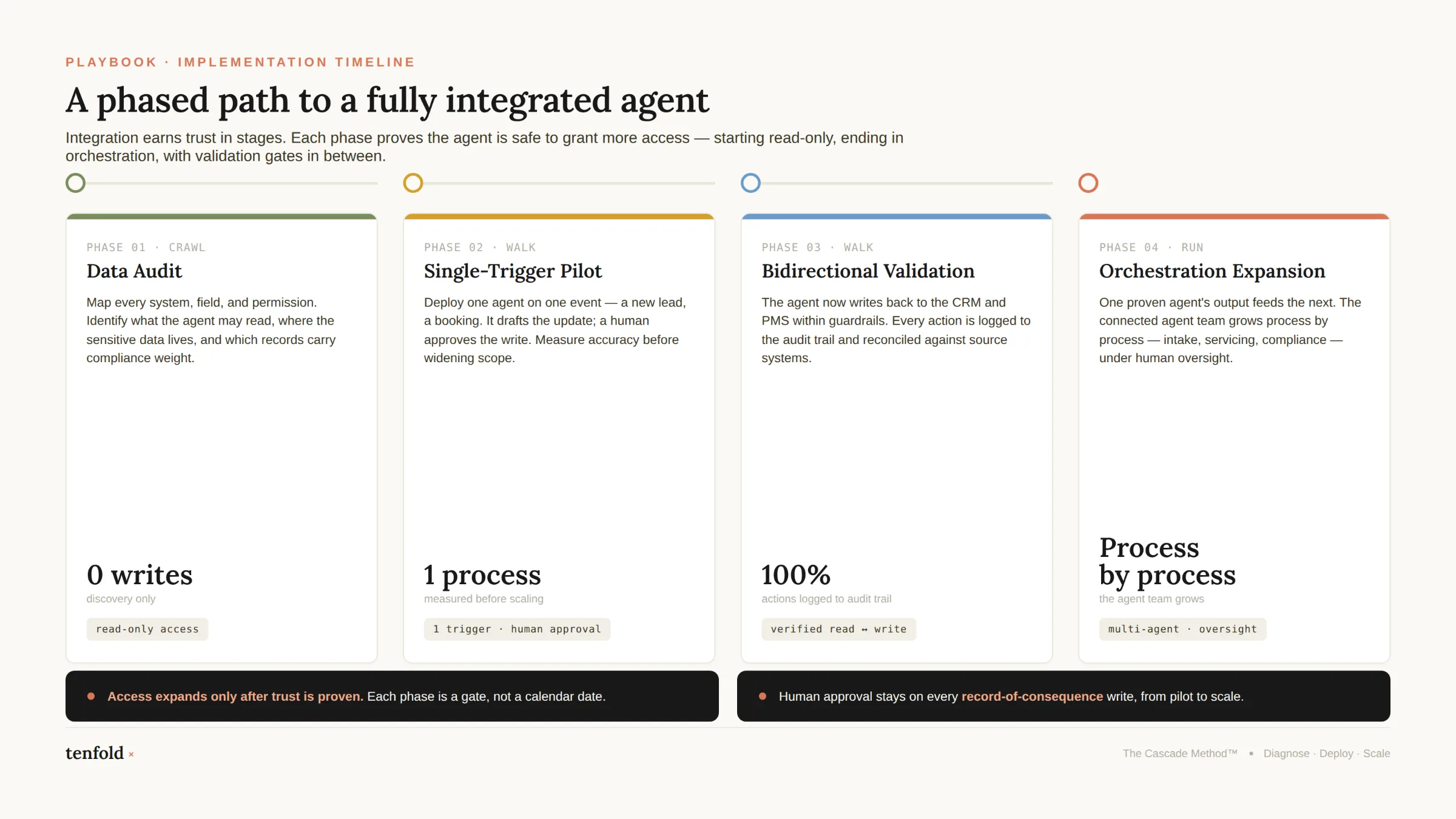
The reason most AI agent projects stay in pilot is scope. Teams try to build the full orchestration layer before they've proven the core data connection works. The organizations that reach production fastest do the opposite — they scope ruthlessly and expand from a working foundation.
Phase 1: Data readiness audit (Week 1–2)
Before writing a single agent prompt, audit your CRM for the four issues that kill integrations:
Duplicate records — identify and merge before the agent trains on conflicting data
Missing field population — which fields the agent needs to read are empty for >20% of records?
Schema consistency — do your PMS/compliance/POS systems use the same field names and data types as your CRM?
Write permission mapping — which fields should the agent own? Which require human approval before update?
This audit takes two weeks and prevents six months of rework. It is not optional.
Phase 2: Single-trigger pilot (Week 3–6)
Scope ruthlessly. One data trigger. One automated action. One measurable outcome. For fintech, this might be: new account application submitted → agent reads CRM for existing relationship history → enriches with third-party KYC data → creates structured compliance record → flags edge cases for human review. For hospitality: booking confirmed → agent reads CRM guest profile → generates personalized pre-arrival message with relevant upsells → logs sent message back to CRM.
Neither of these requires a multi-agent orchestration layer. Both are production-deployable in four to six weeks when the data layer is clean.
Phase 3: Bidirectional sync validation (Week 6–8)
Before expanding agent scope, validate that every agent action is writing back to the CRM correctly. Check for field mapping errors, timestamp mismatches, and cases where the agent action completed but the CRM record didn't update. These are the bugs that look minor in a pilot and cause serious data quality problems at scale.
Phase 4: Expand to orchestration (Week 8+)
Once Phase 3 is clean, you have the foundation for multi-agent orchestration — where one agent gathers customer intelligence, a second executes the outbound action, and a third monitors outcomes and surfaces anomalies. According to Salesforce research, companies using integrated workflows see up to 40% improvement in operational efficiency — but that number assumes the underlying data architecture is sound.
What Good Looks Like: Agentforce in Production
Salesforce's own deployment of Agentforce across its customer support ecosystem is the clearest public benchmark for what CRM-integrated agents can deliver at scale.
In just over one year, Agentforce handled 3 million support conversations, contributing to measurable results: year-over-year support caseload dropped by 8%, representing more than 170,000 fewer cases. The same deployment enabled Salesforce to deliver live, synchronous chat support in seven languages — something it had never achieved in its 27-year history.
The broader platform numbers confirm the direction of the market. Agentforce ARR surpassed $500 million, growing 330% year-over-year — making it Salesforce's fastest-growing product in company history. By 2027, 50% of all service cases are expected to be resolved by AI, up from 30% in 2025, according to Salesforce's State of Service data.
For enterprise teams evaluating whether to build on Salesforce's native agent layer versus a custom orchestration stack: the answer depends on your existing CRM investment. If you're already on Salesforce, Agentforce's native data access — reading and writing directly to CRM records without middleware — removes the integration layer that kills most agent projects. That's not a pitch for Agentforce specifically. It's a structural argument for native-first architecture wherever it's available.
At Inforge, we've found that the single highest-ROI decision in any AI agent implementation is choosing an architecture that minimizes the distance between the agent and the authoritative data source. Every middleware layer you add is a point of latency, a schema translation risk, and a failure surface that your team will be debugging at 11pm when the agent starts misfiring.
The Mistake That Derails Most CRM Agent Projects
The most common failure mode isn't technical. It's organizational.
Teams add AI agents to broken data infrastructure and assume the AI will compensate. It won't. According to Forrester, incomplete data sets are among the top reasons AI implementations underperform. An agent trained on a CRM where 30% of accounts have missing email fields, 20% have duplicate records, and post-interaction notes are entered inconsistently will produce outputs that are confidently wrong — which is worse than no output at all.
The second most common failure mode is one-directional integration. Teams build agents that read from the CRM but don't write back to it. This creates information asymmetry: the agent acts on data, but the action doesn't update the record, so the next agent interaction — or the next human interaction — starts from a stale state. In fintech, this is a compliance risk. In hospitality, it means your guest's preference for a high-floor room never makes it into the profile that determines their next booking experience.
Fix the data. Build bidirectional. Scope small. Expand from a working base. That's the whole framework.
Summary
CRM-integrated AI agents are production-ready for fintech and hospitality — but only when the underlying data architecture supports them. The organizations that are seeing real ROI from agent deployments share three traits: they audited and cleaned their CRM data before deployment, they built bidirectional sync so agent actions update the record of truth, and they started with a single well-scoped pilot before expanding to orchestration. At Inforge, we've built our entire delivery model on this principle — AI agents running full Salesforce implementations, not as an experiment, but as the way we operate every day. If your agent pilot is stalled, the problem almost certainly lives in the data layer, not the AI.
[INTERNAL LINK: suggested anchor — "Talk to Inforge about your CRM integration" → link to Inforge contact or services page]
Frequently Asked Questions
Q: What's the most common reason AI agent CRM integrations fail in fintech and hospitality?
A: Fragmented, inconsistent CRM data is the primary cause — not AI limitations. When records are duplicated, fields are unpopulated, or systems use different identifiers for the same customer, agents produce unreliable outputs. A data readiness audit before deployment prevents most integration failures.
Q: Do AI agents need to write back to the CRM, or is read-only access sufficient?
A: Read-only is insufficient for production use. An agent that reads customer data but doesn't update the CRM record after acting on it creates information asymmetry — the next interaction, whether human or automated, starts from a stale state. Bidirectional sync is a hard requirement for agents operating in revenue-critical or compliance-critical workflows.
Q: How long does it take to deploy a CRM-integrated AI agent in a fintech or hospitality context?
A: A well-scoped single-trigger pilot — one data event, one automated action, one measurable outcome — is deployable in four to six weeks when the data layer is clean. Multi-agent orchestration typically follows in weeks eight through twelve. Projects that attempt full orchestration from day one take significantly longer and have higher failure rates.
Q: What Salesforce-specific tools are relevant for AI agent CRM integration?
A: Salesforce Agentforce provides native agent capabilities that read and write directly to CRM records without middleware — removing the integration layer that causes most agent reliability issues. Agentforce ARR grew 330% year-over-year to surpass $500 million, which reflects rapid enterprise adoption. For teams already on Salesforce, native-first architecture is the lowest-risk path to production.
Q: How do regulatory requirements affect AI agent design in fintech CRM workflows?
A: Regulators increasingly require explainability, audit trails, and human oversight mechanisms built into agentic systems — not added after deployment. The OCC expanded its examination scope in late 2025 to include AI model risk management, and the EU AI Act establishes a trajectory toward full auditability for high-risk financial AI applications. Every agent action should generate a timestamped, readable log, and write access should be scoped to fields the agent explicitly owns.
