
Can AI Agents Automate Insurance Claims Processing? What Agencies Need to Know
Yes — AI agents can automate insurance claims processing, and the agencies already deploying them are posting results that are hard to argue with: claims resolution times dropping from 30 days to under 8, cost per claim falling by 30–40%, and fraud detection catching patterns no human adjuster would catch at volume. The question for most agencies is no longer *whether* this technology works. It's whether your organization is set up to deploy it safely, compliantly, and in a way that actually sticks.
Quick Answer: AI agents can handle the majority of routine claims tasks — intake, document verification, coverage checks, fraud flagging, and payout recommendations — autonomously and at scale. For complex or high-stakes claims, the strongest implementations keep a human in the loop for final decisions. The technology is production-ready. The governance, data infrastructure, and regulatory readiness at most agencies are not.
Key Takeaways:
AI agents are cutting claims resolution time by up to 75%, from 30 days to 7.5 days on average, according to BCG research.
Cost per standard claim drops 30–40%, from $40–60 down to $25–36 with AI-enabled workflows.
The NAIC Model Bulletin on AI has been adopted by 24 US jurisdictions as of August 2025 — compliance is no longer optional.
The top adoption barriers are skills/resource gaps (52%), data readiness issues (40%), and regulatory uncertainty (36%).
Agencies that move thoughtfully — with explainable AI, documented governance, and phased rollouts — outperform those that rush to black-box solutions.
Why Insurance Claims Are the Highest-ROI Target for AI Agents
Claims processing is the single most expensive and operationally intensive function inside any carrier or agency. According to McKinsey, claims processing accounts for 70 to 85 percent of an insurer's total premium spend. The average cost to process a single auto claim runs $280 to $420 when you factor in adjuster time, administrative overhead, vendor management, and re-inspection costs.
For a mid-size carrier handling 500,000 claims per year, that's $140–210 million annually — just on operations.
The workflow is also structurally well-suited for agentic automation. Claims follow clear decision trees. The tasks are document-heavy, repetitive, and time-sensitive. And the data signals AI needs — policy terms, damage photos, historical patterns, fraud indicators — are already sitting in systems most agencies already run.
According to V7 Labs, key trends driving this shift include wider adoption of cloud-native platforms, increased customer personalization through digital tools, and the integration of generative AI and AI agents for handling unstructured data — precisely the kind of content that buries human adjusters.
What AI Agents Are Actually Doing in Claims Today
This isn't theoretical. Several carriers have moved from pilot to production and are reporting hard numbers.
Lemonade holds the benchmark: a full claim settled in 2 seconds using its AI system. As of Q4 2025, 55% of all Lemonade claims are fully automated from start to finish, with 96% of first notices of loss taken without any human intervention.
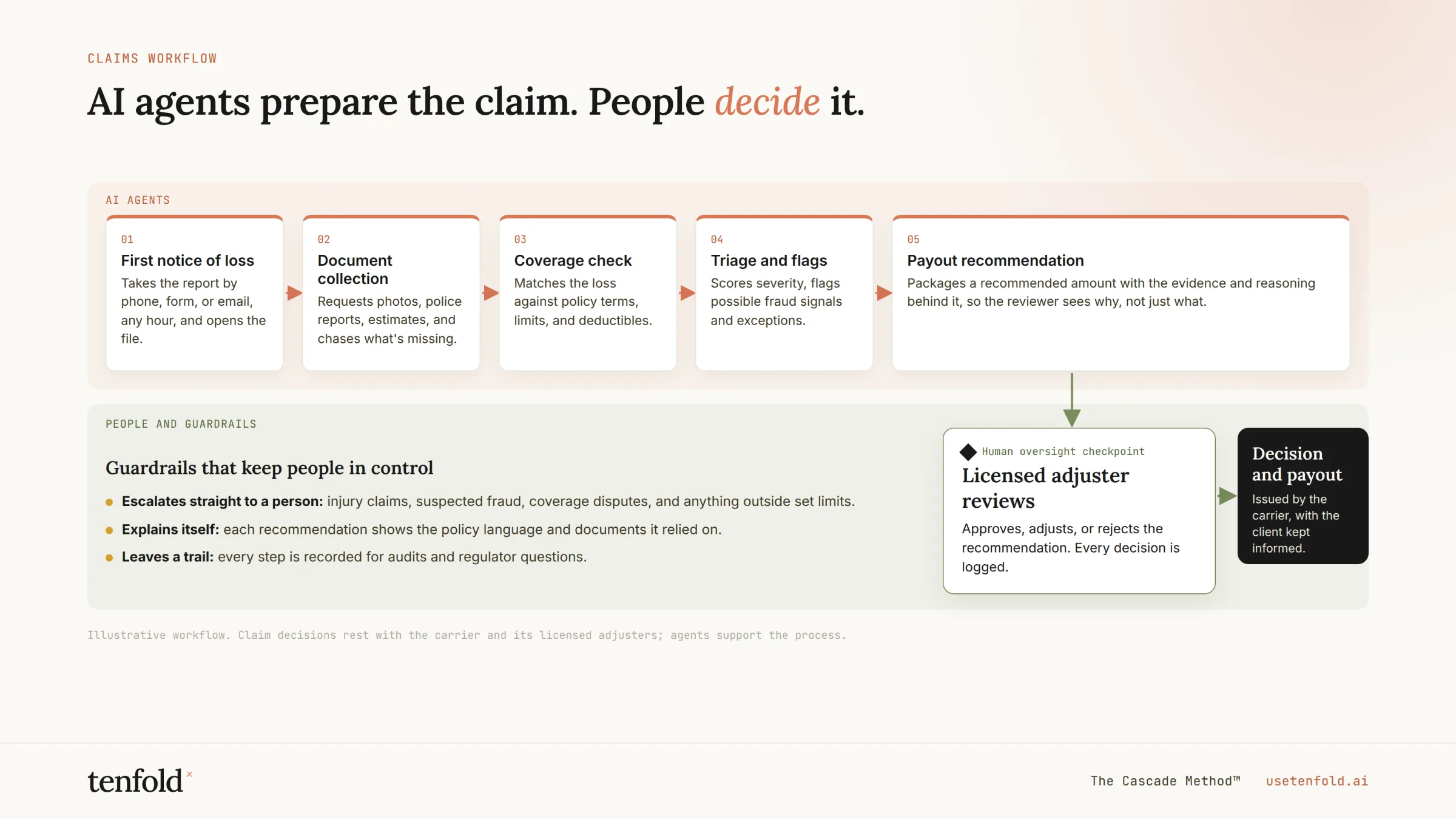
Allianz's Project Nemo is a multi-agent system deployed in Australia in July 2025. Seven specialized AI agents handle everything from coverage verification to fraud detection — each agent owns a distinct step in the claims lifecycle. Processing time dropped by 80%, and a human still approves every payout. That's the architecture agencies should pay attention to: autonomous where it's efficient, human-in-the-loop where it matters.
Aviva deployed more than 80 AI models across its claims domain and reported that liability assessment time on complex cases dropped by 23 days, routing accuracy improved by 30%, customer complaints fell by 65%, and the program generated more than £60 million ($82 million) in value in 2024 alone.
On the computer vision side, Tractable reviews vehicle damage photos at 95% accuracy and cuts estimate review time from roughly 30 minutes to seconds. At Admiral Seguros, 70–75% of customers who receive Tractable's AI link complete their claim digitally.
Across the industry, BCG research shows AI-enabled carriers cut claim resolution time by 75% — from 30 days to 7.5 days on average — while cost per claim drops 30–40%.
The bottleneck isn't AI capability. It's that most agencies aren't yet set up to delegate to it.
The Four Workflows AI Agents Handle Well — Right Now
Not every part of a claim is equally automatable. Here's where agentic AI is delivering measurable results today:
1. First Notice of Loss (FNOL) and Intake
AI agents handle incoming claim calls and digital submissions 24/7, capturing structured and unstructured data, validating coverage in real time, and routing claims to the right team — or resolving them outright if criteria are met. BCG estimates that FNOL automation and adjuster copilots could improve processing speed by as much as 50%.
2. Document Verification and Damage Assessment
Natural language processing extracts policy terms, medical records, repair estimates, and witness statements from unstructured documents — without an adjuster reading every page. Computer vision systems analyze damage photos, classify severity, and generate repair estimates in seconds. Routine claims that previously sat in a queue for days or weeks are cleared in minutes.
3. Fraud Detection
Machine learning models analyze claims against historical patterns, cross-referencing claimants, service providers, and addresses to flag anomalies before payout. According to data compiled by Sonant.ai, automation in fraud detection allows insurers to identify fraudulent claims 50% faster, with fraudulent payout reductions of up to 40%.
4. Payout Recommendation and Adjuster Copilot
For complex claims that require human judgment, AI agents function as copilots — surfacing relevant precedents, policy language, and recommended settlement ranges so adjusters make faster, more consistent decisions. This is where agentic AI handles what Cognizant describes as the exception management problem: unlike rigid rule-based systems, agentic AI can learn how to manage novel edge cases, store the resolution, and execute it automatically when the same issue arises again.
The Compliance Reality Every Agency Must Understand
The efficiency numbers are compelling. But any agency moving toward AI-driven claims automation without a compliance-first architecture is building on sand.
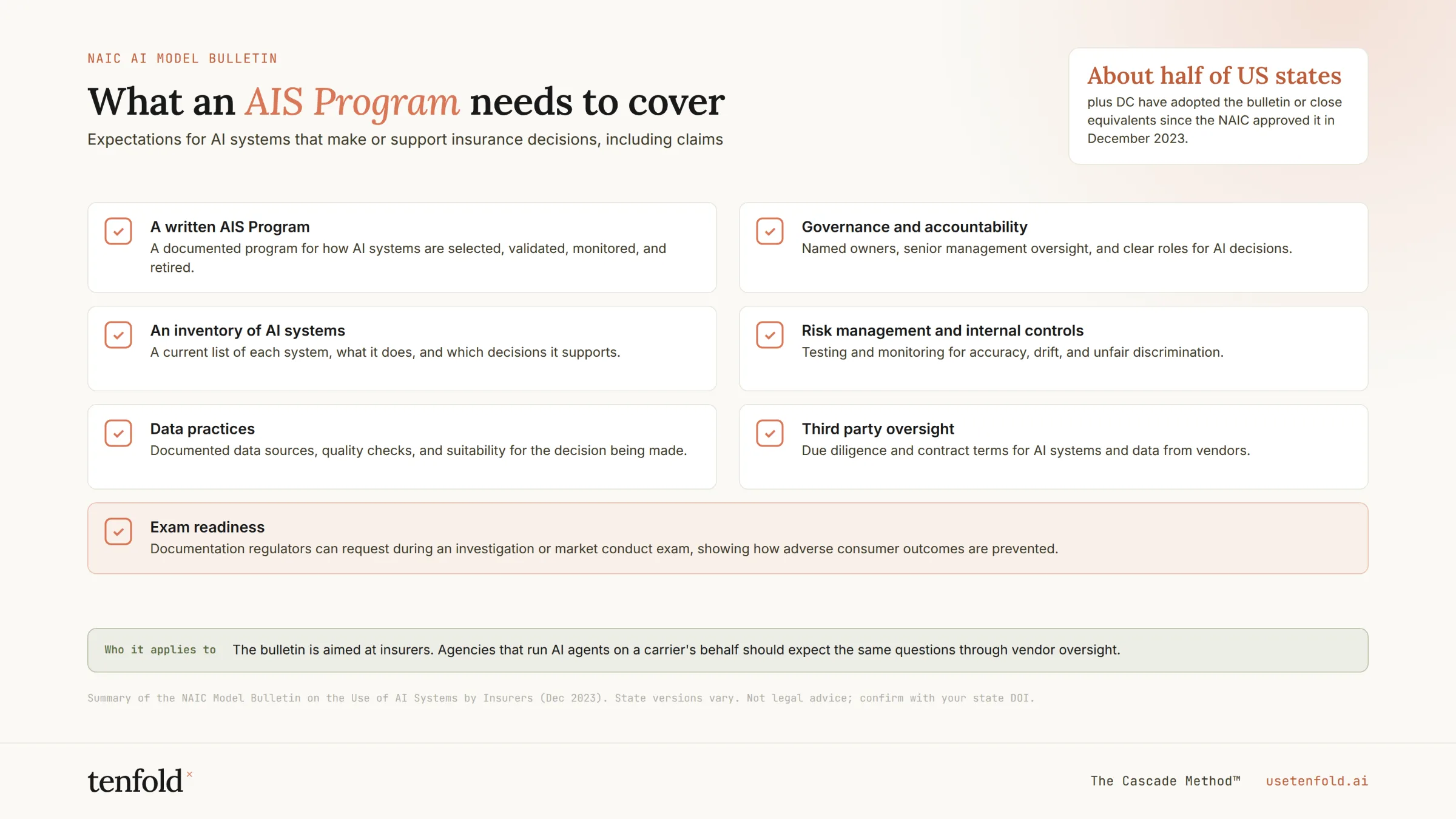
The NAIC Model Bulletin on AI has been adopted by 24 US jurisdictions as of August 2025. It requires insurers to develop, implement, and maintain a written AI Systems Program that addresses governance, risk management, internal controls, and documentation — the kind of documentation a state insurance department may request during a market conduct examination.
The state-level picture is fragmented and getting more complex. Colorado enacted the nation's most comprehensive standalone AI governance statute (SB 205), with full anti-discrimination requirements and annual impact assessments for high-risk AI systems. New York and California have added specific requirements around algorithmic explainability and bias testing. At least 17 states introduced advanced AI-specific insurance bills in 2025 alone. The Senate voted 99–1 to preserve state authority to regulate AI — this patchwork of state requirements is growing, not converging.
For agencies operating across multiple states, that means navigating overlapping compliance stacks: state insurance regulation, state privacy laws like CCPA, and for health-adjacent lines, HIPAA. If you operate internationally, the EU AI Act classifies many insurance AI functions as high-risk applications, triggering rigorous obligations that add cost and complexity.
Here's what regulators are actually auditing: how you govern AI, how you test it for bias, and what your documentation looks like when an examiner requests it. Black-box AI models can no longer be defended in a regulated environment. Explainability must be baked into the system design — not retrofitted after deployment.
Why Most Agencies Are Still Stuck — and How to Break Through
Nearly 90% of insurance executives identify AI as a top strategic initiative. But according to a Roots survey, only 22% report having AI solutions running in production. The largest group — 45% — remains in the exploration stage, still meeting with vendors and evaluating options.
The adoption gap is real, and the barriers are predictable:
Skills and resource constraints (52%) — Most agencies don't have in-house AI engineering capacity to build or integrate agentic systems.
Data readiness (40–45%) — Claims data is often fragmented across legacy systems, stored in inconsistent formats, or not structured for AI-style integration.
Regulatory uncertainty (36%) — With state laws evolving month to month, agencies are hesitant to commit to an architecture that may need to change.
Legacy infrastructure (cited by 41%) — Systems built before AI integration existed weren't designed for the kind of real-time data flows agentic workflows require.
Organizational resistance (35%) — Adjusters and operations staff need to understand what AI is handling, why, and how it changes their role — or they'll find ways around it.
According to BCG, many AI programs have stalled not because the technology failed, but because of limited business engagement, unclear roles and responsibilities, and the probabilistic nature of AI clashing with insurance's inherently risk-averse culture.
The agencies breaking through share a common approach: they start with a bounded, high-volume, low-complexity claim type. They demonstrate measurable results. Then they expand. Trying to automate everything at once is how pilots die.
At Tenfold, we've found that the agencies making the fastest progress aren't necessarily the ones with the biggest budgets — they're the ones who treat AI implementation as an operational transformation, not a technology purchase.
What a Responsible AI Claims Architecture Looks Like
Based on what's working in production across the industry, a responsible AI claims implementation has five non-negotiable components:
1. Explainable decision logic. Every AI-driven claims decision must be traceable and documentable. Regulators and courts now require that insurers explain *why* an AI system made a particular decision. Build explainability in from day one.
2. Human review protocols for adverse outcomes. Claim denials, escalations, and high-value settlements must have a defined human review step. Project Nemo and Aviva both kept humans in the final payout decision — this is the pattern to follow.
3. Bias testing and audit trails. Colorado's AI statute and the NAIC bulletin both require ongoing bias monitoring. This isn't a one-time check; it's an operational process that needs to run continuously.
4. Phased rollout starting with straight-through processing (STP). Begin with the simplest, highest-volume claim types where straight-through processing is already viable. According to WTW's March 2026 analytics survey, 14% of insurers have already implemented STP in claims workflows, with another 36% planning to adopt it.
5. Integration with existing systems — not replacement. AI agents work best as a layer on top of existing claims management platforms, not as wholesale replacements. The integration pattern matters as much as the AI model itself.
Summary
AI agents can automate the majority of routine insurance claims tasks — and the carriers that have deployed them are reporting results that were unthinkable five years ago. The technology is production-ready. The harder problems are organizational: data infrastructure, regulatory compliance, governance frameworks, and getting your team aligned around what AI is doing and why. Agencies that approach this as an operational transformation — with phased rollouts, explainable AI, and compliance baked in from the start — will build durable advantage. Those that rush to black-box solutions or wait for perfect regulatory clarity will find themselves on the wrong side of a widening gap. At Tenfold, we help organizations build the operational foundations that make AI agent deployment work — not just in theory, but in production. If you're evaluating what AI-first claims operations could look like for your agency, [talk to our team](/contact).
Frequently Asked Questions
Q: Can AI agents fully replace human claims adjusters?
A: Not entirely — and the best implementations aren't trying to. AI agents excel at handling high-volume, low-complexity claims autonomously and functioning as copilots on complex cases. Human adjusters remain essential for nuanced judgment calls, adverse claim decisions, and customer-facing escalations. The Allianz Project Nemo model — autonomous processing with human approval of every payout — is the most defensible architecture both operationally and regulatorily.
Q: What types of insurance claims are easiest to automate first?
A: Simple, high-volume, document-heavy claim types with clear decision criteria are the best starting point: minor auto claims, property damage with photo evidence, travel insurance claims, and straightforward health claims with standard billing codes. These are where straight-through processing (STP) rates of 70–90% are achievable with mature AI systems.
Q: What does the NAIC Model Bulletin mean for my agency?
A: As of August 2025, the NAIC Model Bulletin on AI has been adopted by 24 US jurisdictions. It requires a written AI Systems Program covering governance, risk management, internal controls, and documentation. State departments may request this documentation during a market conduct examination. If you're using AI in claims decisioning without this governance framework in place, you have regulatory exposure you may not be able to see yet.
Q: How long does it take to implement AI agents in a claims workflow?
A: A phased approach typically runs 12–24 months for meaningful end-to-end automation. Early phases — document processing, FNOL automation, fraud flagging — can show results in 6–8 months. Full AI claims transformation, where 30–40% of claims process without human intervention, is a 12–24 month build depending on data readiness and system complexity.
Q: What's the biggest mistake agencies make when deploying AI for claims?
A: Building or buying black-box systems without explainable decision logic — and discovering the compliance problem after deployment. Retrofitting explainability onto a model that wasn't designed for it is expensive and often produces weaker results than building for explainability from the start. The second most common mistake is treating this as a technology project rather than an operational transformation, which is why change management and stakeholder alignment matter as much as the model itself.
