
Can AI Agents Handle Client Intake? How Law Firms Are Cutting Response Time from Days to Minutes
Yes — AI agents can handle law firm client intake, and the firms deploying them are seeing results that make the question of *whether* to act increasingly hard to ignore. A five-minute response window delivers a 400% conversion lift over responding an hour later. Yet according to Hennessey Digital's 2025 study of 1,333 law firms, 26% of firms never respond to an online lead at all, and 39% either take more than two hours or simply never reply.
The gap between what clients expect and what most firms deliver is not a technology problem. It is a process problem — and AI agents are built to close it.
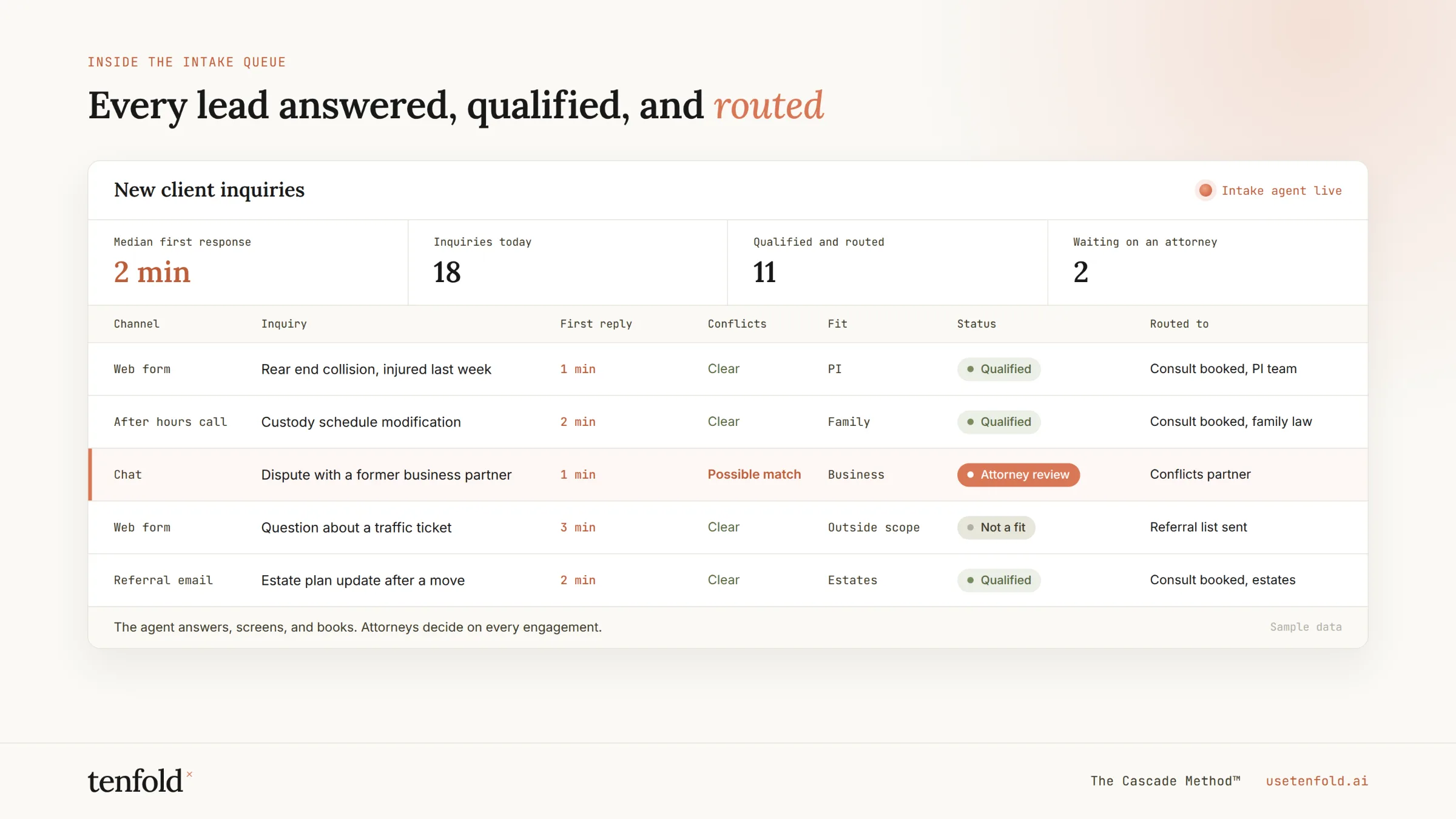
Quick Answer: AI agents can autonomously manage the full legal intake loop — qualifying leads, running conflict checks, collecting documents, scheduling consultations, and syncing data to your case management system — without a paralegal touching every step. Firms that deploy them report response times measured in seconds, not days, and conversion rate gains measured in multiples, not percentages.
Key Takeaways:
26% of law firms never respond to online leads; 39% take more than two hours (Hennessey Digital, 2025)
Responding within five minutes converts at 400% higher rates than responding after an hour
AI agents can handle up to 80% of routine intake inquiries without human involvement
Firms using client intake technology see 51% more leads and 52% higher revenue on average (Clio, 2025)
Ethical and compliance guardrails — including ABA Formal Opinion 512 — are now well-established for AI-assisted intake
The revenue math is not subtle: closing the intake gap from 14% to 30% conversion can be worth $200K–$400K annually from the same ad spend
The Intake Problem Most Law Firms Won't Admit They Have
The legal industry has a lead-response crisis, and the data is unambiguous.
According to Clio's 2025 Legal Trends Report, only 33% of law firms respond to emails from prospective clients — down from 40% in 2019 — and 35% of calls to small and mid-sized firms go unanswered during business hours. That silence is costing the industry an estimated $109 billion a year in lost potential revenue.
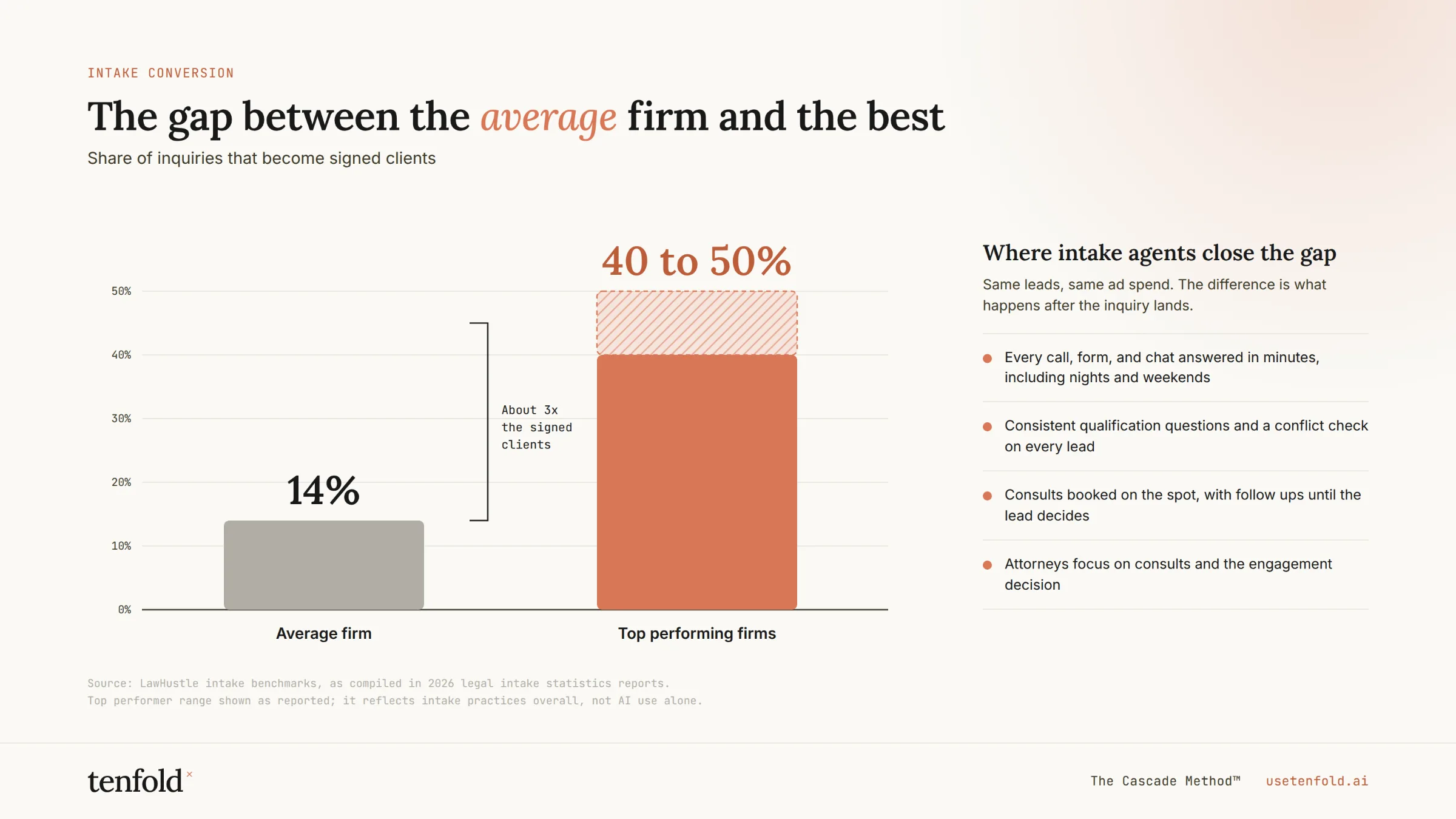
The conversion math compounds the problem. The industry average intake conversion rate sits near 14% — meaning the typical firm loses five of every six prospects, many of them simply to silence and delay, according to MyCase platform data. Top-performing firms convert 40–50% of leads into signed clients. The gap between those two numbers is almost entirely an intake execution problem.
The reason 78% of legal clients hire the first attorney who responds is not that the second attorney is less qualified. It is that the client never hears from them at all.
What AI Agents Actually Do in the Intake Process
AI agents in legal intake are not chatbots that answer FAQs. They are autonomous systems that execute multi-step workflows — qualifying the matter, running conflict screens, collecting documents, and routing the case — without a human prompting each action.
The most capable platforms today operate across the full intake loop:
Lead Capture and Qualification
AI agents engage prospective clients the moment an inquiry arrives — via web chat, phone, SMS, WhatsApp, or social — and qualify the lead using firm-provided criteria. According to Attorneys.Media's 2025 analysis, AI voice agents can handle up to 80% of routine client inquiries without human involvement, meaning after-hours calls that previously converted at near-zero rates can be qualified, scheduled, and routed before the next business day begins.
Conflict Checks and Matter Classification
Agents can run preliminary conflict-of-interest screening and matter classification automatically — before a partner ever picks up the phone. This removes one of the highest-friction steps in intake from the attorney's workload entirely.
Document Collection and CRM Write-Back
Once a lead is qualified, agents collect required documents, follow up on missing information, and write structured data directly into the firm's case management system — Filevine, Clio, MyCase, Litify, and others. Law firms using AI voice agents report reducing client intake processing time by up to 60%, driven not just by faster call answering but by automation of the downstream tasks that follow each interaction.
Scheduling and Consultation Booking
Agents handle consultation booking end-to-end, syncing with attorney calendars and sending confirmation and reminder sequences. No staff intervention required.
The shift from a 30-field web form to a conversational AI agent is significant: conversational intake captures context and responds in seconds, while forms capture fields and wait for a human callback. Measured lift versus a static form runs 2.5x to 4x in completed intakes, with the average AI-led interaction running four to seven minutes without a human touching it.
The Revenue Case Is Not Subtle
AI intake is not an operational nicety. For most law firms, it is the single highest-leverage investment available.
According to Clio's 2025 Legal Trends Report, firms using client intake technology see 51% more leads and 52% higher revenue on average. Solo firms using intake tools like e-signatures, digital forms, and schedulers reported 53% higher revenue than those without.
The arithmetic is straightforward. A firm signing 12 new clients a month at a $15,000 average case value that moves its conversion rate from 14% to 30% adds $200,000 to $400,000 in signed revenue per year — from the same ad spend. The leads were already arriving. They were just disappearing into silence.
One personal injury firm profiled by Aloware moved its lead capture rate from 20% to 85% after switching to AI voice intake. Another firm reported increasing case conversion from 10% to 35% after implementing AI-driven intake. These are not edge cases — they are the expected outcome of closing a five-minute response window that most firms are currently missing by hours or days.
According to Smith.ai platform research, law firms using always-on AI receptionists capture an average of 23% more qualified leads monthly compared to firms relying solely on daytime staff, with the majority of that gain coming from evenings and weekends — the exact window when 42% of inbound legal calls arrive.
The Compliance Reality: What ABA Formal Opinion 512 Actually Requires
The ethical question around AI intake is real, but it is also largely resolved — if you implement correctly.
ABA Formal Opinion 512 (2024) establishes the framework. It requires firms to uphold competence, confidentiality, candor, and supervision obligations when using AI. In practice, that means three things for intake specifically:
1. Vendor vetting: Intake conversations touch privileged and confidential information before an engagement even exists. Vendor selection is now a compliance decision. The evaluation criteria are not aspirational — bar regulators, courts, and malpractice insurers have all published their answers.
2. Disclosure: AI use in client-facing intake must be disclosed where required by state bar guidance. The standards vary by jurisdiction and are evolving rapidly.
3. Attorney accountability: A lawyer must remain responsible for engagement decisions. The AI qualifies and routes — it does not replace the attorney's judgment on whether to take a case.
According to the 2026 Legal Industry Report, while nearly 70% of legal professionals use generative AI tools, only 56% of law firms have implemented formal governance policies. That gap is where risk lives. The firms getting this right are not banning AI — they are governing it. As the North Carolina Bar Association noted in 2026, simply telling lawyers not to use AI is unrealistic — these tools are now part of everyday technology. The question is whether your firm has a policy for it.
AI-assisted client intake is ethical when firms follow ABA Formal Opinion 512's requirements on competence, confidentiality, and supervision: vetting how vendors handle prospective-client data, disclosing AI use where required, and keeping a lawyer responsible for engagement decisions.
How to Implement AI Intake Without Getting It Wrong
The firms that fail at AI intake deployment typically make one of three mistakes: they pick a tool before mapping the workflow, they treat intake as a form problem instead of a conversation problem, or they deploy without a human oversight layer.
Here is the implementation sequence that works:
Step 1: Audit your current intake leak. Before selecting a platform, measure your actual response times, unanswered call volume, and lead-to-consultation conversion rate. If you don't know your baseline, you cannot measure the lift.
Step 2: Define the qualification criteria. AI agents qualify based on the criteria you give them. Practice area, jurisdiction, case type, statute of limitations proximity — define these before deployment, not after.
Step 3: Choose the right agent architecture. Single-agent platforms handle one workflow. Multi-agent architectures handle the full lifecycle. Match the architecture to your volume and practice area complexity.
Step 4: Integrate with your case management stack. An AI intake agent that doesn't write back to Clio, Filevine, MyCase, or your existing system creates more work than it eliminates. Native CRM write-back is not optional — it is the ROI.
Step 5: Establish the human oversight layer. Flag AI-qualified matters above a value threshold for attorney review before commitment. Document your supervision policy. Run a 60-day pilot on one practice area before firm-wide rollout.
The firms seeing the fastest returns start with a single, high-volume practice area — personal injury, immigration, family law — where intake speed is a direct revenue driver. They measure response time, qualification rate, and signed matters for 60 days. Then they scale.
What Separates AI Agents from Basic Intake Automation
Not every tool calling itself an AI intake solution is an AI agent. The distinction matters.
Most platforms digitize the intake form and call it automation. A true AI agent runs the process: qualifying leads, collecting documents, following up on missing information, and routing cases — without anyone on staff prompting them to do so. Form-based systems capture fields and wait for a human callback. Conversational AI agents capture context and respond in seconds.
The capability gap is visible in the data. The key differentiators to evaluate:
| Capability | Form + Automation | AI Agent |
|---|---|---|
| Responds after hours | Delayed | Immediate |
| Handles open-ended answers | No | Yes |
| Asks follow-up questions | Scripted only | Dynamic, context-aware |
| Conflict-check screening | Manual | Automated |
| CRM write-back | Manual | Native |
| Escalates complex matters | No | Yes, with handoff |
The hybrid model — AI handling structured intake questions and data capture at scale, while live agents step in for sensitive conversations or complex fact patterns — is increasingly common and addresses the concern that AI alone cannot handle every legal matter. Smith.ai's model, for example, keeps live North American agents available as a fallback layer, ensuring no call ever hits a dead end.
Summary
The legal industry's intake gap is a documented revenue problem with a documented solution. Law firms that respond within five minutes convert at 400% higher rates than those that take an hour or more — and AI agents are the only mechanism that reliably hits that window at scale, around the clock, across every channel. The compliance framework is established. The implementation playbook is clear. The firms that deploy AI intake correctly are not just saving staff time; they are compounding conversion rates into substantially higher revenue from the same inbound volume.
At Tenfold, we specialize in implementing AI agent systems that handle exactly this kind of high-stakes, multi-step workflow — from lead qualification through CRM integration and beyond. If your firm is evaluating where AI delivers the fastest, most measurable return, client intake is the answer.
Frequently Asked Questions
Q: Can AI agents really handle legal client intake without a human?
A: Yes — AI agents can autonomously handle the qualify, screen, route, and follow-up loop for most legal inquiries. According to Attorneys.Media's 2025 analysis, AI voice agents can manage up to 80% of routine client inquiries without human involvement. A lawyer must still remain accountable for the engagement decision itself, but everything before that handoff can be fully automated.
Q: Is it ethical for a law firm to use AI for client intake?
A: Yes, when implemented correctly. ABA Formal Opinion 512 (2024) establishes the requirements: uphold competence, protect client confidentiality, disclose AI use where required, and maintain attorney supervision of engagement decisions. Bar regulators, courts, and malpractice insurers have all published guidance on compliant implementation.
Q: How fast can AI intake actually respond to a new lead?
A: AI agents respond in seconds — not minutes, not hours. The five-minute response window is considered the threshold for maximum conversion; conversational AI intake hits that window 24/7, including evenings, weekends, and holidays when 42% of legal calls arrive.
Q: What conversion rate improvement can a law firm realistically expect?
A: The industry average conversion rate is approximately 14%. Firms using AI-assisted intake consistently report rates of 30–50%. One personal injury firm moved its lead capture from 20% to 85%. Firms using client intake technology overall report 51% more leads and 52% higher revenue on average, according to Clio's 2025 Legal Trends Report.
Q: How long does it take to see results from AI intake?
A: Legal marketers and intake vendors report that AI intake delivers its earliest gains — in response time, lead qualification, and after-hours coverage — often within 90 days. Most firms running a 60-day pilot on a single practice area have clear data on response time, qualification rate, and signed matters before committing to firm-wide rollout.
