
ChatGPT vs Claude vs Gemini: Which One Should You Actually Use?
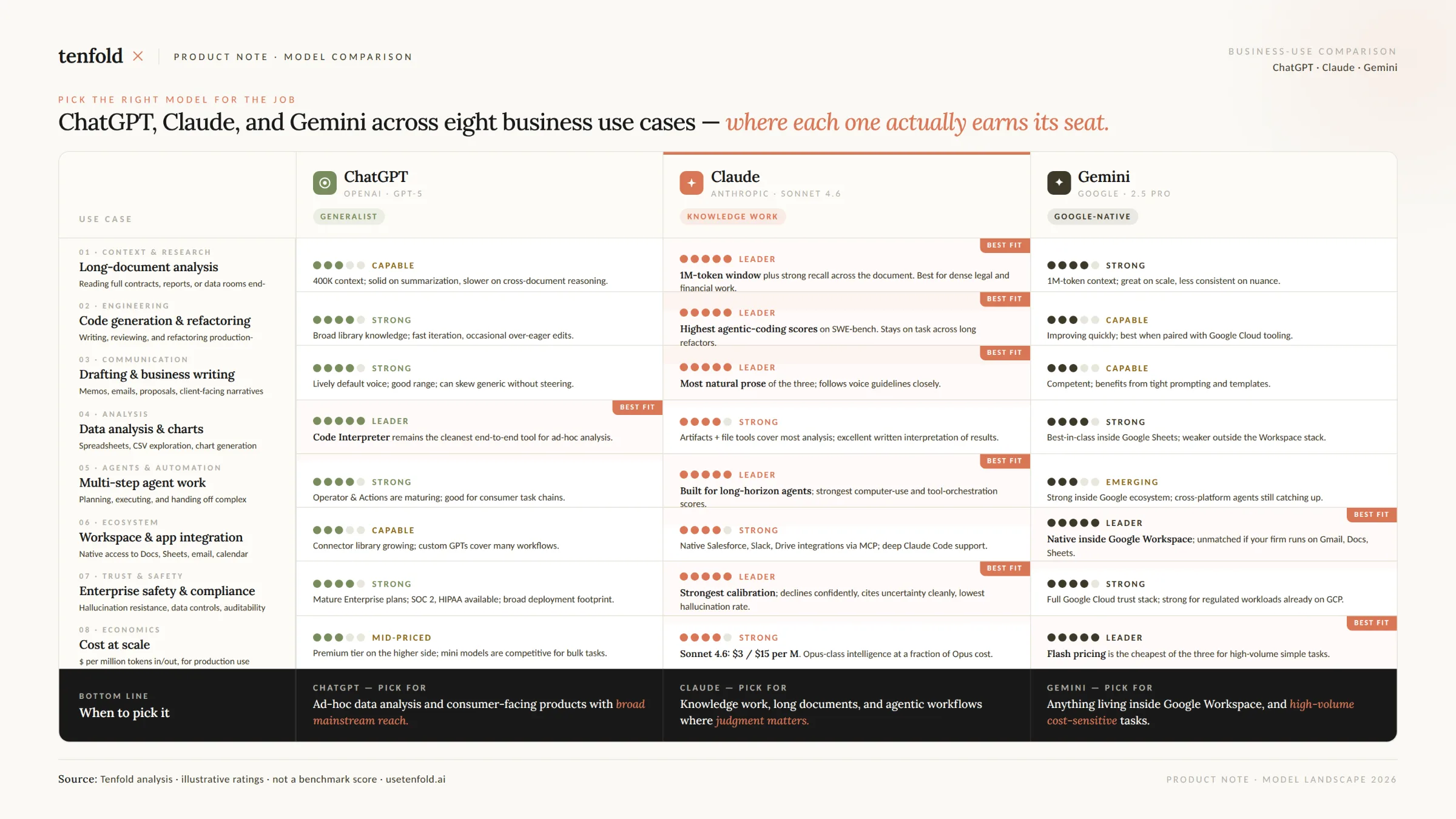
The honest answer: none of them is universally "the best." ChatGPT wins on ecosystem breadth and memory. Claude wins on instruction-following and deep reasoning. Gemini wins on real-time data and Google Workspace integration. The right choice depends entirely on what you're trying to accomplish — and most serious operators use more than one.
Quick Answer: For general-purpose business use, start with ChatGPT. For long-form writing, complex reasoning, or coding, use Claude. For research, multimodal tasks, or Google-native workflows, Gemini is the stronger pick.
Key Takeaways:
No single AI model dominates every use case — the strongest workflows combine all three.
Claude leads in instruction-following, writing quality, and context window size for enterprise.
ChatGPT leads in ecosystem, memory, and image generation.
Gemini leads in real-time web access, speed, and Google Workspace depth.
For C-suite and Operations leaders evaluating AI agents, the model choice is secondary to the implementation strategy.
What Each AI Model Actually Does Well
Before picking a tool, understand what each model was built for — and where each falls short.
ChatGPT (OpenAI) is the all-rounder. According to Search Engine Journal, ChatGPT is best for everyday answers, voice chat, image generation, and computer use. Its persistent memory feature — still absent from Claude and Gemini — gives it a meaningful edge for users who need continuity across sessions. Its plugin and integration ecosystem is the most mature of the three.
Claude (Anthropic) is the precision instrument. According to Artificial Analysis, Claude excels at conversational accuracy and instruction-following. In enterprise deployments, Claude's context window reaches 500,000 tokens — dwarfing ChatGPT Enterprise's context ceiling — enabling it to analyze dozens of 100-page documents or full multi-hour transcripts in a single prompt. Anthropic also emphasizes lower hallucination rates and stronger ethical guardrails, which matters in compliance-heavy environments.
Gemini (Google DeepMind) is the research and integration play. According to BairesDev, Gemini is a strong choice for AI-driven research, especially after the 2.5 update, thanks to Google's search infrastructure. Its 1 million token context window makes it the largest of the three for processing massive codebases or document libraries. For organizations already operating in Google Workspace, Gemini's native integration with Gmail, Docs, Sheets, and Meet creates a productivity multiplier that the others can't replicate out of the box.
ChatGPT vs Claude vs Gemini for Writing and Content
Writing is where the differences are sharpest — and where team leads most often choose wrong.
Claude consistently outperforms on nuanced, long-form, and voice-preserving edits. According to Creator Economy, Claude nailed conversational style and format in head-to-head writing tests, while ChatGPT cut too much copy and lost key details, and Gemini's edits felt too verbose and sterile. For content teams producing strategy docs, technical posts, or polished brand copy, Claude is the current leader.
For social media content and B2B LinkedIn campaigns, the picture is different. According to Improvado, Claude prioritized user benefits before technical features and maintained concise messaging in LinkedIn post tests — while ChatGPT delivered technically accurate but uninspiring output, and Gemini leaned verbose.
For image generation and marketing assets, ChatGPT's image feature leads. It follows instructions best and produces the strongest text rendering — useful for marketing teams creating infographics, ad assets, and visual content at scale.
Bottom line for content teams: Claude for long-form and brand voice. ChatGPT for versatile content at volume and visual assets.
ChatGPT vs Claude vs Gemini for Coding
For technical teams, the gap between models is real and measurable.
According to Playcode, Claude is best for complex logic and debugging — it makes fewer errors on tricky problems. ChatGPT is most versatile for general coding tasks across broad language and framework coverage. Gemini is the fastest with the largest context window, making it the practical choice for processing full repositories or large codebases.
In a direct test of the same TypeScript problem, Claude produced cleaner code, better types, and a more thorough solution. Gemini responded fastest but was less strict on type safety. ChatGPT produced a working solution but lacked the depth Claude delivered.
For AI agent development specifically — the kind of agentic, multi-step automation that Tenfold specializes in — Claude's instruction-following precision and context depth make it the natural foundation. Hallucinations in agentic workflows aren't just embarrassing. They're expensive.
ChatGPT vs Claude vs Gemini for Enterprise and Research
Enterprise selection criteria look different from individual use. Security, context window, hallucination rate, and integration depth all matter more than "which one sounds smartest."
According to IntuitionLabs, Anthropic adoption has been growing rapidly from mid-2025, particularly in finance, law, and coding — domains where context depth and precision requirements are non-negotiable. Claude's 500,000-token enterprise context window is the current ceiling for any major provider.
For deep research, the results depend on depth vs. usability. In multi-model tests, Gemini produced the most voluminous output — 48-page reports with 100 sources — but conclusions were often verbose. ChatGPT hit a practical sweet spot: concise enough to act on, detailed enough to be useful. Claude synthesized well but went shorter by default.
For Google Workspace-native organizations, according to Gmelius, Gemini's deep integration with Gmail, Docs, Drive, and Meet lets it generate emails, summarize docs, and analyze Sheets data directly — without leaving the tools teams already use daily.
For Microsoft-stack organizations, neither ChatGPT, Claude, nor Gemini competes with Copilot's native integration into Word, Excel, Outlook, and Teams.
The enterprise decision framework:
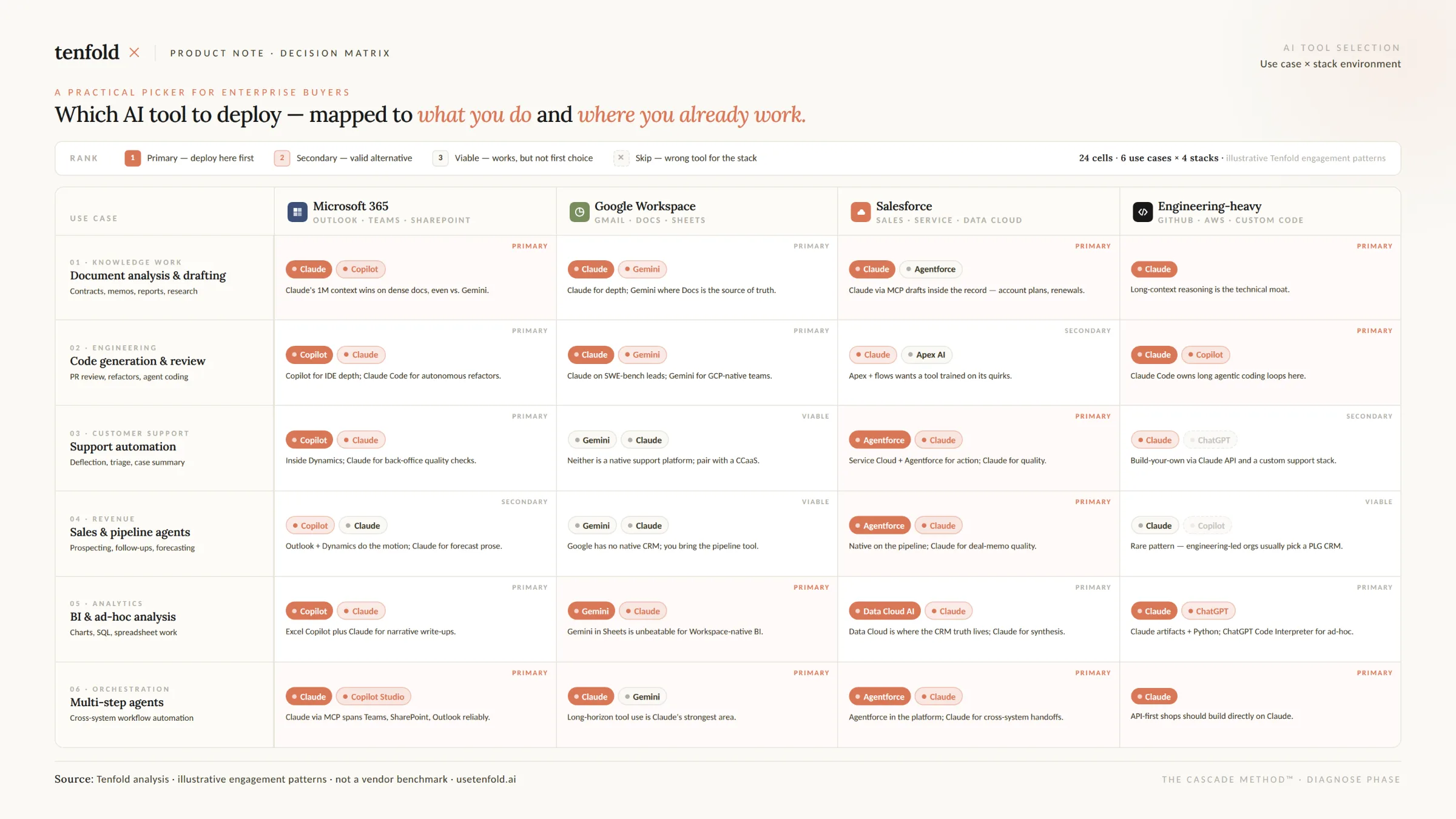
Deep document analysis + coding + compliance → Claude
Versatile productivity + memory + image generation → ChatGPT
Google Workspace integration + real-time search + speed → Gemini
Pricing: What You Actually Pay
All three models offer free tiers with meaningful limitations. According to Artificial Analysis, standard paid plans cluster around $20/month across all three providers. Premium tiers — Claude Max, ChatGPT Pro, Google AI Ultra — run $200–$300/month and are positioned for high-volume professional use.
For teams, Claude Pro is $20/month individually or $30/user/month on the Team plan. ChatGPT Plus is $20/month, with the Team plan at $25–$30/user/month. Gemini's business pro plan starts at $20/user/month, enterprise at $30/user/month.
The real cost isn't the subscription. It's the time lost when teams use the wrong model for the wrong job — and the compounding errors when AI agents are deployed without a coherent implementation strategy.
Summary
ChatGPT, Claude, and Gemini are not interchangeable. Each model has a distinct performance profile that maps to specific workflows, team structures, and technical environments. The organizations extracting the most value from AI in 2025 aren't loyal to a single model — they're deploying each tool where it wins.
At Tenfold, we help C-suite and Operations leaders move beyond the model debate and focus on what actually delivers outcomes: the implementation layer. The model you choose matters far less than how you deploy it, govern it, and integrate it into the workflows that drive your business.
Frequently Asked Questions
Q: Which AI is best for business use in 2025 — ChatGPT, Claude, or Gemini?
A: It depends on your stack and use case. ChatGPT is the most versatile all-rounder with the strongest ecosystem. Claude leads in precision, long-form writing, and complex reasoning. Gemini is the right choice if you live in Google Workspace or need real-time web access. Most high-performing teams use a combination of all three.
Q: Is Claude better than ChatGPT for writing?
A: For nuanced, long-form, and voice-preserving writing, yes — Claude consistently outperforms in head-to-head tests. ChatGPT is stronger for high-volume content generation and versatility across content types. For social media and B2B content specifically, Claude also edges out on conciseness and user-benefit framing.
Q: Which AI has the largest context window?
A: Gemini leads with a 1 million token context window for processing large codebases or document sets. Claude Enterprise offers up to 500,000 tokens — the strongest enterprise offering and far ahead of standard ChatGPT. For analyzing large documents or multi-hour transcripts in one session, Claude or Gemini are the right tools.
Q: Is it worth paying for a premium AI plan?
A: For professional use, yes. Free tiers impose meaningful limits on context, model access, and daily usage. Standard paid plans at ~$20/month unlock the features that actually matter for business workflows. The more important question is whether your team has a strategy for how AI fits into your operations — without that, any plan is money spent inefficiently.
Q: How should Operations leaders evaluate AI tools for their org?
A: Don't start with the model — start with the workflow. Identify the three to five highest-value tasks where AI can reduce time or error, then match the model to the task profile. The bottleneck isn't AI capability. It's that most organizations aren't yet set up to delegate to it effectively.
