
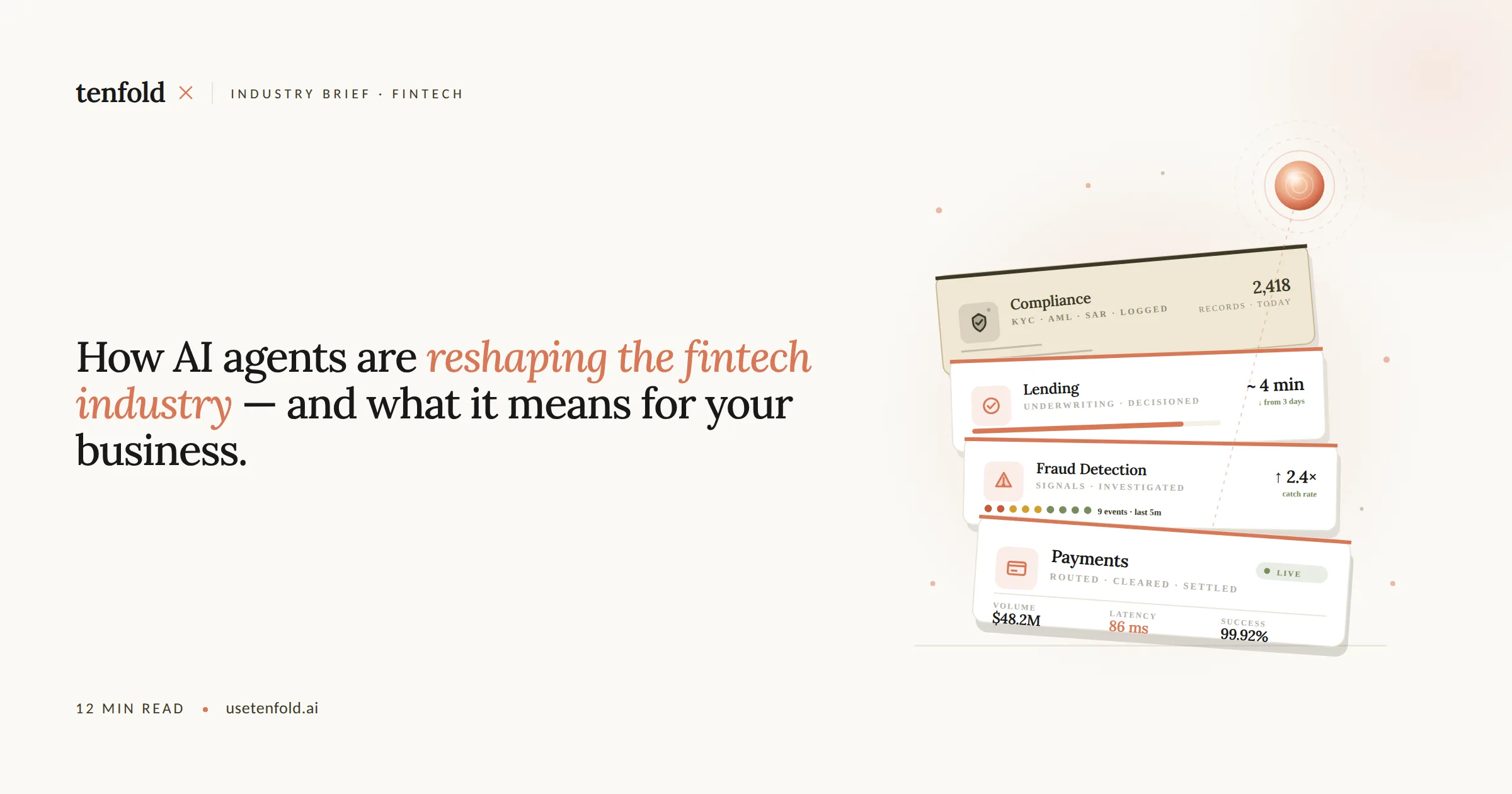
How AI Agents Are Reshaping the Fintech Industry — and What It Means for Your Business
AI agents are already running critical workflows inside the world's largest financial institutions. Not as experiments. Not as demos. As live, production systems — detecting fraud across billions of transactions, underwriting loans in minutes, and automating compliance tasks that once required entire teams.
The fintech industry isn't waiting to see if AI is ready. The question now is whether your organisation is structured to deploy it before the window for competitive advantage closes.
Key Takeaways:
Agentic AI has moved beyond rule-based automation — it now reasons, plans, and executes across multi-step financial workflows without constant human direction.
The global AI in finance market is projected to grow from $38.36 billion in 2024 to $190.33 billion by 2030, driven by demand in fraud prevention, compliance, and lending.
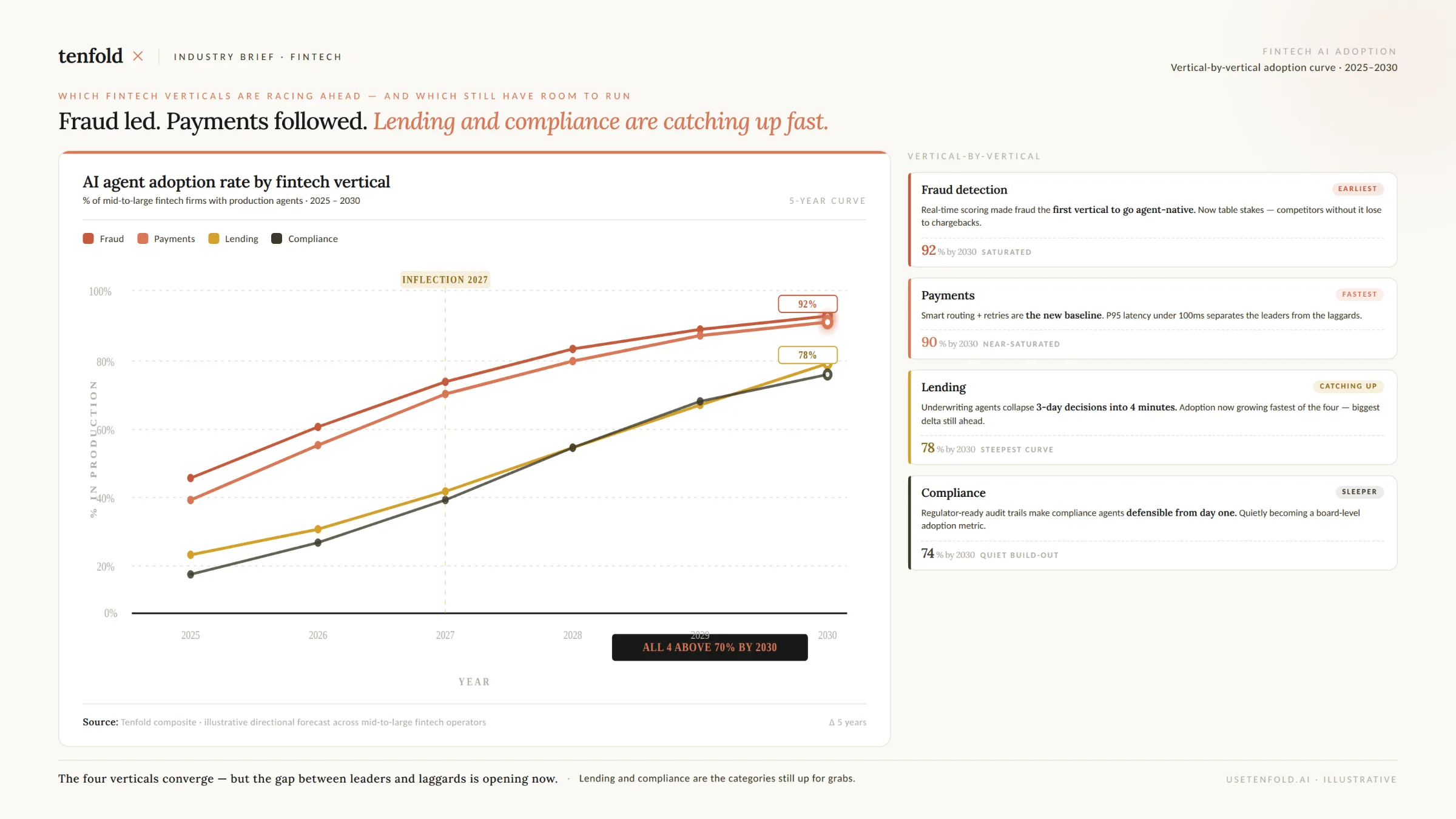
Payments, credit underwriting, RegTech, and customer service are the four verticals seeing the fastest AI agent deployment right now.
The biggest barrier isn't technology — it's whether your organisation is set up to delegate real work to AI agents and govern the outcomes.
At Tenfold, we help financial services and fintech organisations move from AI curiosity to AI execution — with production-grade agent implementations, not proof-of-concept theatre.
What "Agentic AI" Actually Means in a Fintech Context
Agentic AI isn't a smarter chatbot. It's a fundamentally different operating model.
Where traditional automation follows a fixed script — "if X, do Y" — an AI agent reasons over a goal, determines what data it needs, takes action across multiple systems, adapts when conditions change, and reports outcomes. It doesn't need a human to approve each step.
According to nCino, autonomous AI agents in financial services demonstrate four defining capabilities: goal-directed reasoning, multi-step planning, adaptive decision-making, and independent execution — all without requiring approval for each individual step.
The practical result? According to Brilworks, autonomous AI agents can now detect fraud across billions of transactions in real-time, underwrite loans using 1,600+ variables, automate regulatory compliance reporting, and manage investment portfolios without human intervention.
This is the operating model that leading fintech firms are building toward. Not "AI as a feature" — AI as the backbone of core financial operations.
The Scale of What's Happening — By the Numbers
The financial sector's AI adoption trajectory is unlike any other industry.
According to the Federal Reserve, AI adoption in the financial sector grew 127% in the year ending September 2025 — the highest sustained growth rate of any tracked sector. Work-related generative AI adoption in financial services reached 63%, the highest of any industry measured.
The market numbers reflect that urgency. According to AllAboutAI, the global AI in finance market is projected to grow from $38.36 billion in 2024 to $190.33 billion by 2030, at a 33% annual growth rate. By 2025, AI is expected to save banks $200–340 billion and influence $450 billion in revenue.
According to McKinsey, in 2025 the global fintech market generated approximately $650 billion in revenues — a 21% year-over-year growth rate that materially outpaced the broader $15 trillion financial services industry.
Capital is following the signal. According to Edgar, Dunn & Company, in the U.S. alone, AI accounted for 64% of total deal value in H1 2025, with AI-related transactions representing 36% of all VC activity.
These aren't speculative projections. They describe a transformation that is already priced into the market.
Four Areas Where AI Agents Are Doing Real Work Right Now
1. Fraud Detection and Financial Crime Prevention
Fraud has outpaced rule-based systems. Modern threats involve synthetic identities, deepfakes, and coordinated attack networks that evolve faster than static filters can be updated.
According to Brilworks, banks spend an estimated $270 billion annually on compliance globally — much of it fighting financial crime with systems that weren't designed for today's threat surface.
AI agents are changing the calculus. According to Variance (a fintech compliance AI firm), their agents tackle complex and disjointed compliance data before returning fully auditable decisions within minutes — covering KYC, KYB, AML, transaction monitoring, and fraud detection investigations that would typically demand teams of analysts and several days.
The shift isn't just about speed. According to Coherent Solutions, AI is now enabling financial institutions to move from reactive fraud response to proactive, real-time protection — addressing synthetic identities, deepfakes, and increasingly sophisticated attack vectors that traditional systems cannot reason about.
The regulatory layer is tightening alongside the threat. According to fin.ai, EU AI Act high-risk classifications apply explicitly to credit scoring, fraud detection, and automated decision-making in financial services — with non-compliance penalties reaching up to €35 million or 7% of worldwide turnover. AI agents built for auditability and traceability aren't optional. They're a compliance requirement.
2. Autonomous Payments and Agentic Commerce
Payments are the highest-volume, highest-stakes workflow in fintech — and agents are now executing them end-to-end.
According to Deloitte, major players including BNY, Mastercard, PayPal, and Visa are already experimenting with agentic commerce — agents that transact on behalf of customers. Mastercard is collaborating with both IBM and Microsoft to build agentic commerce capabilities at the platform layer.
According to The Financial Brand, Stripe's Payments Foundation Model processes approximately $1.4 trillion in payments volume annually, using AI to detect fraud, optimise payment flows, and predict disputes.
AWS went further in May 2026, launching Amazon Bedrock AgentCore Payments — a service that lets AI agents autonomously discover, authorise, and execute payments, with built-in wallet management, policy-based spending controls, and a full audit trail. According to AWS, this brings native, managed payment capabilities to AI agents without requiring custom payment infrastructure.
The direction is clear: the next generation of payment rails will be designed for agents, not just humans.
3. Credit Underwriting and Lending
Traditional credit decisioning relied on a narrow set of variables — bureau scores, income verification, and asset checks. That model systematically excluded creditworthy borrowers and left lenders with incomplete risk pictures.
According to Brilworks, AI agents now underwrite loans using 1,600+ variables — incorporating alternative data, behavioural signals, and real-time fraud indicators to produce faster, more accurate credit decisions.
According to nCino, a bank or credit union that processes loan applications in hours while competitors take days reshapes what customers consider acceptable performance — and becomes the standard against which others are measured.
According to The Financial Technology Report, companies like Lendbuzz are harnessing alternative data and AI to rethink credit access, enabling over $1.5 billion in annual auto loan originations for segments that traditional underwriting routinely rejected.
This is the compounding advantage of agentic AI in lending: faster decisions, broader addressable markets, and lower credit losses — simultaneously.
4. Compliance and RegTech Automation
Regulatory complexity is growing faster than compliance teams can scale. According to Brilworks, the RegTech market — valued at $12.7 billion in 2023 — is projected to reach $33.1 billion by 2028 at a 21.1% CAGR.
AI agents are becoming the infrastructure layer for compliance operations. According to Appinventiv, tools like Kodex AI operate multiple specialised regulatory agents that continuously scan regulatory updates, map them to internal processes, and trigger real-time adjustments — reducing audit surprises and keeping institutions aligned with evolving law.
According to Edgar, Dunn & Company, Compliance & RegTech represents 11% of AI investment flow across the fintech ecosystem, while Credit & Underwriting accounts for 14% — both areas where the ROI of autonomous agents is measurable and defensible.
The Operational Reality: What Separates Leaders From Laggards
Not every fintech AI deployment is working. And understanding why separates the organisations capturing value from those burning budget on demos.
According to FinTech Weekly, 2025's most important lesson came from understanding what didn't work. Early AI mistakes involved treating it as a cosmetic upgrade on top of legacy systems — impressive in presentations, absent from real operations.
The teams that actually moved the needle took a different approach: contained, auditable use cases with specific outcomes. Reconciliation time cut. Forecasting accuracy measured. Audit prep compressed. They stopped talking about AI strategy and started retiring manual processes.
According to SS&C's 2025 Global Enterprise AI Survey, while 29% of organisations have adopted agentic AI and 80% believe it enhances productivity, 37% cite security and compliance risks as key barriers — alongside a lack of operational trust in AI systems.
The gap isn't capability. It's organisational readiness. Most institutions haven't yet restructured their workflows, governance models, or data infrastructure to support agents doing real, accountable work.
According to Accenture, 2026 is shaping up as the year agentic AI creates scaled transformation in financial services — but a clear gap is already emerging between market leaders, the chasing pack, and the laggards. Visionaries now anticipate the rise of the "10× bank," where a single individual leads a team of AI co-workers to deliver exponentially greater output.
At Tenfold, we've seen this bifurcation firsthand. The organisations winning aren't the ones with the most AI tools. They're the ones that have restructured around agent-first delivery — and built the governance to back it.
What Comes Next: The Horizon Past 2026
The current wave is automation of known workflows. The next wave is agents that initiate action — without being asked.
According to Windsor Drake's AI in Fintech Report, the outlook positions AI as the foundational operating system for finance, with tokenised assets and autonomous agents projected to unlock trillions in value by 2030.
According to FinTech Weekly, 2025 was the year AI agents transformed how fintechs operate internally. 2026 is when those agentic features get offered directly to customers — opening new product categories that didn't previously exist.
According to CB Insights, AI agents could democratise financial access, boost efficiency in fintech, and unlock Web3's potential for programmable economies. The caveat: success hinges on addressing regulatory hurdles and building the infrastructure to support agents at scale.
The bottleneck isn't AI capability. It's that most organisations aren't yet set up to delegate real financial decisions to agents — and govern the outcomes confidently.
That's the implementation problem. And it's exactly what Tenfold solves.
Summary
AI agents are not a future state for fintech — they're the present operating model for institutions that intend to lead. From fraud detection and autonomous payments to credit underwriting and regulatory compliance, the workflows being transformed are the ones that define competitive differentiation in financial services. The data is unambiguous: adoption is accelerating, capital is concentrating in AI-native firms, and the gap between leaders and laggards is widening with every quarter.
At Tenfold, we specialise in helping financial services and fintech organisations move from AI interest to AI execution — building and deploying production-grade agent systems that retire manual processes, reduce risk, and compound over time. The proof isn't a pitch deck. It's the delivery model we operate every day.
Frequently Asked Questions
Q: What is an AI agent in fintech?
A: An AI agent in fintech is an autonomous software system that can reason over a goal, take multi-step actions across financial systems, and execute decisions — such as approving a payment, flagging a fraud signal, or filing a compliance report — without requiring human approval at each step. Unlike rule-based automation, agents adapt when conditions change and handle complex, variable workflows.
Q: How are AI agents being used in fraud detection?
A: AI agents in fraud detection analyse transactions in real-time, reason through context (not just pattern-match), and produce auditable decisions with traceable logic. This is a significant upgrade over legacy rule-based systems, which couldn't differentiate between a flagged transaction and a genuine edge case — leading to high false-positive rates that damaged customer experience.
Q: Are AI agents compliant with financial regulations?
A: Compliance depends on how agents are built and governed. The EU AI Act classifies credit scoring, fraud detection, and automated financial decision-making as high-risk AI systems, requiring transparency, traceability, and human oversight mechanisms. Well-implemented agents are built audit-first — every reasoning step logged and defensible under regulatory scrutiny.
Q: How long does it take to implement AI agents in a financial services context?
A: Timeline depends on scope and data readiness. Contained use cases — such as automating a reconciliation workflow or a specific compliance check — can be deployed in weeks. Enterprise-wide agent implementations that replace multiple manual processes take longer, but the ROI compounds faster than most organisations expect once the first agents are in production.
Q: How is Tenfold different from hiring an AI consultant or building in-house?
A: Tenfold is an AI agent implementation specialist — not a generalist consultant. We build and deploy production-grade agent systems, not strategies or slide decks. Our parent company, Inforge, operates its entire Salesforce delivery model through AI agents — so the implementation model we bring to clients is the same one we use ourselves, every day.
