
How Are Accounting Firms Using AI Agents? 7 Real Use Cases for Tax Season and Beyond
Accounting firms are no longer piloting AI. They are deploying autonomous agents at scale — across tax preparation, compliance monitoring, GL reconciliation, and client advisory workflows. The question isn't whether your firm will adopt AI agents. It's whether you'll be early enough to matter.
Quick Answer: Accounting firms are using AI agents to automate tax return preparation, document collection, compliance monitoring, bookkeeping reconciliation, client status updates, audit support, and strategic advisory triggers. These are live deployments, not proofs of concept.
Key Takeaways:
Wolters Kluwer found AI adoption among tax and accounting firms jumped from 9% in 2024 to 41% in 2025 — a shift that happened in a single year.
EY deployed 150 specialized AI agents supporting 80,000 tax professionals and processing 3 million+ compliance cases.
Firms using AI agents close month-end books up to 7.5 days faster and support 55% more clients per week without adding headcount.
The biggest gains aren't from replacing accountants. They come from eliminating coordination work so accountants can focus on judgment.
Mid-market firms now have access to the same agentic capabilities the Big 4 built internally — through platforms and implementation partners.
What's Driving Adoption Right Now
The numbers have arrived — and they're hard to argue with. According to the Wolters Kluwer 2025 Future Ready Accountant Report, AI adoption among tax and accounting firms rose from 9% in 2024 to 41% in 2025. Of those firms, 72% used AI at least weekly and 77% planned to increase AI investment within the year.
On the productivity side, a joint MIT Sloan and Stanford Business School study published in August 2025 found that accountants using generative AI closed month-end books 7.5 days faster and supported 55% more clients per week — without a single additional hire.
The bottleneck isn't AI capability. It's that most firms aren't yet structured to delegate to it. The seven use cases below are where the delegation is already working.
Use Case 1: Tax Return Preparation and Document Extraction
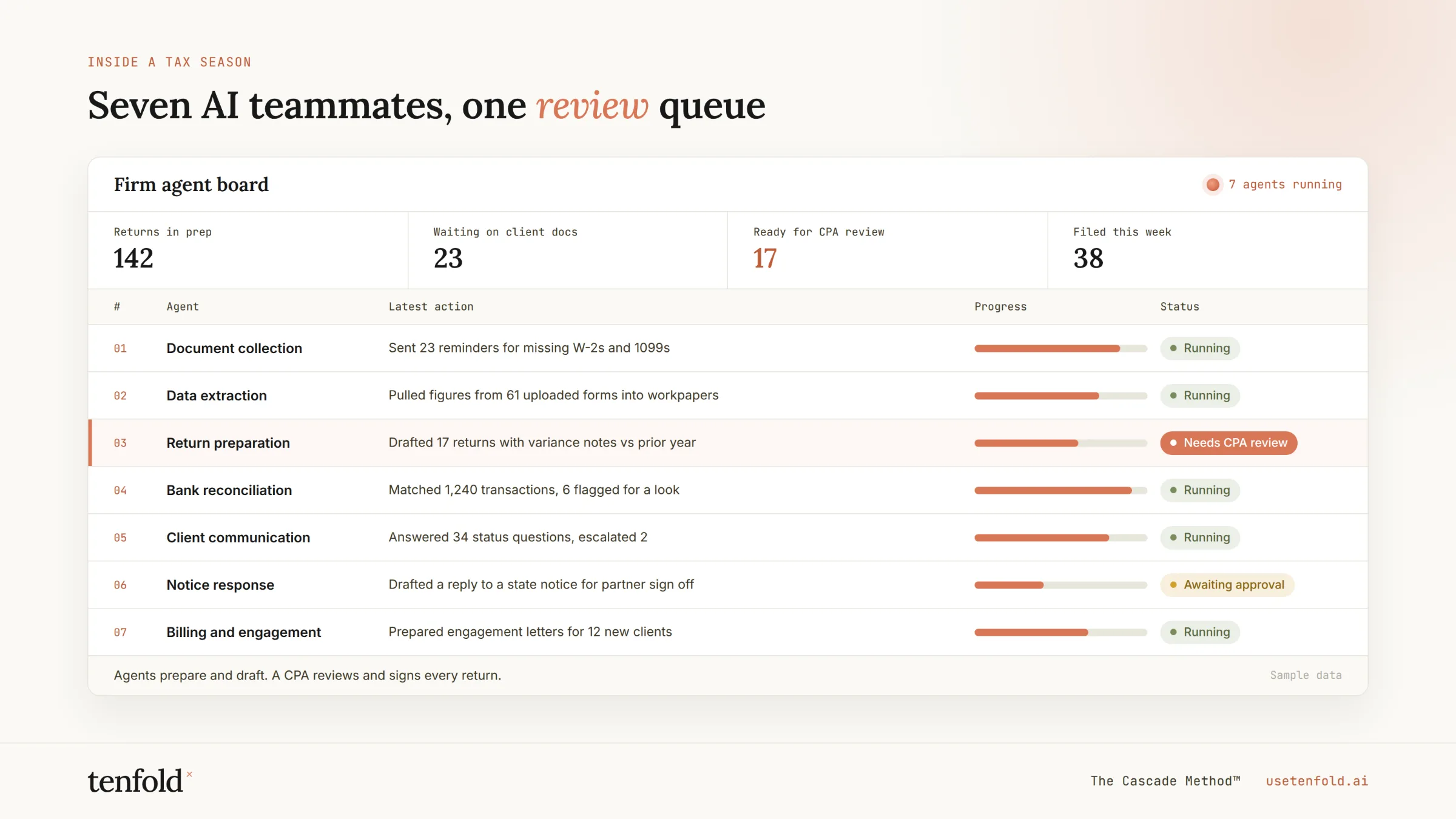
This is where AI agents are making the most measurable dent during tax season. Agents read multi-page PDFs — W-2s, 1099s, 1040s, K-1s — extract every relevant field into structured formats, and prepare draft workpapers for reviewer sign-off. No manual typing. No rekeying across systems.
According to DualEntry's 2026 AI in Accounting Guide, some firms report over 80% automation of individual tax return preparation, while audit teams are reducing document analysis time by 50% or more through AI-powered tools. The same source notes that AI cuts overall tax preparation time by up to 65%.
Thomson Reuters' *Ready to Review* product applies agentic AI to 1040 workflows specifically — automating an unprecedented share of the process so reviewers handle exceptions, not entry. At Plante Moran, a Michigan-based accounting and consulting firm, 96% of staff agreed their AI assistant (Thomson Reuters CoCounsel) was a useful tool after adoption.
For firms handling 500+ individual returns, the math is straightforward: agents compress weeks of data-entry work into hours of review.
Use Case 2: Client Document Collection and Follow-Up
For most accountants, chasing clients for missing documents is one of the most painful parts of tax season. It's pure coordination work — no judgment required, high volume, easy to drop.
AI agents now own this workflow end to end. According to TFSF Ventures, a Tax Organizer Agent can distribute customized tax organizers to every client based on entity type and prior-year filing history, track responses, send reminders, and flag incomplete submissions — all without a staff member touching it. For firms with 500+ returns, this agent eliminates thousands of manual follow-up emails during peak season.
The result isn't just time saved. It's a faster intake cycle that lets preparation begin earlier — compressing the entire season timeline.
Use Case 3: Compliance Monitoring and Deadline Tracking
Tax law changes constantly. Deadlines vary by jurisdiction. Extensions get filed. Estimated payments get adjusted. Keeping a clean compliance calendar across a book of 200+ clients is a full-time job — and a liability if something slips.
Agentic AI handles this by tracking regulatory updates, monitoring filing calendars, and flagging deadlines before they become problems. According to the Corporate Finance Institute's Practical Guide on AI Agents for Accounting, compliance monitoring agents track regulatory updates continuously, classify transactions against current tax rules, and surface patterns that suggest planning opportunities or structural changes warranting advisor input.
Thomson Reuters' 2025 State of Tax Professionals Report found that firms with a formal AI strategy are widening the performance gap over those without one — specifically in their ability to monitor compliance across large client portfolios without proportional headcount increases.
Use Case 4: Bookkeeping, Reconciliation, and Month-End Close
Bank reconciliation is the prototypical AI agent use case: repetitive, rules-based, high-volume, and error-prone when done manually under pressure. According to the Future Firm resource on AI agents in accounting, agents can process incoming invoices and transactions continuously throughout the month, learn firm preferences over time, flag anomalies, and present exceptions for human review — rather than routing every transaction through a staff member.
Ramp's Accounting Agent is a live example: it codes transactions at the moment they occur, gets smarter with each correction, and reconciles with the ERP in real time.
The Journal of Accountancy describes a fully agentic reconciliation workflow where an agent accesses the general ledger, subledgers, and bank feeds simultaneously, performs reconciliation, flags discrepancies with explanations, and generates draft adjustments for human approval — all without manual input at each step.
For mid-market firms, a case study cited by Tommaso Maria Ricci's 2026 AI for Accounting Guide is instructive: a professional services firm with an $8M revenue run rate reduced its accounting team's time on operational tasks from 60% to 35% within 90 days of AI deployment, then took on 40% more clients without adding headcount.
Use Case 5: Workflow Routing and Review Queue Management
Here's a failure mode that every firm recognizes: returns stack up on one reviewer's desk while two others have capacity. No one has visibility. Deadlines slip. Clients call.
Workflow routing agents solve this directly. According to TFSF Ventures, a Workflow Routing Agent assigns prepared returns to reviewers based on complexity, reviewer expertise, and current workload, then tracks review status and escalates bottlenecks automatically. During peak season, this prevents the pile-up problem without requiring a manager to actively redistribute work.
At scale, the same logic applies to audit queues, engagement letter approvals, and any multi-step review process where hand-offs between team members create latency.
Use Case 6: Client Advisory Triggers and Proactive Planning
This use case is where AI agents move from operational support to revenue generation. Instead of waiting for a client to ask about tax planning, an Advisory Trigger Agent monitors financial data continuously and surfaces opportunities before the client even knows to ask.
TFSF Ventures describes these agents monitoring for unusual income spikes that suggest estimated payment adjustments, entity type changes that could reduce tax burden, retirement contribution optimization windows, and capital gains harvesting opportunities — then routing these findings to the responsible CPA for review and client outreach.
According to the 2025 Intuit QuickBooks Survey, 93% of accountants now report using AI to support strategic advisory work, including generating real-time financial insights and creating AI-generated financial summaries. This isn't a marginal capability — it's becoming table stakes for firms that want to retain high-value clients.
Thomson Reuters research found that enterprise generative AI use among tax and accounting firms nearly tripled year over year, from 8% in 2024 to 21% in 2025 — with advisory applications leading the growth curve.
Use Case 7: Client Status Communication
The most common client inquiry during tax season: *"Is my return done yet?"* Multiply that by 400 clients across a 10-person team, and you have a meaningful drain on staff time — for a task that requires zero judgment.
A Client Status Agent pulls real-time status from the firm's workflow system and delivers formatted updates via email or text: return received, in preparation, in review, ready for signature, filed. According to TFSF Ventures, this agent eliminates hundreds of phone calls and emails during peak season — freeing staff to focus on actual tax work rather than status updates.
The broader point: this isn't a trivial automation. It's a client experience upgrade. Clients who get proactive status updates without asking are more satisfied, more likely to refer, and less likely to call the front desk.
What the Big 4 Are Already Running
For C-suite leaders evaluating whether this is real, the Big 4 deployments are the clearest signal:
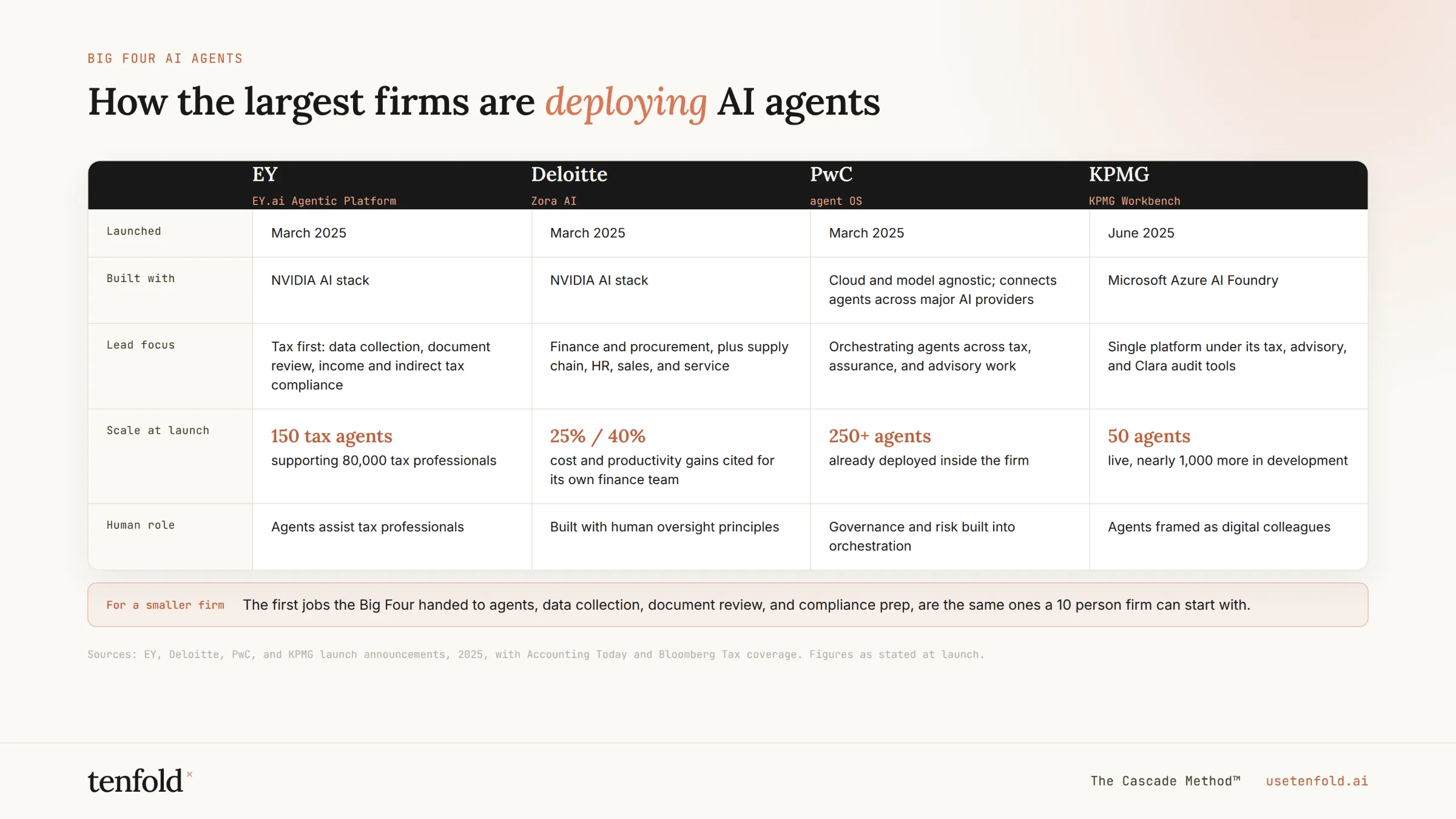
EY deployed 150 specialized AI agents supporting 80,000 tax professionals through EY.ai, handling data collection, document review, and tax compliance across 3 million+ compliance cases.
Deloitte's Zora AI, built on NVIDIA infrastructure, targets a 25% cost reduction and 40% productivity increase, with finance automation already live internally.
PwC's GL.ai handles journal entry review and GL analysis at client scale. PwC and OpenAI announced a joint initiative to build AI agents for planning, forecasting, reporting, tax, and accounting — described by PwC as focused on "practical, high-value workflows where AI agents can execute and coordinate work under human supervision."
KPMG has committed $2 billion over five years to AI deployment across audit, tax, and advisory.
The Big 4 are famously conservative institutions with significant client liability exposure. When they deploy AI agents at this scale, they're not experimenting. They're signaling that the risk calculus has shifted.
Summary
AI agents in accounting have moved past the pilot phase. The use cases are real, the efficiency gains are measurable, and the firms deploying at scale — from the Big 4 to lean mid-market practices — are widening the performance gap over those still running manual workflows. The seven use cases above represent where the ROI is clearest today: tax prep, document collection, compliance monitoring, reconciliation, workflow routing, advisory triggers, and client communication.
At Tenfold, we help organizations implement AI agents designed for exactly these kinds of high-volume, judgment-light workflows — the ones where autonomous execution creates the most headroom for the work that actually requires expertise. If your firm is evaluating where to start, that's where the conversation begins.
Frequently Asked Questions
Q: Are accounting firms actually using AI agents, or is this still experimental?
A: The deployments are live and at scale. Wolters Kluwer found AI adoption among accounting firms jumped from 9% to 41% in a single year. EY is running 150 agents supporting 80,000 professionals. Mid-market firms are deploying agents for reconciliation, tax prep, and document collection with measurable results.
Q: What's the difference between AI in accounting software and an AI agent?
A: Traditional AI in accounting software surfaces suggestions or flags issues for a human to act on. An AI agent takes action — it can pull from multiple systems, execute multi-step workflows, and route outputs to the next stage of a process without a human intervening at each step. The distinction matters because agents handle entire workflow segments, not just individual tasks.
Q: Will AI agents replace accountants?
A: No — but they will change what accountants spend their time on. The strongest use cases remove coordination work and surface exceptions earlier. Judgment calls, client relationships, complex tax positions, and audit sign-offs stay with experienced professionals. Deloitte's 2025 CFO survey found 49% of CFOs are prioritizing automation of routine work specifically to free people for higher-value tasks.
Q: Where should a mid-market firm start with AI agents?
A: Start with repetitive, evidence-rich workflows where the source of truth is clear and results can be checked against deterministic rules. Document collection, compliance calendar monitoring, and bookkeeping reconciliation are the highest-confidence first pilots. Expand only after you've measured results on a contained workflow.
Q: How does an AI agent handle compliance risk in accounting?
A: The key design principle is human control over tax positions, filings, advice, and material financial decisions. Agents prepare, draft, flag, and route — they don't file or approve. All material outputs flow to a reviewer before any external action is taken. This preserves the audit trail, segregation of duties, and professional accountability that regulated accounting work requires.
