

How Construction Firms Use AI Agents for Bids, RFIs, and Project Updates
They use them to take over the document-heavy, follow-up-heavy work that slows projects down. AI agents read bid packages and pull out scope and requirements, organize subcontractor bids, find answers to RFIs in existing drawings and specs, draft responses for review, track open items, and turn field notes into clear project updates. Project managers and estimators stay in control. They just spend far less time searching, chasing, and retyping.
Quick Answer: Construction firms use AI agents to review bid documents and extract scope, requirements, and deadlines; invite and follow up with subcontractors and level their bids; check incoming RFIs against drawings and specs, draft responses, and track response times; chase overdue submittals; and compile daily reports and project updates for owners and stakeholders. Engineers, estimators, and PMs review and approve the output.
Key Takeaways:
The Navigant Construction Forum's study of more than 1 million RFIs across 1,362 projects found the average project generated 796 RFIs, each costing about $1,080 to review and answer.
The same study found a median RFI response time of 9.7 days, and about 22% of RFIs never received a response.
13.2% of RFIs were unnecessary because the answer already existed in the project documents.
A 2018 PlanGrid and FMI study estimated that time spent on non-productive work like searching for project data and resolving conflicts costs the US construction industry about $177.5 billion in labor each year.
AI agents help most with bid document review, RFI research and drafting, submittal follow-up, and project reporting.
The Real Cost of Paperwork in Construction
Construction runs on information: drawings, specs, bid packages, submittals, RFIs, change orders, daily reports, and an endless stream of emails. Keeping that information moving is a full-time job, and often several.
RFIs show the scale of the problem. The Navigant Construction Forum, in a widely cited 2013 study of more than 1 million RFIs across 1,362 projects, found that the average project generated 796 RFIs. Each one cost about $1,080 to review and respond to, adding up to roughly $859,000 per project. The median response time was 9.7 days, and about 22% of RFIs never got a response at all, which the study flagged as a major predictor of disputes.
Even more telling: 13.2% of RFIs were unnecessary, because the answer was already in the contract documents. Someone just had to find it.
The broader picture is similar. A 2018 PlanGrid and FMI study estimated that rework, searching for project data, and resolving conflicts cost the US construction industry around $177.5 billion in labor every year.
The bottleneck isn't building. It's the information work around it.
How AI Agents Help with Bids and Estimating
Bid season is a volume game. Estimators have to review large bid packages, coordinate subcontractors, and get numbers out on tight deadlines.
Bid document review. The agent reads plans, specs, and bid instructions, then extracts scope, key requirements, bonding and insurance requirements, deadlines, and addenda into a clear summary.
Go or no-go support. It compares the opportunity against your criteria, like project type, size, location, and current backlog, to help leadership decide which bids to pursue.
Subcontractor outreach. It identifies the right subs for each trade from your database, sends invitations to bid, tracks responses, and follows up with those who haven't replied.
Bid leveling prep. It organizes incoming sub bids side by side, flags exclusions and scope gaps, and highlights missing information for the estimator.
Proposal assembly. It drafts qualifications, schedules, and standard proposal sections from your past submissions for the team to review.
How AI Agents Help with RFIs
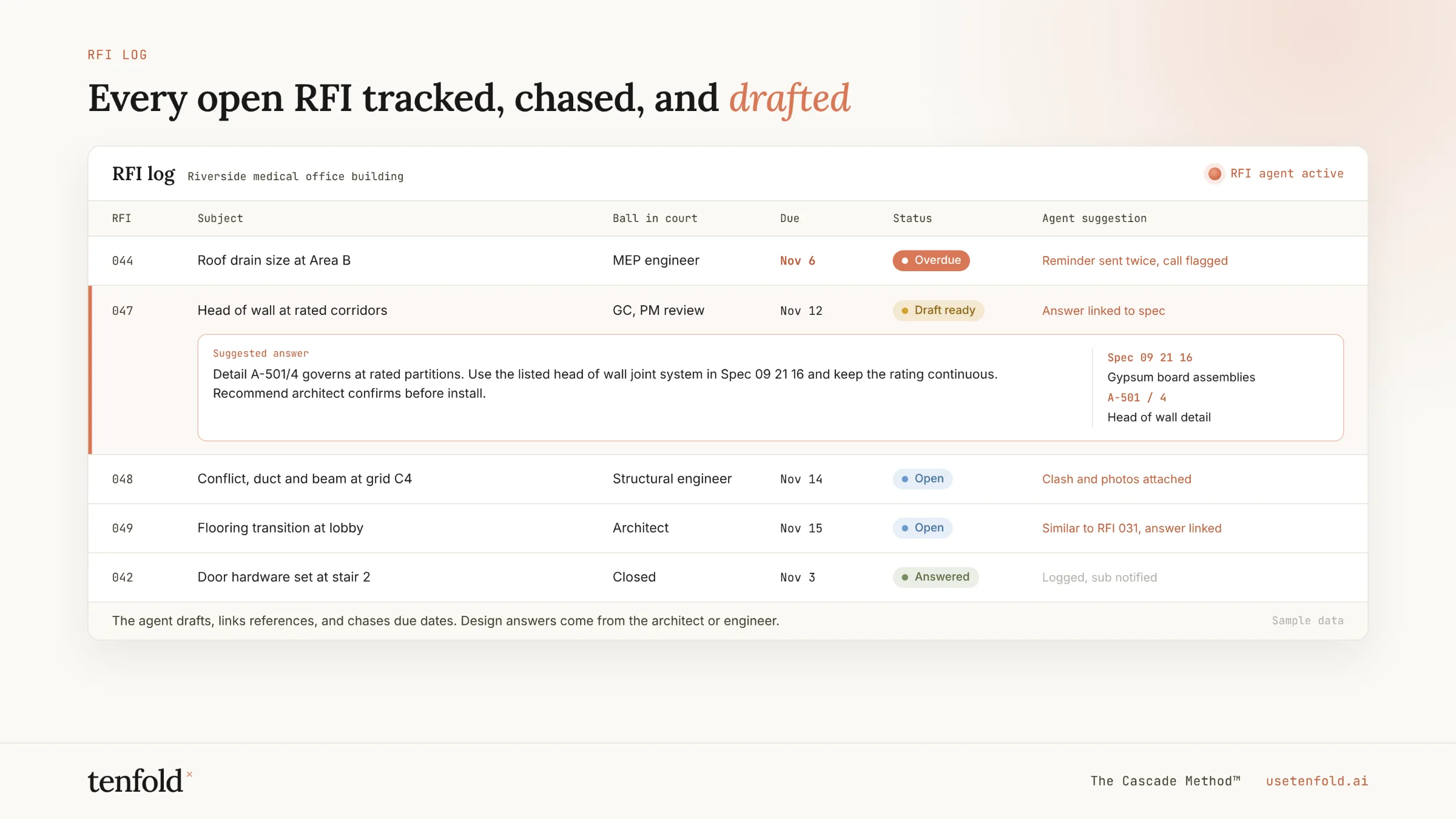
RFIs are one of the clearest fits for AI agents, because so much of the work is searching documents, drafting, and tracking.
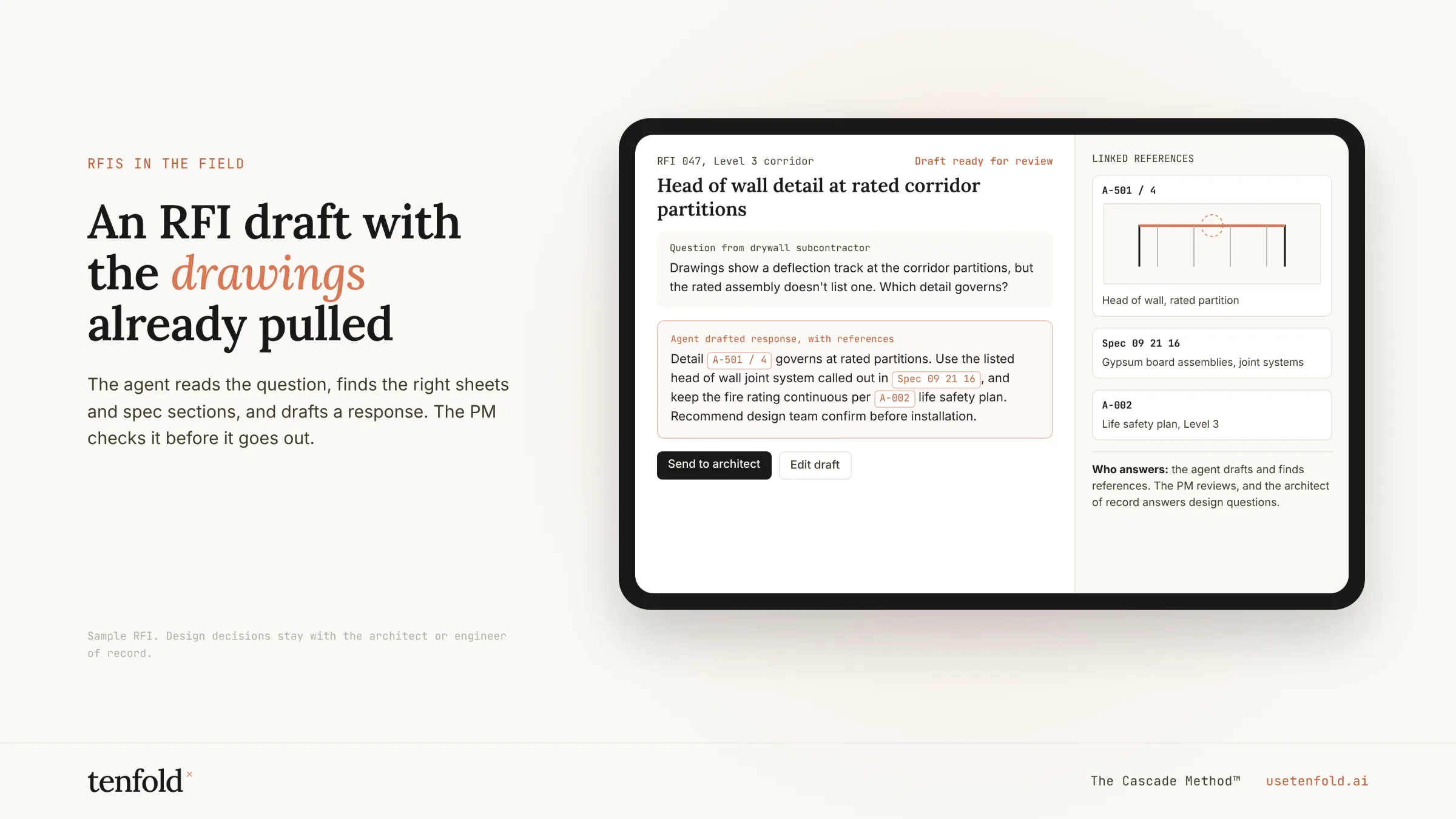
Pre-check before submitting. Before an RFI goes out, the agent searches the drawings, specs, and previous RFIs to see if the answer already exists. That alone targets the 13.2% of RFIs Navigant found to be unnecessary.
Research and drafting. For incoming RFIs, the agent finds the relevant drawing sheets, spec sections, and related RFIs, then drafts a response for the design team or PM to review.
Routing. It sends each RFI to the right reviewer based on discipline and includes the context they need.
Tracking and follow-up. It monitors response deadlines, sends reminders before they're due, and escalates overdue items, so nothing joins the 22% that never get answered.
Impact flagging. It flags RFIs that may affect cost or schedule so the team can address potential change orders early.
How AI Agents Help with Project Updates and Reporting
Owners, executives, and stakeholders all want updates, and PMs spend hours compiling them.
Daily reports. The agent turns field notes, photos, voice memos, and crew logs into structured daily reports.
Weekly owner updates. It compiles progress, open RFIs, submittal status, upcoming milestones, and risks into a clear summary for the PM to review and send.
Submittal follow-up. It tracks submittal deadlines and reminds subcontractors and reviewers before items become late.
Meeting notes and action items. It summarizes OAC meetings, captures decisions and action items, and follows up with owners.
Stakeholder questions. It answers routine questions about status, schedules, and documents from the project record.
What Separates AI Agents from Construction Software
Most firms already use project management platforms, estimating software, and document management tools. These are essential systems of record. But they still depend on people to search, draft, chase, and compile.
AI agents work on top of those systems. Instead of a PM searching through 400 drawing sheets to answer an RFI, the agent finds the relevant references and drafts the answer. Instead of an assistant manually chasing late submittals, the agent tracks deadlines and sends reminders automatically.
Software stores the information. Agents do the work of moving it.
Guardrails for Construction Firms
Licensed professionals approve technical answers. AI drafts RFI responses; the design team or engineer of record makes the call.
Contractual communications get human review. Anything that affects scope, cost, or schedule should be reviewed before it goes out.
Clear document sources. The agent should cite the specific drawing sheet or spec section behind every answer.
Access by project. Agents should only access documents for the projects they support.
Complete logs. Every action should be recorded for dispute protection and documentation.
Where Construction Firms Should Start
RFI pre-check and tracking. Fast wins on time saved and response times.
Submittal follow-up. Simple to deploy and reduces schedule risk.
Bid document review and sub outreach. High impact during bid season.
Project reporting. Broad time savings for PMs once data flows are connected.
At Tenfold, we've found that the construction firms seeing the fastest results aren't the ones with the most software. They're the ones that clearly define which workflows they want to hand off, keep licensed professionals approving technical decisions, and give the agents access to the project documents they need.
Summary
Construction firms lose enormous time to bid prep, RFIs, submittals, and reporting. Navigant's study of more than 1 million RFIs found each costs about $1,080 to process, the median response takes 9.7 days, 22% go unanswered, and 13.2% weren't necessary in the first place. AI agents can review bid documents, coordinate subcontractors, research and draft RFI responses, track deadlines, and compile project updates, while engineers, estimators, and PMs keep final approval. The constraint isn't what AI can do. It's whether your firm is ready to delegate.
Tenfold helps construction firms evaluate, implement, and operationalize AI agents for bids, RFIs, submittals, and project reporting, with human review built in.
Frequently Asked Questions
Q: How are construction companies using AI agents?
A: Construction firms use AI agents to review bid documents, coordinate subcontractor bids, research and draft RFI responses, track RFI and submittal deadlines, compile daily reports, and prepare project updates for owners and stakeholders.
Q: Can AI agents answer RFIs?
A: AI agents can research RFIs by finding relevant drawings, specs, and past RFIs, and draft responses for review. Technical answers should always be reviewed and approved by the responsible design professional or PM.
Q: How much do RFIs cost construction projects?
A: The Navigant Construction Forum found the average RFI cost about $1,080 to review and respond to, with an average of 796 RFIs per project, adding up to roughly $859,000 per project.
Q: Can AI help with construction bidding?
A: Yes. AI agents can summarize bid packages, extract requirements and deadlines, invite and follow up with subcontractors, organize sub bids for leveling, and draft standard proposal sections.
Q: Will AI agents replace project managers or estimators?
A: No. AI agents take over document searching, drafting, tracking, and follow-up so PMs and estimators can focus on decisions, relationships, and keeping projects on track.
