
How Much Does It Cost to Build a Custom AI Agent in 2026?
Building a custom AI agent in 2026 costs between $10,000 and $450,000+, depending on how complex the system is, how many integrations it needs, and how tightly regulated your industry is. Most mid-market builds land between $40,000 and $150,000. But the build cost is only part of the story — and often the smallest part of what you'll spend over three years.
At Tenfold, we're AI agent specialists. We've built and deployed agent-first systems that handle real enterprise workflows, and we've seen firsthand where budgets go wrong. This guide gives you the honest numbers.
Quick Answer: A simple task-automation agent starts around $10,000–$30,000. A mid-tier autonomous workflow agent runs $30,000–$120,000. Enterprise-grade multi-agent systems with custom integrations and compliance layers start at $150,000 and can exceed $450,000. Add 15–30% of the build cost annually for ongoing maintenance.
Key Takeaways:
Custom AI agent development ranges from $10K (simple chatbot) to $450K+ (multi-agent enterprise system)
Annual maintenance costs add 15–30% of the original build cost every year
Monthly operating costs (API fees, cloud hosting, monitoring) run $500–$15,000+ post-launch
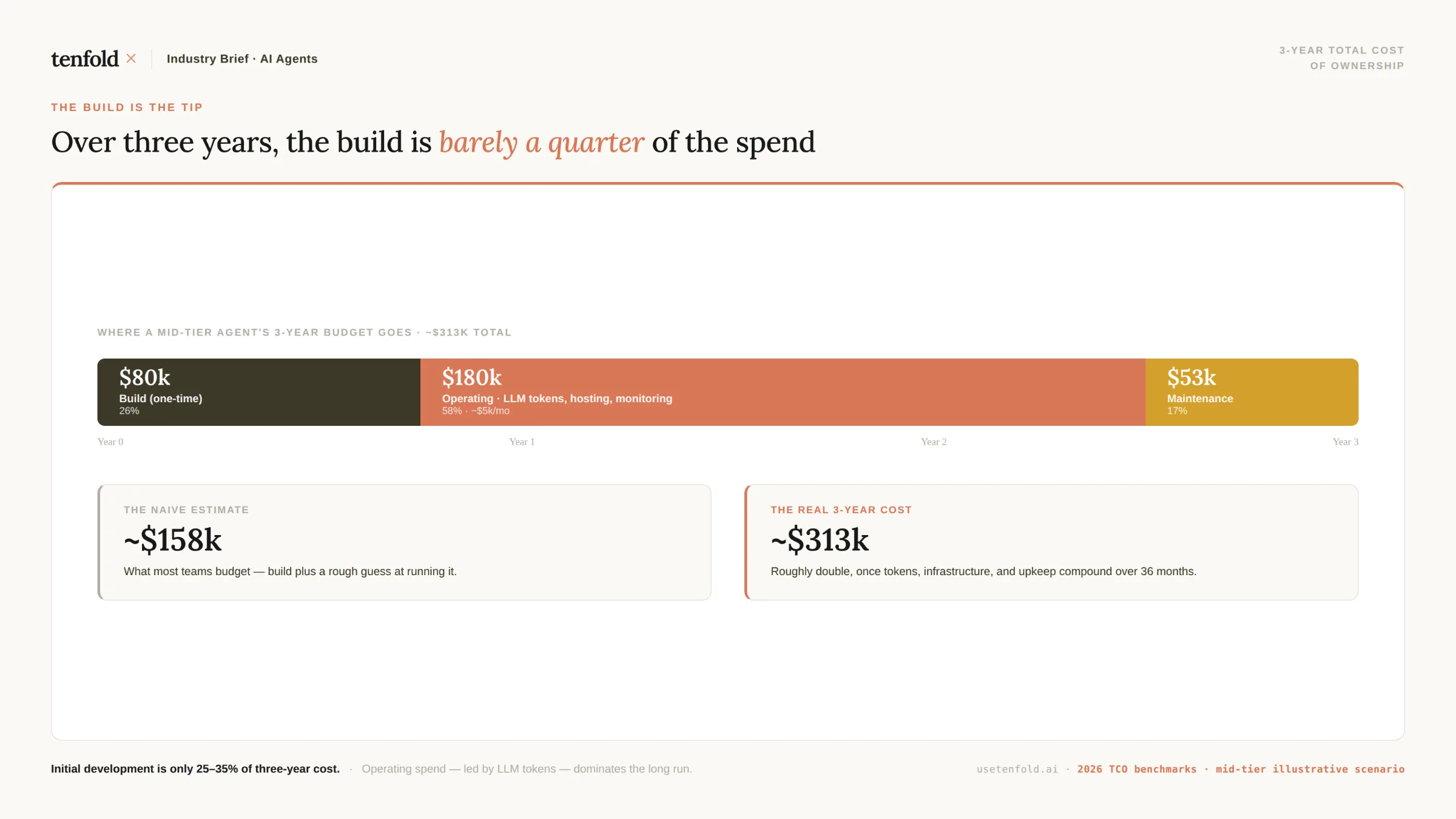
The build cost typically represents only 25–35% of three-year total cost of ownership
A focused MVP scope can cut initial build cost by 30–50% without sacrificing business value
ROI timelines of 4–8 months are realistic for well-scoped, high-volume workflow automation
What Drives AI Agent Development Costs
Cost is not determined by a single variable. It is the product of at least five compounding factors — and misjudging any one of them is how projects end up 40–60% over budget.
Autonomy level is the primary driver. A rule-based reflex agent that responds to fixed inputs costs a fraction of a fully autonomous agent that plans multi-step tasks, reasons about context, and executes actions without supervision. Each step up in autonomy can add tens of thousands in development cost due to guardrail implementation, larger context window management, and extensive testing requirements.
Integration depth is the second biggest variable. According to DestiLabs, every API your agent needs to call — Salesforce, Stripe, Shopify, your ERP, your proprietary database — adds $2,000–$5,000 in development time per integration. Legacy enterprise systems often require custom connectors, middleware layers, and schema mapping that can take 4–8 weeks per system.
Compliance requirements can double a budget overnight. HIPAA, SOC 2, GDPR, and PCI-DSS each add audit logging, data handling constraints, and security reviews. According to Azilen, healthcare and financial services agents cost the most — $120,000–$400,000+ — precisely because of compliance, auditability, and accuracy requirements.
Team location and composition determine how far your budget stretches. According to Groovy Web, US-based senior AI engineers bill at $150–$250/hour, while offshore teams with genuine production experience bill at $30–$80/hour. On a typical mid-complexity engagement requiring 1,500 development hours, that difference exceeds $180,000.
Data readiness is the most underestimated cost of all. According to Riseup Labs, data preparation sometimes matches the modeling cost itself — and that expense shows up before a single line of agent code is written.
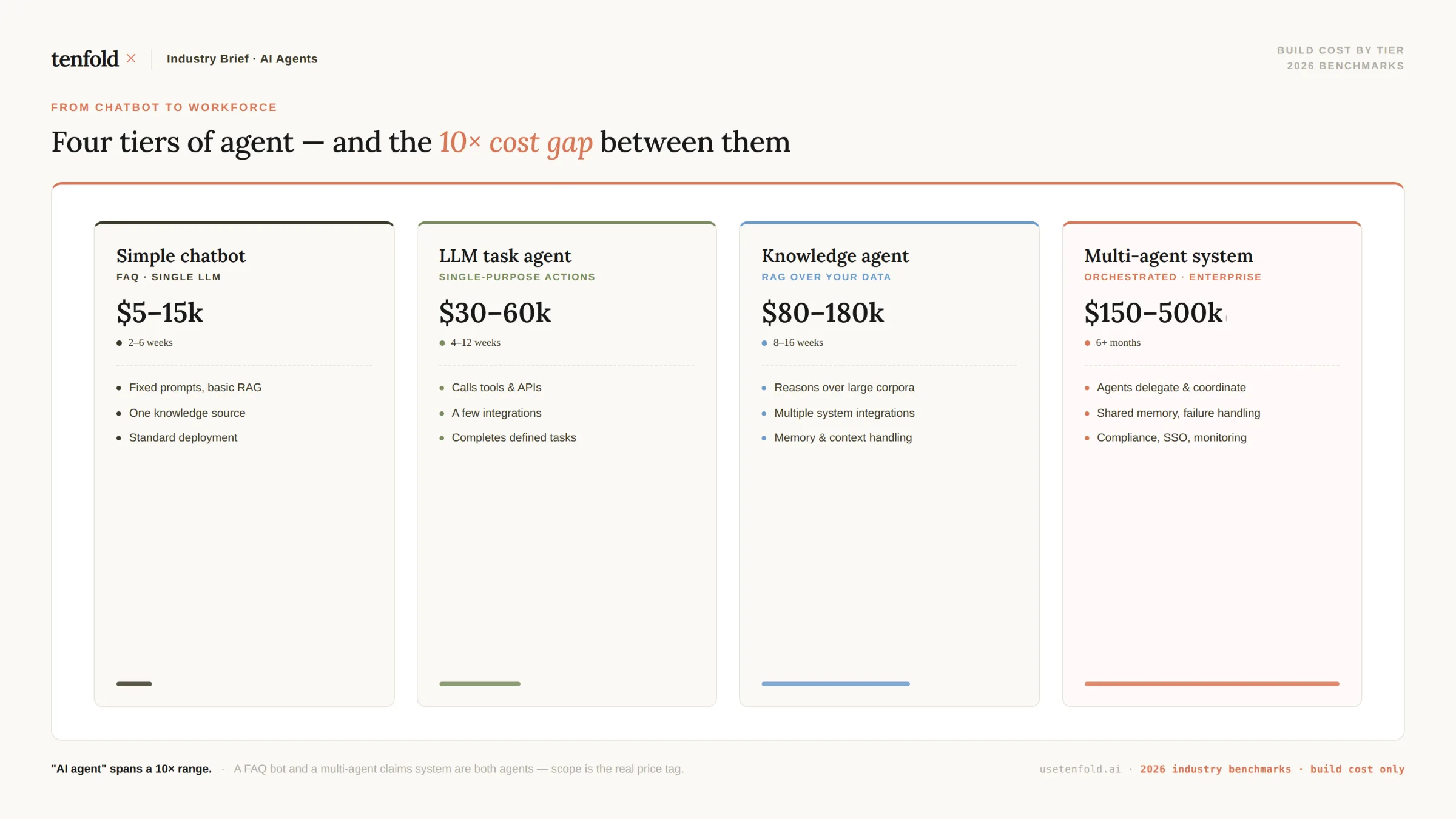
The Four Cost Tiers in 2026
Here is how AI agent development breaks down across complexity levels, based on current market data.
Tier 1 — Simple Reflex Agents ($5,000–$30,000)
These are rule-based systems with no memory, no planning, and no awareness of past interactions. They handle predictable inputs with scripted responses. Use cases include FAQ bots, basic triage agents, and single-process automation.
According to Riseup Labs, simple reflex agents (basic chatbots) cost under $10,000 at the low end, while a custom-built simple agent with better reliability and integration runs $20,000–$30,000. Timeline: 4–8 weeks.
Be clear about what this tier cannot do. A Tier 1 agent does not read your CRM, does not trigger downstream workflows, and does not handle ambiguous inputs gracefully. If you need any of those things, you're in Tier 2.
Tier 2 — Autonomous Workflow Agents ($30,000–$120,000)
This is where most mid-market projects belong. These agents use large language models (LLMs) to understand context, call external tools, update records, trigger actions, and loop until a task is complete.
According to DestiLabs, a multi-step autonomous agent that handles real business workflows — placing orders, processing refunds, updating CRMs — runs $50,000–$150,000. Azilen puts LLM task agents at $50,000–$120,000 and RAG-based knowledge agents at $80,000–$180,000.
Timeline: 2–4 months. A Tier 2 agent with three integrations is a very different scope from one with fifteen.
Tier 3 — Enterprise Multi-Agent Systems ($150,000–$450,000+)
These are coordinated systems where multiple specialized agents collaborate across complex, regulated workflows. They require custom ML models, orchestration layers, persistent memory architecture, and comprehensive observability infrastructure.
According to Azilen, multi-agent systems with planning start at $150,000 and go well beyond $400,000. DestiLabs reports that enterprise-grade multi-agent orchestration with compliance, audit trails, and custom ML models pushes past $200,000. Timeline: 6+ months.
If your use case involves sensitive customer data across multiple systems in a regulated industry, you're building in this tier. Plan accordingly.
A Real-World Example
A mid-market UK fashion retailer needed an agent to automate product listing updates across six marketplaces. Their team was spending 40 hours per week on manual updates. According to Groovy Web, the build — a Tier 2 multi-step workflow agent using GPT-4o with a custom prompt library — cost $34,000 with monthly operating costs of $420. That is a realistic benchmark for a focused, well-scoped Tier 2 build.
The Hidden Costs Most Vendors Won't Quote You
The build price is only the beginning. This is where most AI agent budgets unravel.
LLM API tokens. Every time your agent reasons, retrieves, or responds, you're paying per token. According to DestiLabs, a Tier 2 agent handling 10,000 customer interactions per month using GPT-4o costs roughly $250/month in API fees alone. Model routing — using cheaper models for simple queries and expensive ones only when needed — is one of the highest-ROI optimizations you can build in from the start.
Cloud infrastructure. Ongoing API usage (GPT-4, Claude) runs $100–$10,000/month depending on volume. Cloud hosting adds $200–$5,000/month on top of that, according to Riseup Labs.
Vector database hosting. RAG-based agents require vector databases (Pinecone, Weaviate, Qdrant). Production workloads start at $70/month and scale with data volume.
Monitoring and evaluation. Continuous evaluation tools like LangSmith, Braintrust, or custom eval pipelines cost $100–$1,000/month and require engineering time to maintain. Skipping this is how you end up with an agent that confidently gives users the wrong answer.
Security and access control. If the agent handles real business data, you need access controls, logging, role-based logic, and API gating. According to Azilen, this adds $500–$2,000/month depending on complexity and compliance needs.
Combined, Azilen reports that mid-tier enterprise agents carry $3,200–$13,000/month in operational spend post-launch, covering LLM API tokens, vector database hosting, monitoring, prompt tuning, and security upkeep. Most teams don't budget for this until the invoice arrives.
The 3-Year Total Cost of Ownership
The number that actually matters isn't the build cost. It's the three-year TCO.
According to alphacorp.ai, initial development represents only 25–35% of three-year costs, with LLM consumption dominating long-term budgets. In practice: if someone quotes you $80,000 to build an agent, your three-year budget should be closer to $230,000–$320,000.
Annual maintenance is the most consistent cost benchmark in the market. According to ProductCrafters, annual maintenance works out to 15–25% of the initial build cost — and fast-growing systems can exceed that. Riseup Labs puts the range at 15–30%.
The math is straightforward. Plan for it, or discover it the hard way.
What the ROI Case Actually Looks Like
The cost is real. So is the return — when the agent is properly scoped.
According to McKinsey's 2026 State of AI, companies that budget correctly and scope precisely can see a 5.8x ROI on AI investment within 14 months of production deployment. Most mid-market implementations see payback within 6–12 months when targeting high-volume, repetitive workflows with clear labor cost baselines.
According to Azilen, a sales intelligence agent saving 10 hours per week across 15 account executives recovers roughly $15,000 per week in productive time — paying back a $150,000 investment in 3–6 months.
Deloitte's State of AI in the Enterprise 2026 found that nearly three-quarters of companies report their most advanced AI initiatives met or exceeded ROI targets — with around 20% seeing returns over 30%.
The bottleneck isn't ROI potential. It's that most organizations scope too broadly in version one, then overspend on a system that takes 14 months to deliver.
How to Reduce Your Build Cost Without Cutting Corners
There are four levers that consistently control cost without sacrificing output quality.
Narrow the scope on v1. According to Azilen, a focused scope reduces engineering time, testing surface area, and integration complexity — often cutting initial AI agent costs by 30–50%. Build one agent that does one task extremely well. Expand from there.
Start with open-source models. Use LLaMA 3, Mistral, or Ollama for early-stage development and evaluation. Shift to OpenAI or Claude only when performance requirements justify the cost. This approach keeps prototype costs contained while you validate the use case.
Use proven orchestration frameworks. LangChain, LangGraph, CrewAI, and Haystack save weeks of engineering time. According to Azilen, picking the right framework at the start can reduce backend engineering costs by 20–40%.
Build observability in from day one. Prompt versioning, feedback loops, and analytics built in from the start are significantly cheaper than retrofitting them after launch. Post-launch behavior drift — accuracy dips, token spikes, unexpected outputs — is where most costs hide.
Build vs. Buy: The Decision That Changes Everything
Not every use case justifies a custom build.
According to alphacorp.ai, ready-to-deploy agents hold 77.3% of the U.S. AI agent market because they reduce technical burden and accelerate implementation. If your use case fits a vendor's capabilities and you don't need deep integration with proprietary internal systems, a no-code or low-code platform may be the right starting point.
Custom builds make sense when your workflow is genuinely differentiating, when data control and IP ownership matter, or when you need to integrate with legacy enterprise systems at depth. According to Decipherzone, the three-year TCO comparison almost always favors custom builds for organizations with high transaction volume or unique data requirements.
The wrong answer is committing to a full custom build before you've scoped the actual workflow complexity. That is consistently the most expensive mistake in AI agent procurement.
At Tenfold, we scope before we build. Not because it's standard practice — because it's the only way to know what tier you're actually in before you've spent anything.
Summary
Custom AI agent development in 2026 ranges from $10,000 for a simple rule-based agent to $450,000+ for an enterprise-grade multi-agent system — with most mid-market projects landing between $40,000 and $150,000. But the build cost is only 25–35% of your three-year exposure once API usage, maintenance, monitoring, and infrastructure are factored in. The organizations that get the best ROI aren't the ones spending the most — they're the ones scoping precisely, building phased, and treating the agent as a continuously operated system, not a one-time project.
Tenfold is built to help enterprise and mid-market organizations implement AI agents that deliver measurable outcomes from day one. If you're evaluating a build, [get in touch with the Tenfold team](/contact) to scope your use case before you commit to a budget.
Frequently Asked Questions
Q: How much does it cost to build a basic AI agent in 2026?
A: A basic rule-based or single-task AI agent costs between $5,000 and $30,000 to build in 2026. This covers simple chatbots, FAQ assistants, and single-process automation tools. These agents have no memory, no planning capability, and limited integration depth — but they can provide fast ROI for narrow, well-defined tasks.
Q: What is the most expensive part of building an AI agent?
A: For most enterprise builds, the engineering layer is the dominant cost — not the LLM API fees. Model API costs represent only 8–15% of total build cost for most enterprise agentic systems. Integration engineering, MLOps setup, security infrastructure, and compliance layers drive the majority of the budget.
Q: How much does AI agent maintenance cost per year?
A: Annual maintenance typically runs 15–30% of the original development cost every year. For a $100,000 build, expect $15,000–$30,000 in annual maintenance. This covers LLM model updates, prompt re-tuning when providers release new versions, security patches, and infrastructure scaling.
Q: How long does it take to build an AI agent?
A: A basic chatbot or FAQ assistant can be built in 4–8 weeks. More advanced NLP and workflow agents typically require 2–4 months. Complex multi-agent or enterprise-grade systems may take 6+ months. Each extra month of development typically adds $20,000–$40,000 in cost depending on team size, so efficient scoping and phased delivery matter.
Q: What's the ROI timeline for a custom AI agent?
A: ROI timelines of 4–8 months are realistic for well-scoped AI agents targeting high-volume, repetitive workflows with clear labor cost baselines. McKinsey's 2026 State of AI research shows a 5.8x ROI on AI investment within 14 months of production deployment for well-scoped projects. Most mid-market implementations see 2x–4x returns over 36 months.
