
How Staffing Agencies Use AI Agents to Screen Candidates Faster
They use AI agents to handle the first pass that's been burying recruiters: reading every application, checking it against the job's real requirements, asking candidates the qualifying questions a recruiter would ask, and delivering a ranked shortlist with notes. Recruiters stay in control of who moves forward. They just stop spending their days on candidates who were never a fit.
Quick Answer: Staffing agencies use AI agents to screen candidates by parsing resumes against job requirements, scoring applicants on must-have qualifications, reaching out by text or email to confirm availability, pay expectations, location, and work authorization, scheduling recruiter interviews, updating the ATS, and producing ranked shortlists. The agent handles volume and speed. Recruiters make the decisions, build relationships, and close placements.
Key Takeaways:
Greenhouse data shows an average of 244 applications per job in 2025, more than double the 2022 level.
CareerPlug's 2025 data found employers average about 180 applicants per hire, and only about 3% of applicants reach an interview.
SHRM data puts the typical recruiter workload at about 20 open requisitions at once.
AI agents compress the screening stage from days to hours by handling first-pass review, candidate outreach, and scheduling.
The best agency deployments keep humans making final decisions, document screening criteria clearly, and monitor for bias.
The Real Cost of Manual Screening for Staffing Agencies
Staffing is a speed business. The agency that presents a qualified candidate first usually wins the placement. But application volume has made speed harder than ever.
According to Greenhouse platform data, job postings averaged 244 applications each in 2025, more than double the level in 2022. CareerPlug's 2025 report, based on more than 10 million applications, found employers receive roughly 180 applicants for every hire, and only about 3% of applicants make it to an interview.
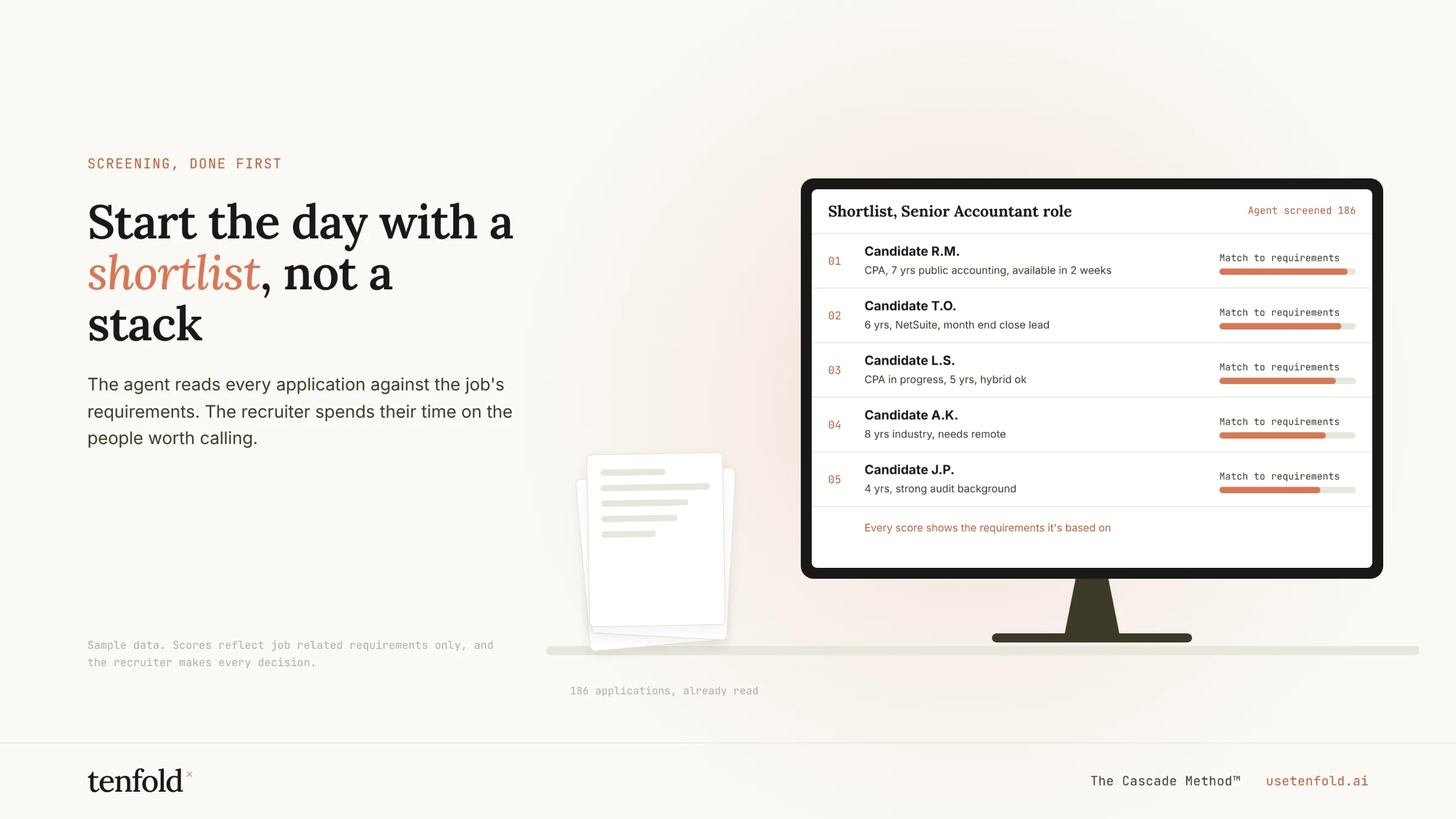
Now multiply that across a recruiter's desk. SHRM data puts the typical recruiter at around 20 open requisitions at a time. Even at a few minutes per resume, first-pass screening alone can eat entire days every week, and most of that time is spent rejecting candidates who were never qualified.
Meanwhile, the best candidates are often off the market within days. Every hour spent sorting through unqualified applications is an hour a competitor can use to reach the right candidate first.
The bottleneck isn't recruiter skill. It's volume.
How AI Agents Screen Candidates: The Four-Stage Model
Stage 1: First-pass resume review
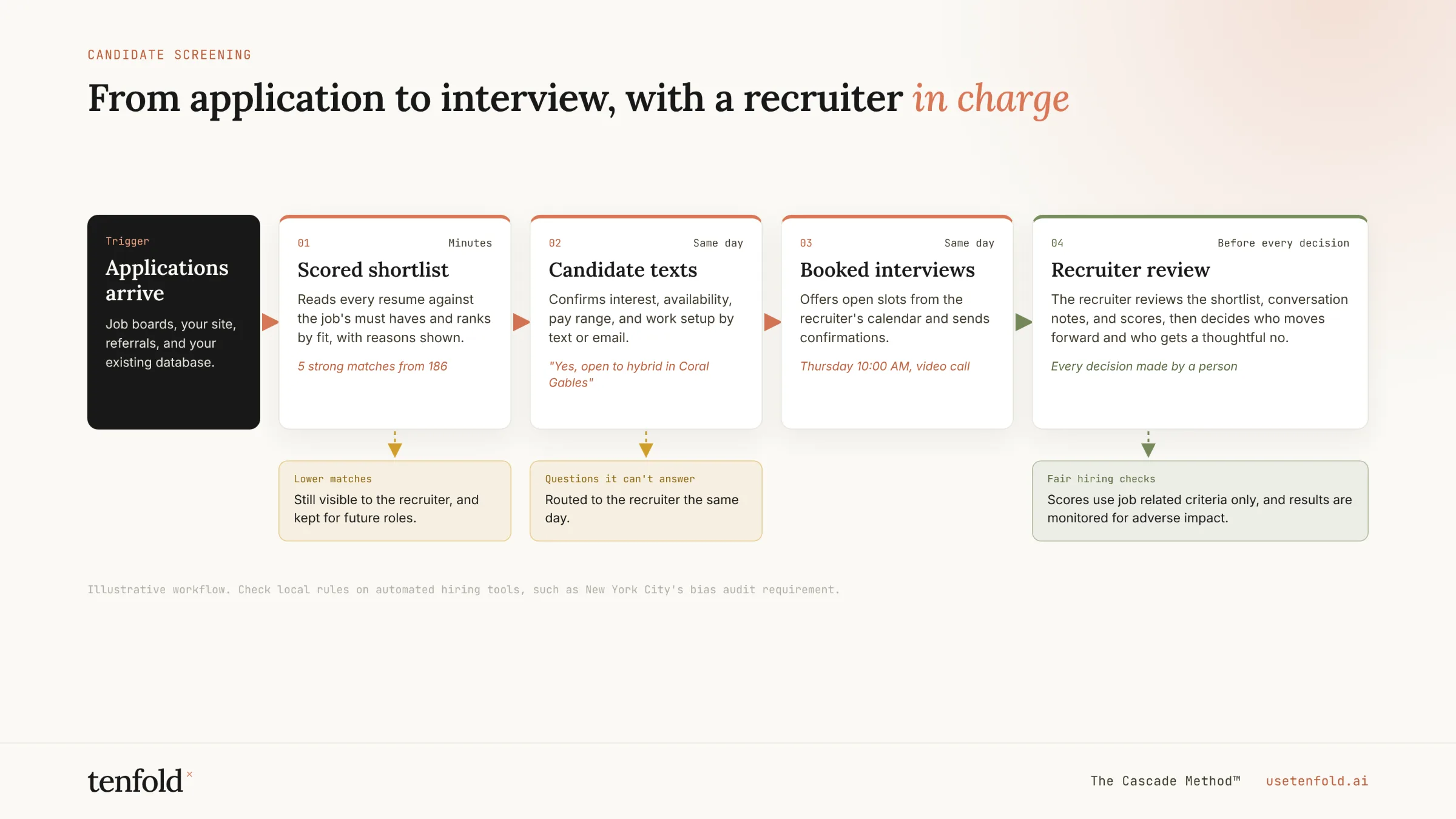
The AI agent reads every application as it arrives and compares it against the job's actual requirements: required certifications, years of experience, specific skills, licenses, location, shift availability. Instead of keyword matching, it interprets context, recognizing equivalent job titles and relevant experience described in different words. Each candidate is scored and tagged with the reasons behind the score.
Stage 2: Candidate outreach and qualifying questions
For candidates who pass the first review, the agent reaches out by text or email within minutes. It asks the questions recruiters ask on every call: Are you available for this schedule? What pay range are you targeting? Can you commute to this location? Do you have the required certification? Are you authorized to work? Responses are captured and added to the candidate record.
Stage 3: Scheduling
Qualified, interested candidates are offered times on the recruiter's calendar and booked automatically, with reminders to reduce no-shows. Candidates who aren't a fit for this role can be tagged for future openings instead of disappearing.
Stage 4: Shortlist and handoff
The recruiter receives a ranked shortlist with a summary for each candidate: how they match the requirements, their answers to qualifying questions, and any flags. The ATS is updated automatically, so the recruiter starts every conversation already informed.
What Separates AI Agents from Basic ATS Screening
Most agencies already have an ATS with knockout questions and keyword filters. So what's different?
Keyword filters are rigid. They reject a strong candidate who described their experience in different terms and pass a weak one who stuffed their resume with the right words. Knockout questions only work if the candidate fills them out.
AI agents work more like a recruiter's first pass. They interpret experience in context, follow up with candidates directly, ask clarifying questions, schedule interviews, and update records across systems. Instead of filtering a list, they move candidates forward.
Automation filters applications. Agents run the screening workflow.
Guardrails Every Agency Should Put in Place
Screening decisions affect people's livelihoods, and AI in hiring is increasingly regulated. Agencies should build in clear guardrails:
Humans make hiring decisions. The agent ranks and summarizes. Recruiters decide who moves forward.
Use job-related criteria only. Screening criteria should be tied directly to the role's real requirements, documented, and agreed with the client.
Monitor for bias. Review outcomes regularly to make sure the agent isn't disproportionately screening out any group.
Be transparent with candidates. Let candidates know when AI is part of the process, and give them a way to reach a person.
Follow local rules. Some jurisdictions, like New York City, require bias audits and candidate notices for automated hiring tools. Involve legal counsel to confirm requirements where you operate.
Where Agencies Should Start
High-volume roles first. Light industrial, warehouse, customer service, and healthcare support roles see the largest application volumes and the clearest requirements.
Candidate outreach and scheduling. Fast to deploy and immediately visible to recruiters.
Database reactivation. Your ATS is full of past candidates. An agent can re-engage them for new openings before you spend on job boards.
Specialized roles. Expand to more complex roles once screening criteria and review processes are proven.
At Tenfold, we've found that the staffing agencies seeing the fastest results aren't the ones with the most recruiting technology. They're the ones that clearly define what a qualified candidate looks like for each role, and give the agent the access to screen, reach out, and schedule on its own.
Summary
Staffing agencies are facing more applications than ever, with Greenhouse data showing 244 applications per job in 2025 and CareerPlug finding only about 3% of applicants reach an interview. AI agents help recruiters keep up by handling first-pass review, candidate outreach, qualifying questions, scheduling, and shortlisting, while recruiters keep control of hiring decisions. With job-related criteria, bias monitoring, and transparency built in, agencies can present qualified candidates faster and spend more time on the relationships that win placements.
Tenfold helps staffing agencies evaluate, implement, and operationalize AI agents for candidate screening, outreach, and scheduling, with human oversight and compliance built in.
Frequently Asked Questions
Q: How do staffing agencies use AI to screen candidates?
A: AI agents review applications against job requirements, score and rank candidates, reach out to ask qualifying questions, schedule interviews with recruiters, and update the ATS. Recruiters review the shortlist and make all hiring decisions.
Q: Will AI agents replace recruiters?
A: No. AI agents take over high-volume, repetitive screening and scheduling so recruiters can spend more time with qualified candidates, clients, and closing placements.
Q: Is AI candidate screening legal?
A: Generally yes, but rules vary by location. Some jurisdictions, like New York City, require bias audits and notices for automated hiring tools. Agencies should use job-related criteria, keep humans in decision-making, monitor for bias, and consult legal counsel.
Q: Can AI agents work with my existing ATS?
A: In most cases, yes. AI agents can connect to popular applicant tracking systems through APIs to read job requirements and candidate records, log activity, and update candidate statuses.
Q: How much faster is AI screening than manual screening?
A: It depends on volume and role complexity, but AI agents can review applications as they arrive and reach out to qualified candidates within minutes. That can compress a screening stage that often takes days into a matter of hours.
