
How to Know If Your Business Is Ready for AI Agents (AI Readiness Checklist)
Your vendors have rebranded everything "agentic," and somewhere in your inbox is a proposal to launch an AI agent project by end of quarter. Here's what the data actually says: only about 17 percent of organizations have deployed AI agents, yet more than 60 percent expect to within two years. That gap between ambition and execution isn't a coincidence — it's a readiness problem. Gartner predicts over 40 percent of agentic AI projects will be canceled by the end of 2027, and the projects that fail don't fail because the technology doesn't work. They fail because the organizations deploying them weren't ready.
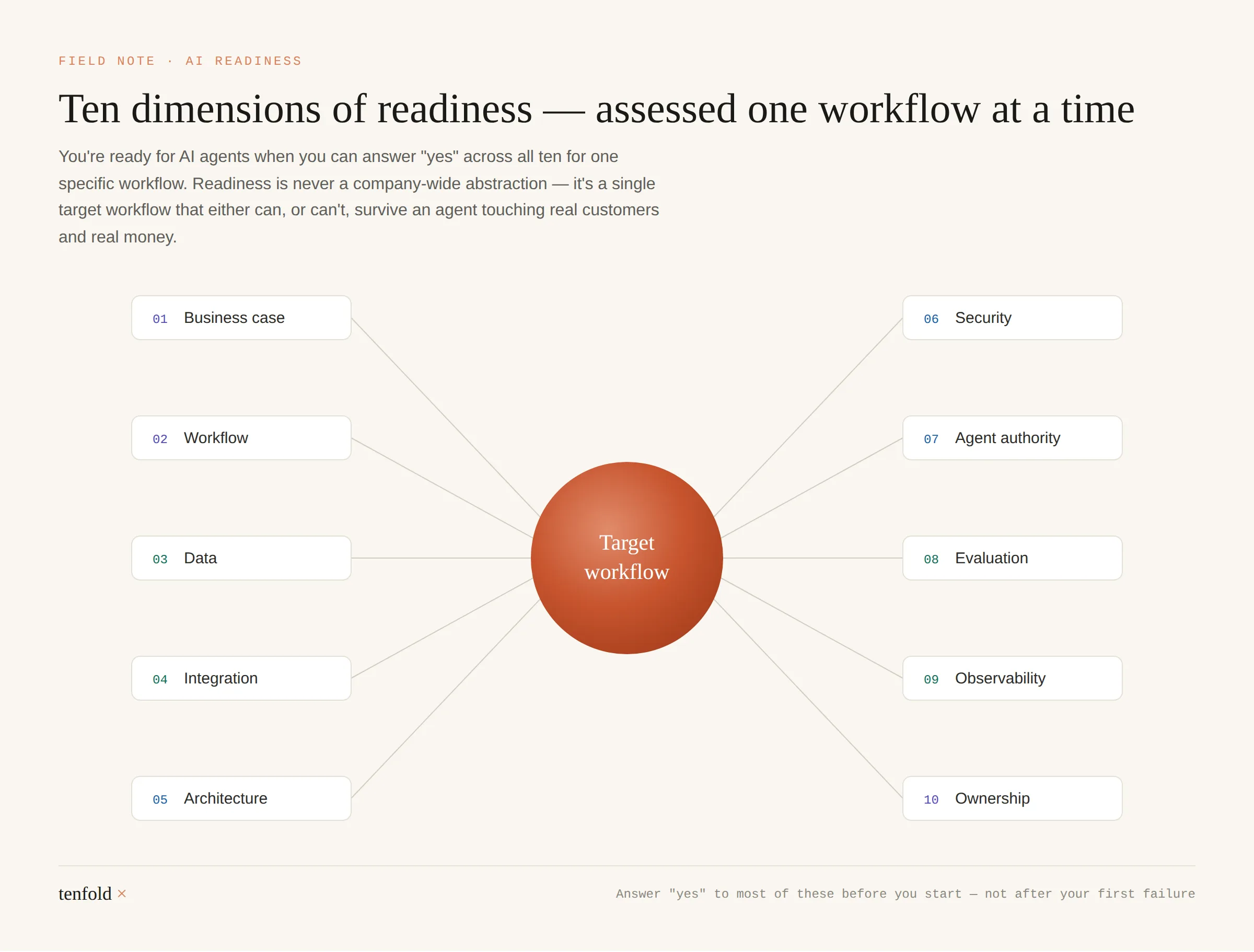
Quick Answer: Your business is ready for AI agents when you can answer "yes" across ten dimensions for one specific workflow: a clear business case, a documented workflow, trustworthy and accessible data, working system integrations, defined agent authority (what it can read, decide, execute, and never touch), security and compliance controls, evaluation criteria, observability, and a named owner accountable for outcomes. Readiness is assessed one workflow at a time — not as a company-wide abstraction.
Key Takeaways:
Getting an AI model to produce something useful is no longer hard. The real question is whether one specific workflow can survive an agent once it starts touching real customers and real money.
Poor data quality is the number-one blocker — IBM found 53 percent of organizations cite it as their top barrier to AI adoption, and Gartner has warned organizations will abandon 60 percent of AI projects through 2026 for lack of AI-ready data.
Agent authority must be explicitly defined: an agent might draft a reply but not send it, summarize a contract but not approve it, prepare a CRM update but require human confirmation to save it.
The failures are organizational, not technical: unclear ownership, undocumented workflows, scattered data, and missing accountability are the reasons to pause before an agent touches a workflow.
Start narrow: pick one revenue-adjacent process, make its data trustworthy, ship one production agent, and compound from there — with foundations in place, a scoped first use case typically reaches production in 90–120 days.
Why Readiness Is About Workflows, Not Ambition
Most AI readiness frameworks stay too abstract. The useful version assesses one real workflow at a time, because that's where agents succeed or fail. Think of a simple example: an agent that does your grocery shopping. If it doesn't know which stores you use, it orders from one that doesn't deliver. If it doesn't know your preferences, you get food you won't eat. If it doesn't know when you're home, the milk spoils on the porch. The lesson scales directly to business: an agent without documented context around your process, data, and rules won't just underperform — it can execute flawed logic that creates operational, security, or reputational damage. You aren't AI-ready until you've documented the context an agent needs to follow.
The Ten Dimensions of Readiness
1. Business case. Is this tied to a measurable outcome — revenue, cost, cycle time — or is it "we should do AI"? If you can't state the outcome, stop here.
2. Workflow. Is the process actually documented, including the edge cases and the manual workarounds people have built? Undocumented workflows are the fastest path to a failed agent.
3. Data. Can you trust it, and can the agent access it? Poor data quality is the single most-cited blocker. If your reporting data isn't trustworthy, fix that first.
4. Integration. Do the systems the agent needs to touch actually connect? An agent that can't reach your CRM, helpdesk, or ERP is limited to surface-level tasks.
5. Architecture. How does data flow through the system, and how are failures handled? This is a production question a pilot never tests.
6. Security and compliance. What can the agent access, and does that satisfy your regulatory obligations (HIPAA, GLBA, EU AI Act)? Every agent should have a scoped identity and least-privilege access.
7. Agent authority. This is the one most teams skip. Define explicitly what the agent may read, decide, prepare, execute, escalate, and never touch. May it draft a customer reply but not send it? Prepare a CRM update but require confirmation to save it? Boundaries that are implicit erode through workflow expansion.
8. Evaluation. How do you know the agent is doing the job correctly — and how will you catch it when it drifts? Define acceptable performance against a set of deliberately difficult inputs.
9. Observability. Can you trace what the agent did when something goes wrong? Every action should produce a log entry — that's how you diagnose failures and improve.
10. Ownership. Who is accountable when the agent makes a wrong decision? Who reviews its logs? Who has authority to shut it down? If you can't answer these clearly today, you're not ready.
The Foundations That Have to Come First
Weak foundations are the reason to pause: unclear workflows, scattered data, missing permissions, and no ownership. The organizations succeeding with agents in 2026 answered "yes" to most of this checklist before they started — not after their first failure. And readiness isn't only technical: if your technology is ready but your people aren't trained or bought in, you'll have a powerful tool nobody uses. Change management is consistently one of the weakest readiness dimensions, and organizations that involve frontline staff early see adoption rates more than double.
The Right Way to Start
Skip the platform-first mega-program. Pick one revenue-adjacent process, make its data trustworthy, define the agent's authority and evaluation criteria, ship one production agent, and compound from there. With foundations in place, a scoped first use case typically reaches production in 90–120 days. Without them, pilots stall indefinitely — which is exactly why the readiness work comes first.
Summary
Your business is ready for AI agents when you can walk one specific workflow through all ten dimensions and answer honestly. The technology works; the failures come from unclear workflows, untrustworthy data, undefined authority, and missing ownership. Assess one workflow, fix the foundations, start narrow, and compound. If you want a structured readiness assessment that tells you exactly which foundations to build before you deploy, the Tenfold team runs exactly that — and builds what the assessment says to build.
Frequently Asked Questions
Q: How do I know if my company is ready for AI agents? A: Run one target workflow through ten readiness dimensions: business case, workflow documentation, data quality, integrations, architecture, security, agent authority, evaluation, observability, and ownership. If you can't answer several of these clearly, fix those foundations before deploying.
Q: What's the most common reason AI agent projects fail? A: Organizational readiness, not technology. The top causes are poor data quality (cited by 53 percent of organizations as their #1 barrier), undocumented workflows, undefined agent authority, and no clear ownership or accountability.
Q: What is "agent authority" and why does it matter? A: It's the explicit definition of what an agent can read, decide, prepare, execute, escalate, and never touch. Because agents act autonomously, undefined boundaries lead to unauthorized actions. Define, for example, that an agent may draft a reply but not send it, or prepare a record update but require human confirmation.
Q: How long until an AI agent reaches production? A: With the right foundations in place, a scoped first use case typically reaches production in 90–120 days. Without them, pilots stall indefinitely — which is why readiness work comes first.
