
RAG Explained for Business Leaders: How AI Agents Use Your Knowledge Base Accurately
Every business leader evaluating AI agents eventually hits the same fear: what happens when the AI confidently makes something up? Large language models are trained on finite, frozen data. They can't naturally access your latest policy update, your proprietary internal documents, or your fast-changing knowledge base — and that limitation is what produces hallucinations, outdated answers, and the inability to cite a source.
Retrieval-augmented generation, or RAG, is the architecture that fixes this. In 2026 it has shifted from experiment to production-critical infrastructure, and understanding it has become essential for any leader making AI investment decisions.
Quick Answer: RAG connects an AI model to your external knowledge sources at the moment it answers a question. Instead of relying only on what it was trained on, the system retrieves the relevant documents, policies, and context from your curated knowledge base first, then generates a response grounded in that verified evidence. The result: current, accurate, citable answers — and a model you can update by changing your documents rather than retraining the model.
Key Takeaways:
Enterprises report 30 to 70 percent efficiency gains in knowledge-heavy workflows after deploying RAG.
Gartner projects that by 2026, over 70 percent of enterprise generative-AI initiatives will require structured retrieval pipelines to mitigate hallucination and compliance risk.
RAG separates knowledge from model weights, so knowledge-base updates never require expensive model retraining — a major cost and agility advantage.
Enterprise RAG fails without governance: access controls, metadata, and context must precede retrieval. Context-grounded RAG has shown up to 5x improvements in AI answer accuracy over raw data schemas.
With 71 percent of organizations now using generative AI in at least one function, RAG has become the reference architecture for turning internal data into trustworthy AI answers.
How RAG Works, Without the Jargon
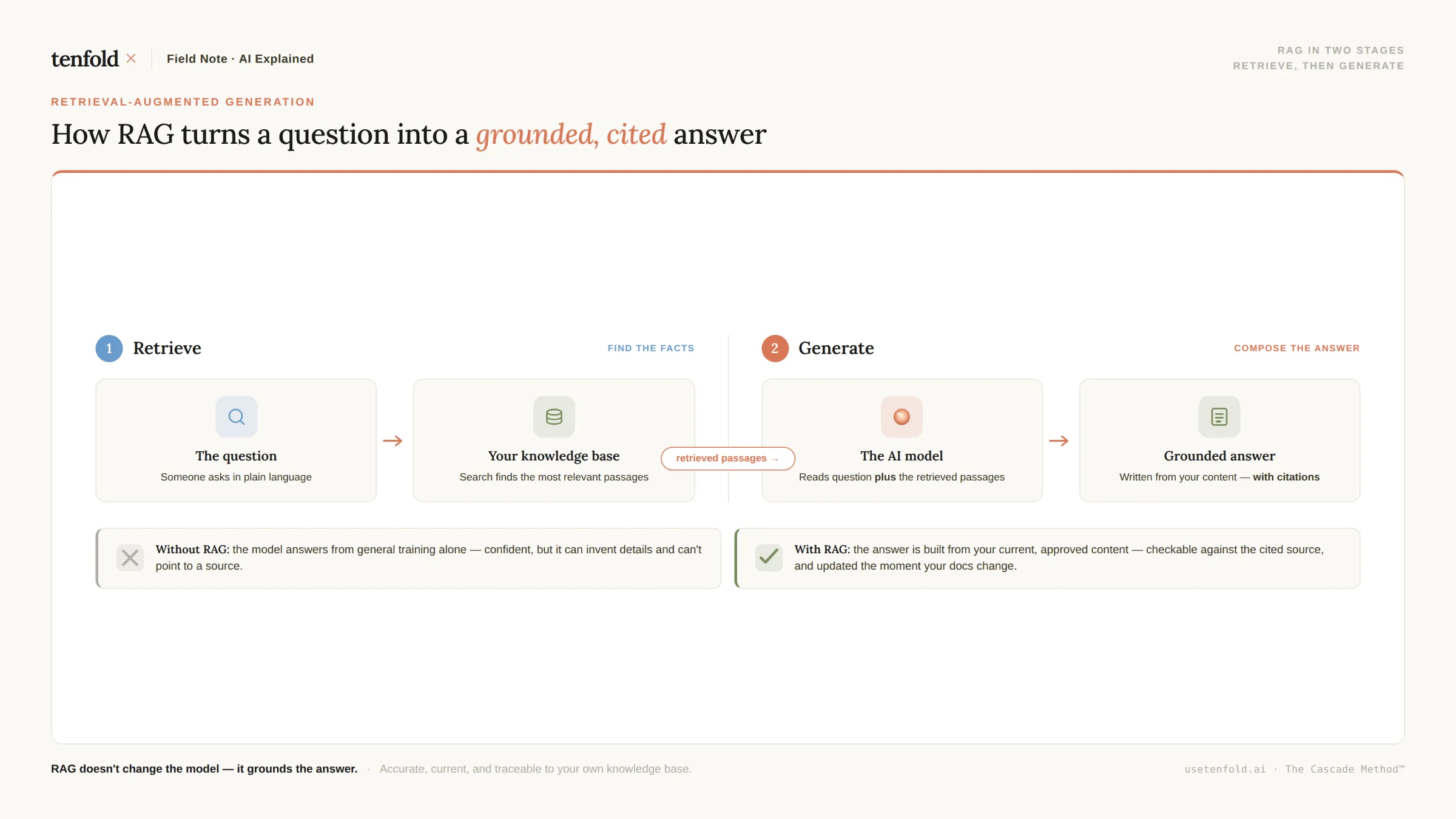
RAG combines two steps. First, retrieval: when someone asks a question, the system searches your knowledge base — documents, procedures, records — and pulls the most relevant pieces. Second, generation: the AI uses that retrieved material as context to produce a contextualized, grounded answer. Because the output is anchored in real, current evidence rather than the model's frozen training data, factual accuracy improves and the answer can cite its source. As IBM puts it, while any generative model can hallucinate, RAG makes it far easier for users to verify outputs for accuracy.
Why Business Leaders Should Care
The practical payoffs map directly to business priorities — accuracy, explainability, compliance, and cost efficiency:
Better decisions. A leader can have an agent analyze sales reports, customer feedback, and market data together before a product launch, drawing on current internal sources.
Trustworthy customer support. A support agent can retrieve the latest policy and answer with specifics, not guesses.
Always current. RAG systems incorporate new information without retraining, so answers stay up to date in fast-moving environments — unlike a fine-tuned model frozen on a past dataset.
Lower cost. Avoiding repeated retraining is a significant saving, and retrieving only the most relevant data reduces computational overhead.
Vendor flexibility. The most future-proof RAG systems are model-agnostic, letting you swap in the LLM that best fits your security, cost, and capability needs.
The Part Most Leaders Underestimate: Governance
Here's the critical message: RAG fails without governance. Effective enterprise RAG requires controlling what the system can retrieve, who can access it, and how outputs are validated before reaching users. Access controls, metadata, and context must come before retrieval — otherwise the agent surfaces the wrong documents to the wrong people, or retrieves stale and conflicting information. Context-graph-grounded retrieval, where the system understands your business definitions and not just raw data, has shown up to 5x accuracy improvements over querying raw schemas.
Agentic RAG: The 2026 Pattern
The dominant pattern this year is agentic RAG, where specialized agents handle retrieval and validation in parallel — one retrieving, another checking, another generating. Even as context windows expand past a million tokens, retrieval matters more, not less: enterprise knowledge bases often exceed billions of tokens, so strategic retrieval ensures only relevant, permission-compliant, high-quality knowledge enters the answer.
What This Means for Your Roadmap
The competitive gap is widening. Organizations that establish a knowledge-runtime platform now will deploy new AI capabilities in weeks while others grind through 6-to-12-month custom builds. The winners won't be those with access to the best models — those are commoditizing — but those who systematically capture institutional knowledge, make it retrievable, and govern it for safe deployment.
Summary
RAG is the difference between an AI agent that guesses and one that answers from your verified knowledge. For business leaders, it's the architecture that makes AI trustworthy enough to deploy in customer-facing and decision-support roles — provided you treat governance, access control, and data quality as prerequisites, not afterthoughts. If you want to understand how RAG fits your knowledge base and use case, the Tenfold team can help you scope it.
Frequently Asked Questions
Q: What is RAG in plain terms? A: Retrieval-augmented generation is an approach where the AI first retrieves relevant information from your own knowledge base, then uses it to generate an answer. It grounds the AI in your current, verified data instead of relying solely on what the model was trained on.
Q: Does RAG eliminate AI hallucinations? A: It significantly reduces them by anchoring answers in retrieved evidence and making outputs verifiable and citable. No system eliminates hallucination entirely, which is why output validation and governance remain important.
Q: Do we have to retrain the model when our information changes? A: No — that's a core advantage. RAG separates knowledge from the model, so you update your knowledge base and the answers update automatically. No costly retraining required.
Q: What's the biggest mistake companies make with RAG? A: Skipping governance. Without access controls, metadata, and context preceding retrieval, the system surfaces wrong or stale documents. Enterprise RAG fails without that foundation.
