
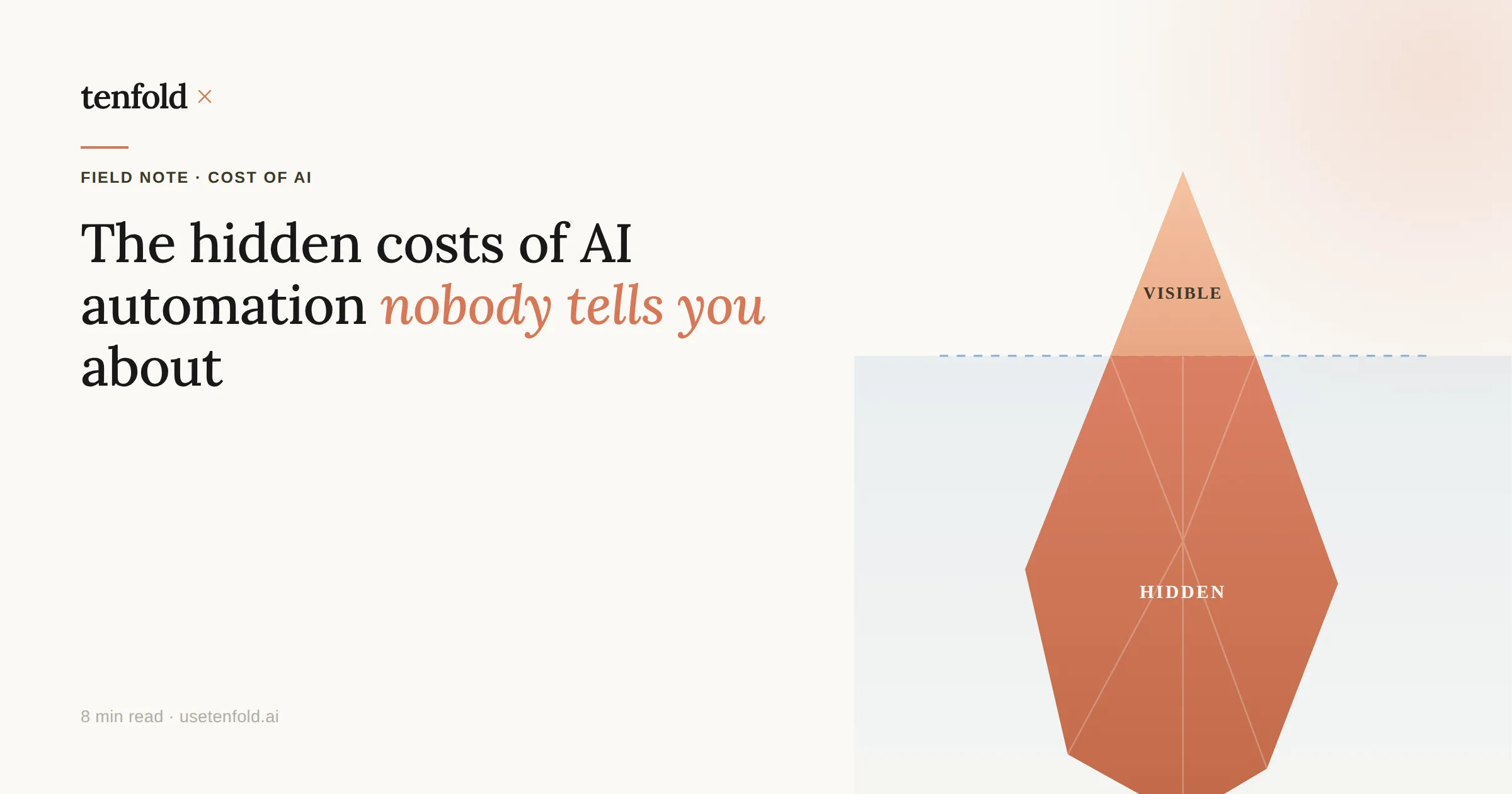
The Hidden Costs of AI Automation Nobody Tells You About
The pitch is seductive: deploy an AI agent, automate a workflow, watch the savings roll in. The reality is that most enterprise teams underestimate the true total cost of building and deploying AI agents by 40 to 60 percent — and that gap, between what gets budgeted and what the project actually costs, is exactly where AI initiatives quietly die. Not with a cancellation announcement, but with a gradual loss of momentum as the real expenses surface.
This isn't a reason to avoid AI automation. It's a reason to budget honestly. The organizations that win don't spend less — they spend with clear eyes on where the money actually goes.
Quick Answer: The hidden costs of AI automation aren't in the model or the software license. They're in data preparation (the single largest line item), integration engineering, permission architecture, governance and compliance, ongoing maintenance, and the long runway to production where the business problem is still being handled manually. Budget for the full picture or join the 40 percent of agentic projects Gartner expects to be canceled by 2027.
Key Takeaways:
Most enterprise teams underestimate the true total cost of ownership by 40 to 60 percent — the gap where AI initiatives die.
Data preparation alone accounts for 60 to 75 percent of total project effort in AI initiatives — the most time-consuming and most underestimated component.
Gartner expects over 40 percent of agentic AI projects to be canceled by the end of 2027, driven by escalating costs, unclear business value, and inadequate risk controls.
22 percent of agent deployments report negative ROI at 12 months — and Forrester attributes the failures to scoping and access problems, not model quality.
Pilots take 6 to 12 weeks but production deployments take 6 to 12 months — and every month of development is a month the original problem is still handled manually.
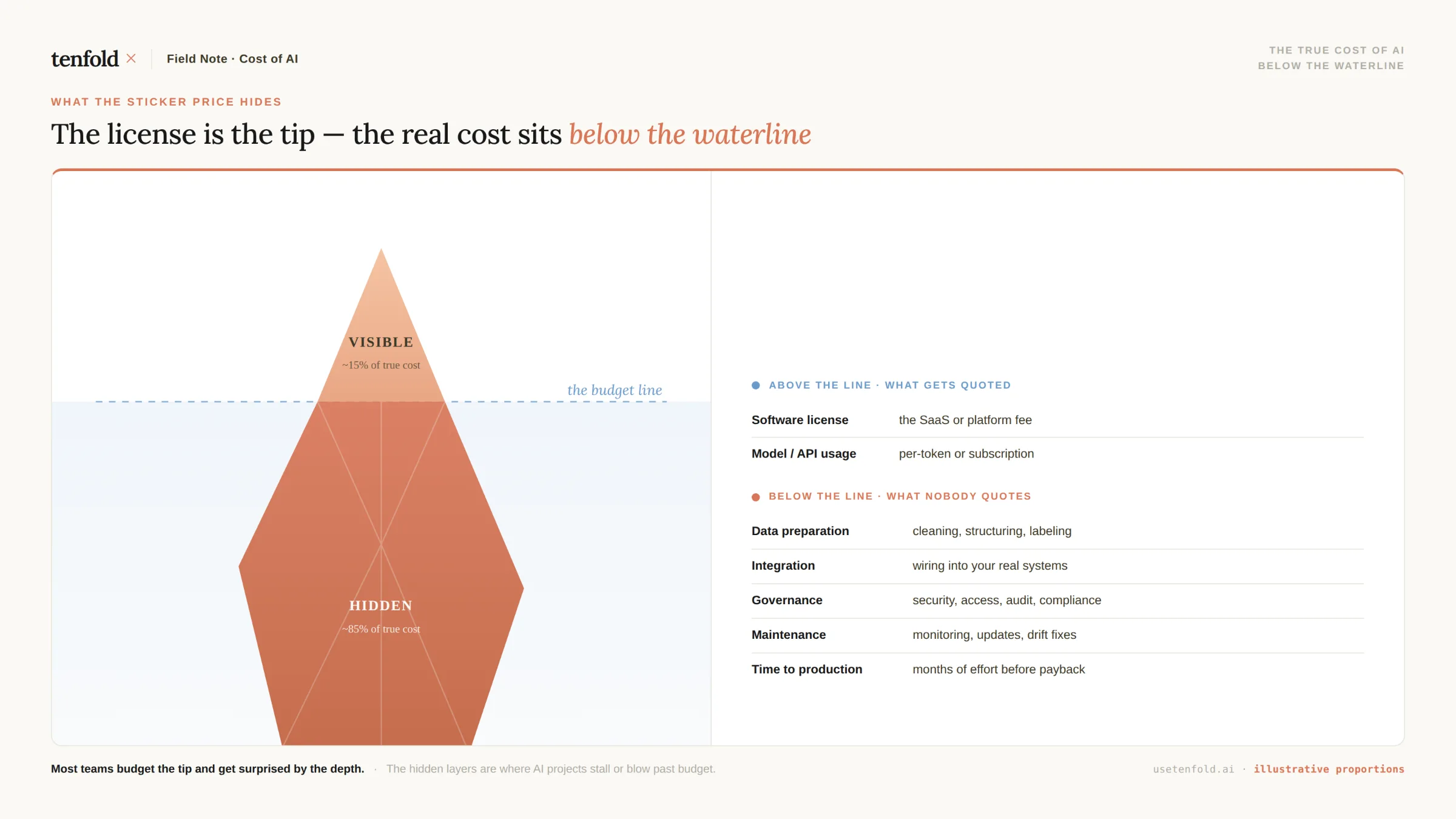
The Cost Layers Nobody Shows You
Data preparation. This is the big one. Industry research indicates data prep accounts for 60 to 75 percent of total project effort. Your data is never as clean, centralized, or accessible as your engineers assume. Over half of organizations cite data quality as their primary blocker, and Gartner has warned that organizations will abandon 60 percent of AI projects through 2026 due to a lack of AI-ready data.
Integration engineering. Agents need to reach across Slack, your CRM, your ERP, your ticketing system, and your knowledge repositories. Every integration requires custom development, testing, and ongoing maintenance. Each connector is a liability without a dedicated team to own it — and integration complexity with legacy systems is among the top causes of scaling failure.
Permission architecture. Traditional user permissions break when an agent needs access to documents general employees can't see directly. You need an entirely new permission model — one most internal teams have never built.
Governance and compliance. In regulated industries, agents must be auditable, explainable, and documented. These requirements don't add themselves; they demand dedicated engineering, legal review, and ongoing monitoring. Gartner predicts AI-related legal claims will exceed 2,000 by the end of 2026 due to insufficient guardrails.
Maintenance and model drift. The AI landscape changes monthly. Models drift, APIs change, and workflows break silently over time. The infrastructure you build today may need partial rebuilding in six months — and building means owning that upgrade path permanently. Ongoing monitoring retainers commonly run from several hundred to several thousand dollars per month.
The time-to-production tax. Moving from prototype to production — edge cases, governance, reliability across thousands of interactions, multi-system integration — stretches to 6 to 12 months, sometimes longer. During that entire window, the business problem the agent was supposed to solve is still being handled manually. Every month of development is value left on the table.
The Silent-Failure Problem
Beyond the upfront costs, there's a quieter expense: agents that fail silently at scale. Minor errors compound over weeks because systems do exactly what they're told, not what you meant. Without automated quality monitoring, incorrect outputs accumulate and propagate through downstream systems before anyone notices — and unwinding that mess is its own cost.
Why the Numbers Still Work — If You Budget Honestly
None of this means AI automation doesn't pay off. Across functions, the median time-to-value is around 5.1 months, and companies seeing returns report strong multiples on invested capital. The point is that the 22 percent of deployments reporting negative ROI almost never lost the technology fight — they lost the planning fight: unclear success criteria, insufficient tool or data access, and unscoped maintenance.
How to Avoid the Trap
Budget for total cost of ownership, not the license. Audit your data readiness before committing to scale. Scope a narrow, high-value use case with measurable success criteria. Account for integration and governance as first-class line items, not afterthoughts. And consider whether partnering with a specialist who has already solved the data, integration, and governance problems compresses your timeline — because the ROI clock doesn't start until the agent reaches production.
Summary
The hidden costs of AI automation are real, but they're predictable — and predictable costs are manageable costs. Data preparation, integration, governance, maintenance, and the long road to production are where budgets blow up and projects die. Name them, budget them, and your AI initiative joins the winners instead of the 40 percent that get canceled. If you want a clear-eyed estimate of what your automation will actually cost and return, the Tenfold team can help.
Frequently Asked Questions
Q: What's the single most underestimated cost of AI automation? A: Data preparation. It accounts for 60 to 75 percent of total project effort, and most teams assume their data is far cleaner and more accessible than it actually is.
Q: How much do teams typically underestimate total cost? A: By 40 to 60 percent. That gap between budgeted and actual cost is the most common reason AI projects quietly lose momentum and get abandoned.
Q: Why does time-to-production matter as a cost? A: Because production deployments take 6 to 12 months, and during that entire window the problem the agent was meant to solve is still being handled manually. The ROI clock doesn't start until the agent is live.
Q: How do I avoid the negative-ROI trap? A: Budget for total cost of ownership, audit data readiness first, scope narrowly with measurable success criteria, treat integration and governance as first-class line items, and consider a specialist partner to compress the timeline to production.
