
Top AI Trends in June 2026: What Enterprise Leaders Need to Know Now
Enterprise AI is no longer an experiment. As of June 2026, the dominant trends are clear: agentic AI is moving from demos into mission-critical workflows, multi-agent systems are replacing single-model solutions, open-source models are challenging proprietary incumbents, and regulatory enforcement deadlines are arriving. The organisations that understand these shifts now will set the pace for the next three years. Those that don't will find themselves reacting to a landscape that has already moved on.
At Tenfold, we implement AI agents inside enterprise operations every day. What we're seeing in the market right now confirms what the data shows: the bottleneck is no longer model capability. It's organisational readiness to delegate real work to AI.
Key Takeaways:
Agentic AI has crossed from experimentation into full-scale enterprise production — across every major industry
Multi-agent systems, where specialised AI agents collaborate on complex workflows, are the dominant new architecture
AI governance and regulatory enforcement (EU AI Act, Colorado AI Act, US state laws) are active obligations, not future concerns
Open-source and smaller fine-tuned models are becoming a serious alternative to large proprietary LLMs for enterprise use
Data readiness — not model quality — is emerging as the primary competitive differentiator in enterprise AI
1. Agentic AI Has Left the Pilot Stage
The clearest signal from June 2026 is that agentic AI is in production. This is not aspirational language — it's operational reality across financial services, healthcare, retail, and software development.
According to NVIDIA's 2026 State of AI report (surveying over 3,200 organisations globally), enterprises have seen AI agent experimentations from 2025 become full-fledged deployments in early 2026, touching everything from code development to legal, financial, and administrative functions. Telecommunications led adoption at 48% agentic AI deployment, with retail and CPG close behind at 47%.
At the infrastructure level, this shift is being baked into the hardware layer. Dell's new Deskside Agentic AI workstations let organisations run always-on AI agents locally — with Dell reporting up to 87% reduction in cloud token costs while keeping sensitive data on-premises. Meanwhile, Google Cloud's Gemini Enterprise Agent Platform — launched at Google Cloud Next 2026 — functions as what Egen.ai described as "an operating system for AI agents," providing a unified environment to build, scale, govern, and optimise agents across an enterprise.
According to Google Cloud's 2026 AI Agent Trends report, "the era of simple prompts is over" — what they call "the agent leap" is now AI orchestrating complex, end-to-end workflows semi-autonomously. For enterprise leaders, this is the defining opportunity of the year: not AI that assists, but AI that executes.
The question your board should be asking is not whether to deploy AI agents. It's which workflows you're delegating first, and what governance structure you're wrapping around them.
2. Multi-Agent Systems Are the New Architecture
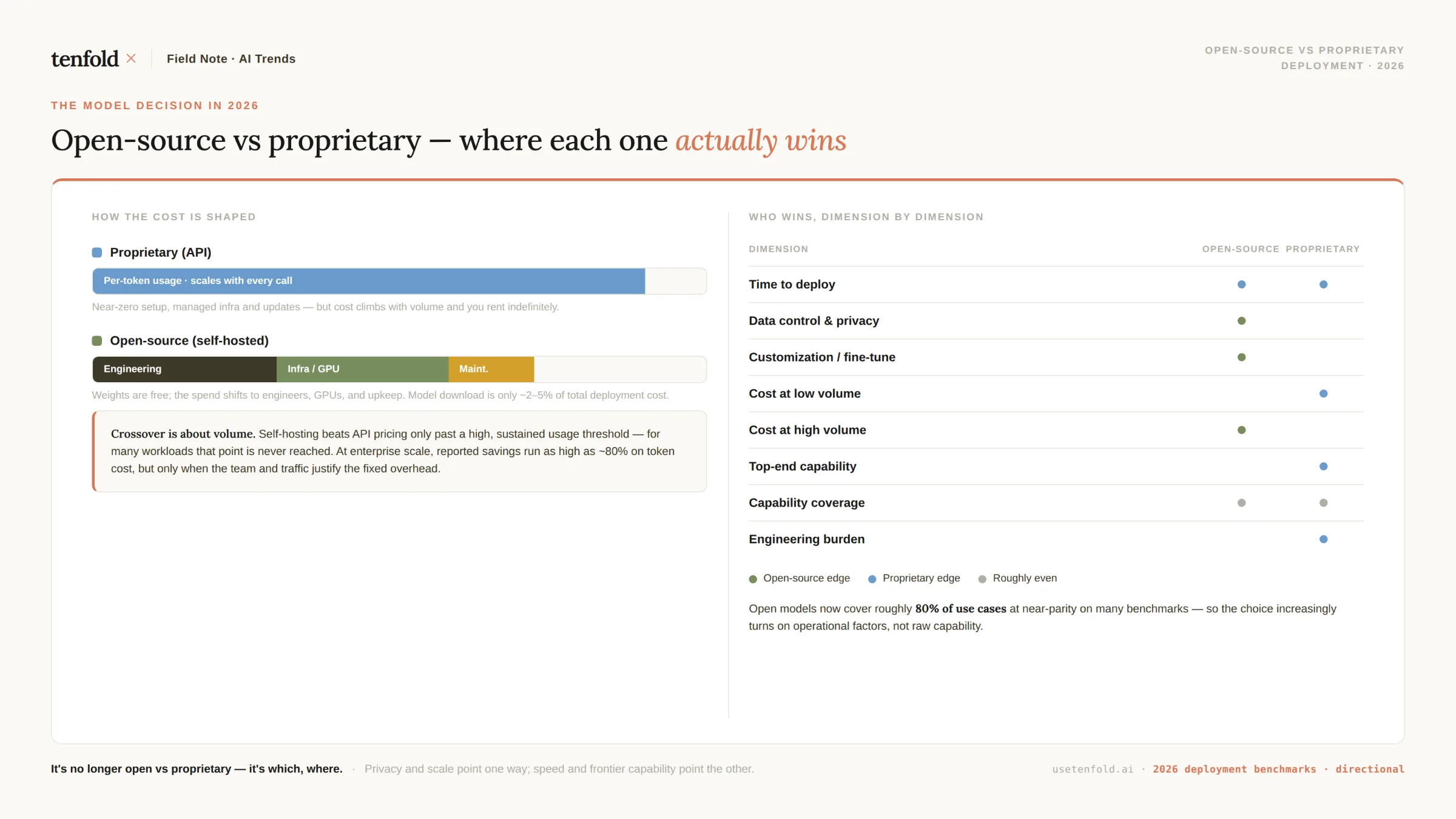
Single-agent solutions are already being replaced by coordinated teams of specialised agents — and the data on this shift is unambiguous.
Gartner reported a 1,445% surge in multi-agent system inquiries from Q1 2024 to Q2 2025 — a signal that technical leaders have rapidly moved from curiosity to implementation planning. Gartner also predicts that 40% of enterprise applications will embed AI agents by the end of 2026, up from less than 5% in 2025.
The architectural logic is straightforward. As Machine Learning Mastery explains, single all-purpose agents are being replaced by orchestrated teams of specialised agents — a "puppeteer" orchestrator coordinating a researcher agent, a coder agent, and an analyst agent, each doing what it does best. IBM's announcement at Think 2026 formalized this thinking with the next generation of IBM watsonx Orchestrate, explicitly built for multi-agent orchestration at enterprise scale.
Production data backs the performance case. Druid's 2026 AI Adoption Benchmark, drawing on 15 months of anonymised usage data, shows containment rates of 80–99.5% across Financial Services, Healthcare, HR & IT, and Higher Education — meaning AI agents are resolving service interactions end-to-end before a human is ever involved.
For organisations still running individual chatbots or single-purpose automation tools: this architecture is a generation behind. The firms compounding advantage right now are the ones building coordinated agent ecosystems, not deploying isolated AI features.
3. Data Readiness Is the Real Competitive Divide
The companies winning with AI in June 2026 are not necessarily the ones with access to the best models. They're the ones whose data is clean, connected, and agent-ready.
According to a Databricks 2026 State of AI Agents analysis of 20,000+ global organisations, companies that implemented AI governance and proper data infrastructure pushed 12x more projects to production than those that didn't. Organisations that used evaluation tools moved nearly 6x more AI systems to production.
This is the finding that most organisations miss. Google Cloud's announcement of its Agentic Data Cloud — an AI-native data architecture including a cross-cloud Knowledge Catalog for grounding agents in enterprise-wide semantic context — was described by analysts as addressing "the real AI bottleneck," which is not compute or model capability but data readiness. Without this layer, agents are "fast but blind."
According to IBM's Think 2026 keynote, an effective agentic enterprise requires four integrated systems working together: agents for coordinated execution; data for real-time, connected information; automation for end-to-end infrastructure and workflows; and hybrid cloud for governance and sovereignty. Remove any one of those pillars, and agents underperform.
At Tenfold, we've found this to be the most underestimated implementation challenge. The clients who move fastest are the ones who invest in data readiness before — not after — they deploy agents. The difference between a pilot that stalls and a deployment that scales is almost always data infrastructure, not the AI itself.
4. Open-Source and Smaller Models Are Rewriting the Economics
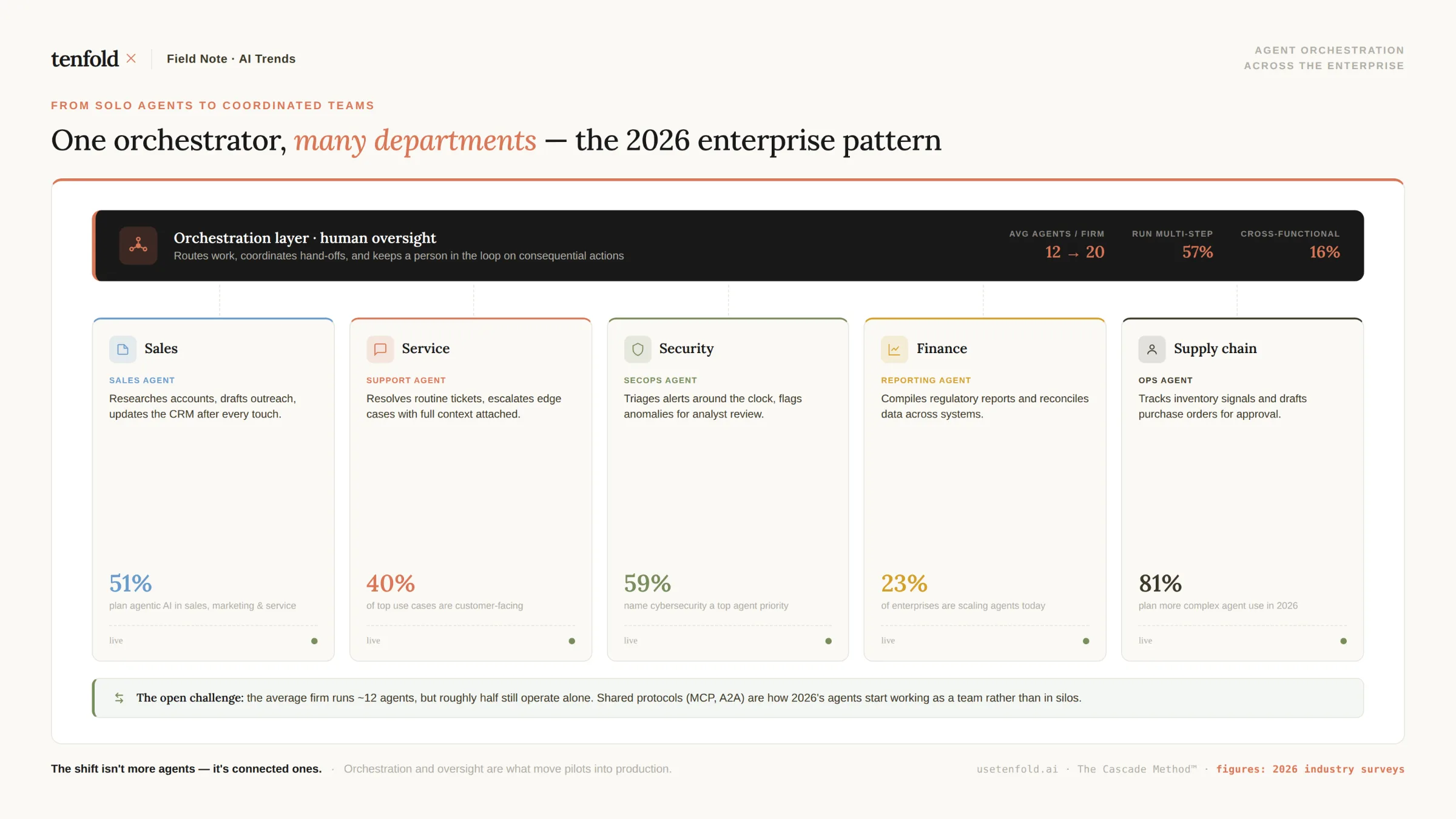
The assumption that enterprise AI requires large, expensive proprietary models is breaking down fast.
According to NVIDIA's State of AI report, 85% of surveyed organisations said open source is moderately to extremely important to their AI strategy. The driver is simple: open-source and open-weight models, combined with fine-tuning on proprietary data, allow organisations to build AI applications that are faster, cheaper, and more specific than general-purpose commercial models.
IBM's Anthony Annunziata, Director of Open Source AI, stated in a published interview that 2026 will see "smaller reasoning models that are multimodal and easier to tune for specific domains" — replacing the one-giant-model-for-everything approach with models that are "just as accurate — maybe more so" when tuned correctly.
This plays out in the coding agent space too. Gartner reported in May 2026 that the enterprise AI coding agent market has entered a new phase of expansion, predicting that by 2027 over 65% of engineering teams using agentic coding will treat traditional IDEs as optional — shifting control to automated platforms. Open-source models like Qwen3-Coder-Next (80B parameters, released in early 2026) are reaching performance close to top closed models while running locally on consumer hardware.
For enterprise leaders: the implication is that building on proprietary APIs is no longer the default smart choice. The teams getting better ROI are building on smaller, fine-tuned models — and retaining the competitive advantage that comes from models trained on their own data.
5. AI Governance Has Moved From Policy to Enforcement
The regulatory honeymoon for AI is over. June 2026 marks the arrival of enforcement — not the announcement of future obligations.
The EU AI Act reaches full application on August 2, 2026, with transparency requirements and rules for high-risk AI systems now enforceable. The Colorado AI Act takes effect June 30, 2026. California's generative AI transparency requirements are already active. According to SecurePrivacy's 2026 Enterprise Governance Overview, "AI risk and compliance in 2026 has matured from theoretical discussions to enforceable legal requirements with substantial penalties for non-compliance."
The business case for governance is not purely defensive. According to Databricks, companies with AI governance frameworks pushed 12x more projects to production — meaning governance is a deployment accelerator, not just a risk mitigation tool. Machine Learning Mastery frames this precisely: the shift in 2026 is from viewing governance as compliance overhead to recognising it as an enabler — mature governance frameworks increase organisational confidence to deploy agents in higher-value scenarios.
The Okta-commissioned AI Agents at Work 2026 survey (292 executives and 492 knowledge workers across seven countries) exposed a systemic breakdown in AI governance — attributable to unclear usage policies, widespread use of unapproved AI tools, and inadequate security safeguards. There is a significant gap between the executive perception of AI governance and the reality on the ground.
Enterprises that treat governance as a strategic function — not an IT checkbox — will deploy more, deploy faster, and expose themselves to less regulatory and reputational risk. Those that treat it as a burden will find their AI programs quietly becoming liabilities.
6. Persistent, Always-On Agents Are the Next Frontier
Beyond task-specific agents, the next wave arriving in H2 2026 is persistent agents — always-on AI systems designed to handle longer workflows over extended periods, with memory that carries across sessions.
Microsoft's Work Trend Index 2026 report (surveying 20,000 knowledge workers across 10 markets) frames this as the shift from AI-as-assistant to AI-as-teammate. The organisations pulling ahead — what Microsoft calls "Frontier Professionals" — are designing repeatable, documented agent workflows with defined human handoff points. The more agents execute, the higher the stakes around human evaluation. That's not a warning against automation. It's the design principle for scaling it safely.
According to ByteByteGo's 2026 AI trend analysis, persistent agents are always-on assistants designed to handle longer workflows over extended periods, many running locally to connect with files, apps, and system settings while keeping data under organisational control. The security implications are significant: as agents read personal data and take actions, mistakes matter more — making reliability and security a first-class concern, not an afterthought.
Three trends identified at Google Cloud Next 2026 underscore this shift: the move from copilots to autonomous workflows, the emergence of persistent AI systems with long-term memory, and the growing importance of data readiness and orchestration as the primary competitive differentiator in enterprise AI.
The organisations building the right operational model now — with agent accountability structures, human oversight at key decision points, and audit-ready governance — will compound their advantage in ways that are increasingly hard to replicate.
Summary
June 2026 is not the beginning of the enterprise AI story — it's the end of the experimentation phase. Agentic AI is in production. Multi-agent architectures are replacing isolated automation tools. Data readiness has separated the organisations getting results from those stuck in pilots. Regulatory enforcement is live. And the economics of AI are shifting toward smaller, fine-tuned models built on proprietary data.
At Tenfold, we implement AI agents for enterprise operations — not as a roadmap exercise, but in production, today. If your organisation is ready to move from evaluation to deployment, that conversation starts here.
Frequently Asked Questions
Q: What is agentic AI and how is it different from earlier AI tools?
A: Agentic AI refers to AI systems that autonomously plan and execute multi-step tasks — rather than simply responding to prompts. Unlike chatbots or single-function automation, agents can coordinate across tools, APIs, and data systems to complete end-to-end workflows with minimal human input. In June 2026, agentic AI is in active production across enterprise functions including customer service, software development, financial operations, and supply chain management.
Q: What are multi-agent systems and why do enterprises need them?
A: Multi-agent systems (MAS) consist of multiple specialised AI agents working together — each handling a specific part of a complex workflow — rather than relying on a single, general-purpose AI. Gartner identified this as a top strategic technology trend for 2026. Organisations using MAS can automate tasks that single agents struggle with, while maintaining modularity, accuracy, and resilience. Druid's 2026 AI Adoption Benchmark shows containment rates of 80–99.5% across industries using multi-agent architectures.
Q: What should enterprises do to prepare for AI governance regulations in 2026?
A: Immediate priorities include documenting AI use cases and their risk classification, implementing audit-ready governance frameworks, establishing clear data access controls, and mapping which jurisdiction's laws apply to each deployment. The EU AI Act reaches full application on August 2, 2026, and the Colorado AI Act takes effect June 30, 2026. Enterprises that build governance infrastructure now will deploy faster — companies with AI governance frameworks pushed 12x more projects to production, according to Databricks.
Q: Is open-source AI viable for enterprise deployment in 2026?
A: Yes — and it is becoming the preferred approach for many enterprise teams. According to NVIDIA's 2026 State of AI report, 85% of surveyed organisations rate open source as moderately to extremely important to their AI strategy. Smaller, domain-specific models fine-tuned on proprietary data are delivering comparable or superior performance to large proprietary models for specific enterprise use cases, while significantly reducing cost and improving data control.
Q: What does 'data readiness' mean for AI agents, and why does it matter?
A: Data readiness means your enterprise data is clean, connected, governed, and accessible to AI agents in a structured way — with semantic meaning, access controls, and real-time context built in. Without it, agents make decisions on incomplete or stale information. Google Cloud's Agentic Data Cloud and IBM's real-time data foundation (via its Confluent acquisition) are both direct responses to this problem. Databricks found that organisations with proper data and governance infrastructure pushed 12x more AI projects to production than those without it.
