
What Is an AI Agent, and How Much Does It Cost to Build One for Your Business?
Ask three agencies what an AI agent costs and you'll get three wildly different numbers for the same paragraph of brief — $12,000, $80,000, $300,000 — and all three can be sincere. The spread says less about the vendors than about how little the word "agent" pins down. So before the price, the definition: an AI agent is software that accepts a goal, decides what to do, takes actions across other apps and databases, and adapts based on the results — without a human directing each step. That autonomy is exactly what makes it powerful, and exactly what makes it hard to price.
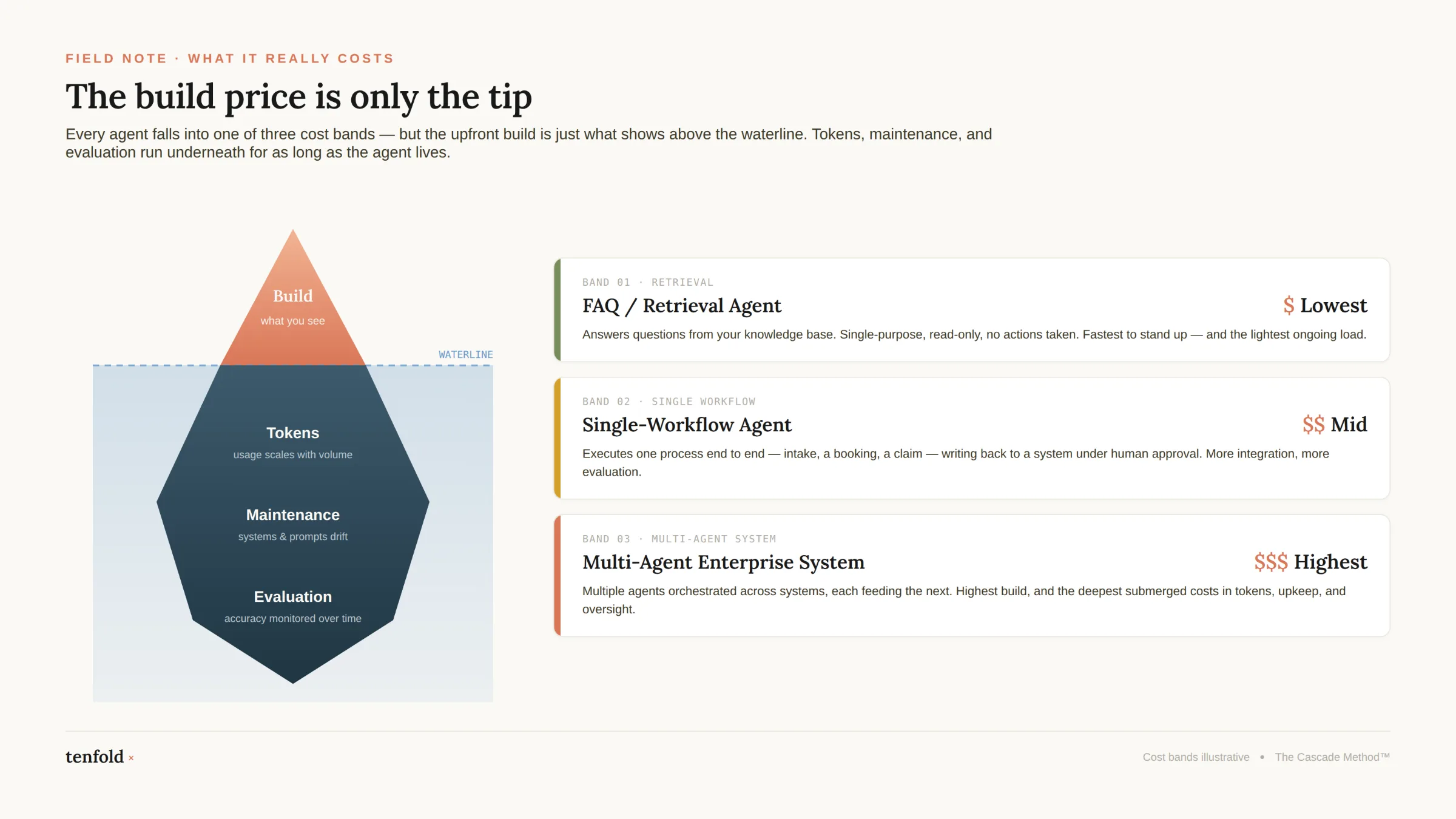
Quick Answer: In 2026, AI agents fall into three build bands: a smart FAQ or support agent with retrieval runs $8,000–$25,000; an agent that owns a single real workflow (with integrations and write access) runs $40,000–$100,000; and a multi-agent system wired into enterprise workflows runs $150,000–$500,000+. But the build price is the smaller half — across three-year cost-of-ownership studies, initial development is only 25–35 percent of total spend. The rest is tokens, maintenance, and evaluation.
Key Takeaways:
Three build bands in 2026: smart FAQ/support agent $8K–$25K; single-workflow agent $40K–$100K; multi-agent enterprise system $150K–$500K+.
The build is the entry fee. Initial development is 25–35 percent of three-year total cost — the rest is tokens, maintenance, monitoring, and the evaluation work that keeps the agent from quietly going wrong.
Autonomy is the cost multiplier: an agent that reads a request is cheap; one with write access to money, three integrations, an approval path, and an evaluation harness is a fundamentally bigger build.
Ongoing run cost for a production agent is roughly $1,500–$13,000/month depending on volume and complexity — and senior oversight time, not model tokens, is now the largest run-cost line.
Token spend in production commonly lands at 3–5x development-phase estimates, because development happens on ten polite test cases and production happens with your actual customers.
What Makes an AI Agent Different from a Chatbot
A chatbot answers a question and stops — it's reactive and stateless. An agent decomposes a goal into steps, calls tools and APIs, makes decisions, takes actions, and self-corrects. The difference shows up directly in cost. Consider two versions of a "returns agent." Version one answers questions about your return policy from your documentation — that's an $8,000–$25,000 build. Version two checks eligibility, issues the refund through Stripe, updates the order record, and emails the customer — now there are three integrations, write access to money, an approval path for edge cases, and an evaluation harness to catch when refund decisions start drifting. Same conversation from the customer's side, but a $60,000–$90,000 build. Autonomy is the multiplier.
The Three Price Bands
Smart FAQ / support agent ($8,000–$25,000). Answers from your knowledge base using retrieval. Fast to build (4–8 weeks), low integration surface, human handles anything complex.
Single-workflow agent ($40,000–$100,000). Owns one real workflow end to end — processing an order, qualifying a lead, handling a return — with real integrations, write access, and exception handling. Timeline 3–5 months. This is the sweet spot for most mid-market businesses.
Multi-agent enterprise system ($150,000–$500,000+). Several agents coordinating across enterprise workflows, with orchestration, governance, and observability. Timeline 6–12 months. Integration engineering and QA/safety testing together account for 40–60 percent of the build.
The Part Vendors Don't Mention: Month Thirteen
Here's the question that reveals whether a vendor understands agents: "what does month thirteen cost?" Because the core loop is metered — one user request fans out into planning calls, tool calls, retries, and a final answer, every step billed by the token. Run cost for a production agent typically lands at $1,500–$13,000/month, covering LLM API costs, infrastructure, monitoring, monthly tuning, and security maintenance. And counterintuitively, model tokens are no longer the biggest line — senior oversight time is. Plan for maintenance too: models drift, prompts break on upgrades, and the test set needs expanding. Budget at least 10 percent of the initial build per year just to keep the agent accurate.
How to Control the Cost
The teams that come out ahead scope narrowly and instrument properly. Build an agent that does one task extremely well rather than a generalist in version one — a focused scope cuts engineering time, testing surface, and integration complexity, often reducing initial cost 30–50 percent. Right-size the model (workhorse models handle most agent work; reserve premium models for the steps that need them), use prompt caching and batching where the workload allows, and pay for a short discovery that models your token costs at real volume before committing to a build price. And keep the build-vs-buy question open: for standard workflows, an off-the-shelf tool is faster; custom earns its cost when the workflow touches your proprietary systems and data.
Does the Math Work?
For the right use case, yes — and dramatically. A well-targeted agent commonly pays for itself in 3–12 months. One documented example: an e-commerce returns agent built for $52,000 handled 73 percent of returns autonomously and saved $14,000/month — break-even in under four months. The key phrase is "well-targeted": agents earn their return on the operations budget, not the launch invoice, and the teams that win are the ones who knew that going in.
Summary
An AI agent is autonomous software that pursues a goal across your systems — and its cost is driven far more by scope, integration, and autonomy than by the underlying model. Expect $8K–$25K for a support agent, $40K–$100K for a single-workflow agent, and $150K+ for multi-agent systems, then roughly double the build across three years for the part that isn't the build. Scope narrowly, instrument properly, and target a high-value workflow. If you want a clear-eyed estimate for your specific use case — including the month-thirteen number — the Tenfold team can scope it with you.
Frequently Asked Questions
Q: How much does it cost to build an AI agent in 2026? A: A support chatbot that answers from your documents runs $8,000–$25,000; an agent that owns a single real workflow with integrations runs $40,000–$100,000; and a multi-agent enterprise system runs $150,000–$500,000+. Then budget roughly double the build across three years for tokens, maintenance, and evaluation.
Q: What drives the price up the most? A: Autonomy and integration. An agent that only reads and answers is cheap; one that takes actions across multiple systems, has write access, needs approval paths, and requires an evaluation harness is a much larger build. The model choice matters far less than scope.
Q: What's the ongoing cost after launch? A: Roughly $1,500–$13,000/month for a production agent, covering API/token costs, infrastructure, monitoring, tuning, and security. Notably, senior oversight time is now the largest run-cost line, not model tokens.
Q: How do I keep the cost down? A: Scope one workflow instead of a platform, right-size the model, use prompt caching and batching, and run a short paid discovery that models token costs at real volume before committing to a build price. Narrow scope alone often cuts initial cost 30–50 percent.
