
Where Are Your Billable Hours Leaking? How AI Agents Recover Lost Time in Professional Services Firms
Billable hours are the lifeblood of professional services. Yet a significant portion of the time your people actually work never makes it onto a client invoice. It leaks — quietly, consistently, week after week — into manual timesheets, administrative overhead, proposal drafts, and status reports that no one is charging for. The good news: this is a solvable problem. AI agents are now recovering that lost time at scale, without requiring firms to hire more people or work longer days.
Quick Answer: Most professional services firms lose between 30–40% of working hours to non-billable activity. AI agents recover a meaningful share of that by automating the tasks that eat billable capacity: timekeeping, reporting, proposal drafting, and billing reconciliation.
Key Takeaways:
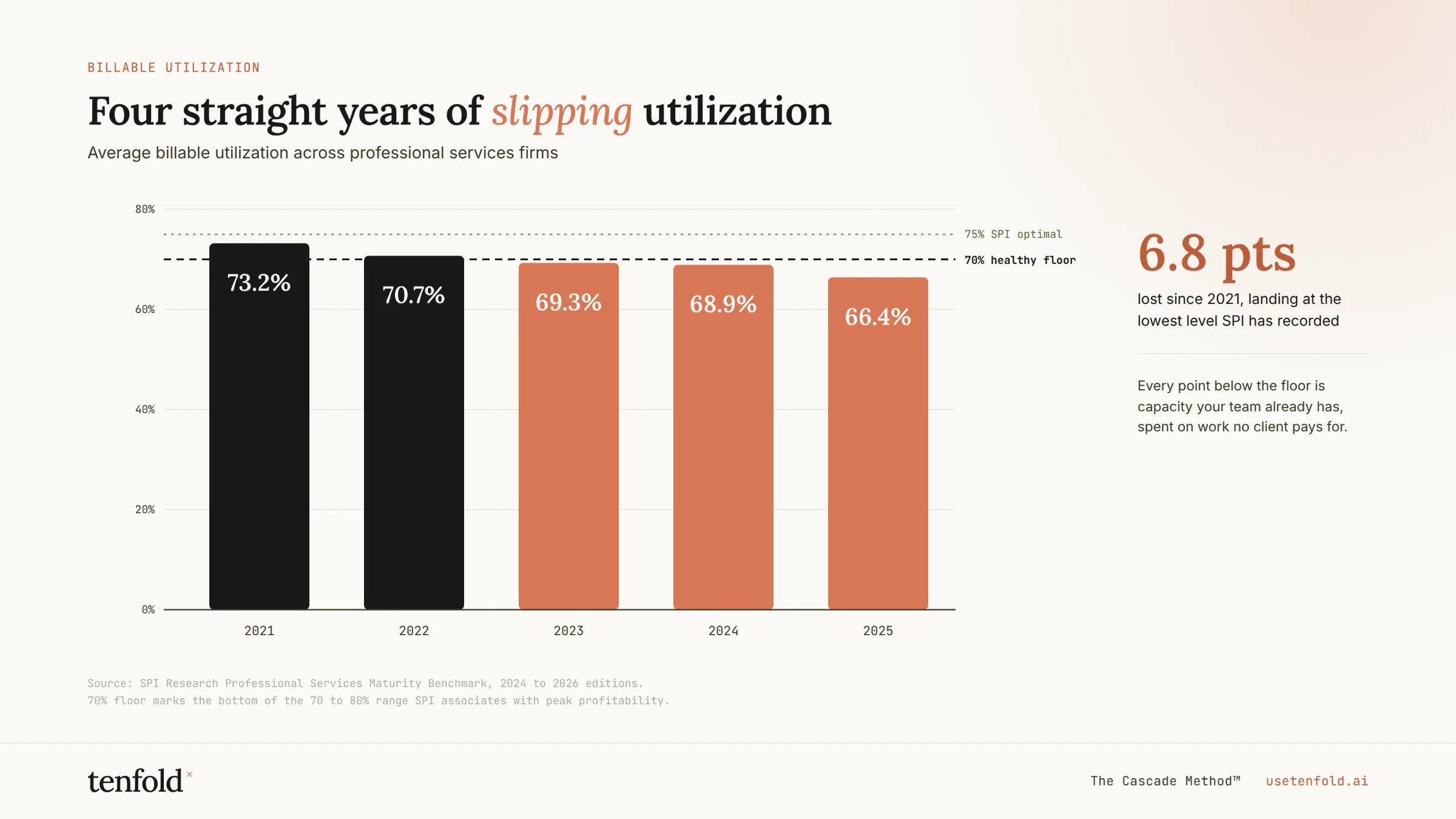
Industry billable utilization hit an all-time low of 66.4% in 2025, well below the 70% minimum benchmark.
The average professional services employee spends roughly a third of their time on work that never appears on a client invoice.
Firms bill only 90–95% of the hours they actually deliver — the remainder leaks through uncaptured micro-tasks and manual reconciliation.
AI agents address the four biggest leak points: timekeeping, proposal drafting, status reporting, and billing.
According to Thomson Reuters, professionals using AI already save an average of five hours per week — 240 hours per year — worth approximately $19,000 per professional in recovered value.
87% of professional services organizations plan to incorporate AI agents as part of their workforce within the near term.
The Utilization Crisis Is Getting Worse, Not Better
Billable utilization — the share of a professional's working time that gets billed to clients — is the core efficiency metric in professional services. And it's in freefall.
According to the 2026 Professional Services Maturity Benchmark, which surveyed 509 firms, billable utilization fell to 66.4% in 2025 — surpassing the previous record low set just the year before. That figure sits 3.6 points below the 70% threshold that SPI Research considers the minimum healthy benchmark. EBITDA margins, which held at 15–16% from 2021 through 2023, crashed to 9.8% and have barely recovered.
The 2025 SPI Research benchmark, surveying 403 firms, had already flagged 68.9% as a five-year low. The trend is moving in the wrong direction, and it's doing so consistently.
This matters because every percentage point of lost utilization is direct revenue walking out the door. For a 50-person firm billing at $200 per hour, closing just a 6-point utilization gap is worth more than $127,500 annually in recovered revenue — and that's a conservative estimate.
The root cause isn't that professionals aren't working. They are. The problem is that the work they're doing isn't making it onto invoices.
The Four Places Your Billable Hours Are Disappearing
Before you can fix a leak, you have to find it. Most firms have the same four structural holes.
1. The Micro-Task Blindspot
Quick Slack messages. Document reviews squeezed between meetings. Strategic thinking that happens on a commute or during a client call that was never formally logged. Each feels too small to record. Together, they add up to 5–8 hours per consultant per week — between 250 and 400 unbilled hours per person over the course of a year. At $100 per hour, that's $25,000 to $40,000 per head, given away silently.
The core issue: manual timekeeping is backward-looking. Professionals reconstruct their week on Friday afternoon from memory, and memory is imprecise. The London School of Economics found that 15% of eligible consulting work is never billed to clients — a direct consequence of this capture failure.
[INTERNAL LINK: How to Improve Billable Utilization Without Adding Headcount]
2. Proposal and Scope Drafting Time
Senior consultants spend 20–40 hours per proposal — scoping, researching, pulling case studies, formatting decks, and crafting pricing. Almost none of that time is billable. It's a necessary cost of winning work, but it's also one of the largest concentrations of non-billable hours in a firm's calendar.
For most firms, proposals get built from scratch every time. Someone has to locate the relevant past proposal, extract the methodology sections, adapt pricing from a comparable engagement, and reformat everything for the new client. The institutional knowledge exists — it just isn't connected.
3. Status Reporting and Client Updates
Weekly status reports are a client expectation in professional services. They're also a significant time sink. The typical cycle — collecting updates from team members, synthesizing progress, formatting the document, chasing missing information — can consume 90 minutes to three hours per engagement per week. For a partner managing five to six active clients, that's a day of working time, every week, producing nothing billable.
Enterprise DNA estimates that consulting firms leak $80,000 to $300,000 annually on repetitive knowledge work — with status reporting as one of the primary contributors.
4. Billing Reconciliation and Timesheet Errors
Even when time is captured, it frequently doesn't map cleanly to the billing structure. Consultants log hours against project codes that don't align with invoicing categories. Internal hours get logged under generic codes that obscure what the work actually was. At the end of the billing cycle, someone — usually a practice manager or operations lead — spends hours reconciling entries, correcting miscategorizations, and chasing approvals.
The result: firms bill only about 90–95% of the hours they actually deliver. The remainder goes uninvoiced, not because the work wasn't done, but because the administrative process failed to capture it accurately.
What AI Agents Actually Do About It
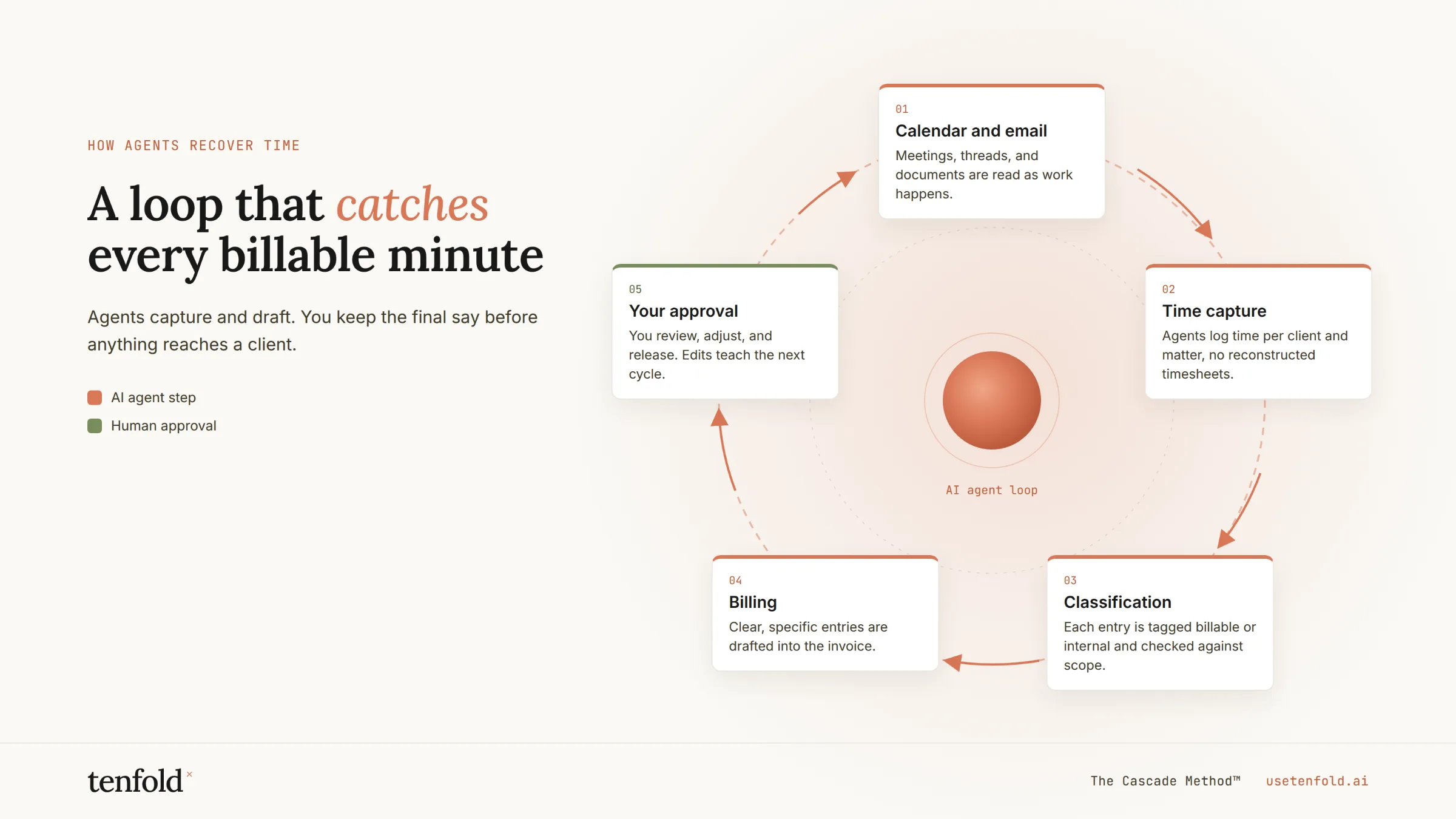
AI agents are not dashboards. They're not reporting tools. They're autonomous software routines that execute multi-step workflows — capturing data, categorizing entries, generating drafts, flagging anomalies, and routing for approval — without waiting for a human to initiate each step.
Applied to professional services, this distinction matters because the leak points described above aren't information problems. They're *execution* problems. The firm already knows what time was worked. The agent's job is to capture it, categorize it, and surface it — continuously, not just at billing time.
Timekeeping Agents
A timekeeping agent monitors digital activity across calendars, email, documents, and communication tools in real time. It identifies billable activity, categorizes it against the firm's billing structure, and generates draft time entries — reconstructing hours that would otherwise be lost in the Friday scramble.
Rather than running a weekly export from a time-tracking system, the agent maintains a rolling utilization calculation that's current to the last submission. Practice leaders can query utilization at any point in the week, not just after the fact. Miscategorizations are flagged before the billing cycle closes.
According to research from Ailerons.ai, early AI adoption in time tracking and invoice approval alone recovers 6–8% of lost billable hours — without any change to how professionals actually do their work.
Proposal Agents
A proposal agent reads a firm's archive of past proposals, case studies, and pricing structures. When a new opportunity is scoped, the agent identifies the most relevant precedents, adapts methodology sections, suggests pricing based on comparable engagements, and drafts an executive summary that mirrors the client's language from the brief.
The output isn't a finished proposal — it's a strong first draft that a senior consultant can review, refine, and submit. Senior time that once went toward blank-page drafting shifts to editing and relationship management. The 20–40 hours per proposal compresses significantly.
Consulting firms using agentic workflows report improving consultant utilization rates by up to 25%, with up to 40% of back-office tasks automated within two years of deployment.
Reporting Agents
A reporting agent runs on a schedule — typically the day before status updates are due. It pulls task completion data, budget burn against plan, milestone progress, and risk flags. It drafts the client-facing report, drops it into a shared document or Slack channel, and waits for a consultant to review and approve.
The entire cycle takes 15–20 minutes instead of 90. According to Enterprise DNA, an AI status reporting agent cuts drafting time by 70%, saving approximately 175 hours per consultant per year in status-report work alone.
Billing and Classification Agents
A billing agent converts approved time entries into accurate invoices and manages the collections cycle. A classification agent — trained on the firm's coding conventions — flags likely miscategorizations in real time, suggests corrections, and routes ambiguous entries back to the submitting consultant for clarification before the billing week closes.
The result is a cleaner billing cycle, fewer write-offs at invoice approval, and a higher percentage of hours delivered actually making it onto the client invoice.
The Numbers Behind the Recovery
The business case for AI agents in professional services is no longer theoretical.
According to the Thomson Reuters Future of Professionals Report 2025, professionals using AI save an average of five hours per week — 240 hours per year — representing an average annual value of $19,000 per professional. For US legal and tax/accounting sectors combined, that translates to a $32 billion annual impact.
Those aren't projections. That's what firms already using AI tools are reporting today.
The Clio 2024 Legal Trends Report estimated that the average lawyer records just 2.9 hours of billable work in an eight-hour day. For a $300-per-hour attorney, the daily revenue loss exceeds $1,500 — nearly $400,000 annually per professional. Capturing even a fraction of that recovery fundamentally changes the economics of a practice.
And at the industry level: 87% of professional services organizations plan to use AI agents as part of their workforce, according to Kantata's annual State of the Professional Services Industry Report. The question for most firms is no longer *whether* to deploy agents — it's *where to start*.
At Tenfold, we've found that firms consistently underestimate how much revenue they're leaving on the table before they audit their time capture processes. The gap between hours worked and hours billed is almost always larger than leadership assumes — and it almost always shows up first in the micro-task layer that no one is currently tracking.
Where to Start: The Right Sequencing
Not all agent deployments deliver equal returns. The sequencing matters.
Start with timekeeping. It's the highest-frequency, lowest-judgment workflow in most firms, and it's where the most revenue leaks. A timekeeping agent that captures micro-tasks and reconstructs time entries from existing digital signals pays back quickly and builds the data foundation that other agents depend on.
Move next to billing classification. Once time is captured accurately, ensuring it maps correctly to the billing structure is the logical next step. This is where the 5–10% of hours that go unbilled despite being worked gets recovered.
Then layer in reporting agents and proposal agents. These have higher setup costs in terms of knowledge ingestion — the agent needs to learn your methodologies, past work, and formatting standards — but they deliver the largest recovery of senior consultant time.
Firms that automate all four workflows report recovering 500–1,200 hours per year in consultant capacity — without hiring a single additional person.
The bottleneck isn't AI capability. It's that most professional services firms aren't yet structured to delegate to it. The firms closing that gap now are building a utilization advantage that compounds over time.
Summary
Professional services firms are operating at a historic utilization low, with billable rates falling to 66.4% in 2025 and margins under sustained pressure. The root cause isn't a workload problem — it's a capture and execution problem. Hours are worked but not logged. Proposals consume senior time that could be billed. Status reports eat days that could be spent on client work. AI agents address each of these leaks directly, autonomously, and without requiring firms to add headcount or change how professionals do their core work.
At Tenfold, we help professional services firms identify their specific leak points and deploy the right agent workflows to close them. The proof isn't a pitch deck — it's a measurable increase in billed hours within the first billing cycle.
Frequently Asked Questions
Q: How much billable time does the average professional services firm lose each year?
A: Industry research indicates that the average professional services employee spends roughly a third of their time on activities that never appear on a client invoice. Firms also bill only 90–95% of the hours they actually deliver, meaning a portion of delivered work goes uninvoiced even when it's tracked.
Q: What is a healthy billable utilization rate for a professional services firm?
A: SPI Research sets 70% as the minimum healthy benchmark, with high-performing firms targeting 75% and above. Industry average fell to 66.4% in 2025 — the lowest level ever recorded — leaving most firms well below the threshold considered sustainable for profitability.
Q: What tasks should AI agents handle first in a professional services firm?
A: Start with timekeeping. It's the highest-frequency workflow with the lowest judgment requirement, and it addresses the largest single source of billable hour leakage. Billing classification comes next, followed by status reporting and proposal drafting as the agent layer matures.
Q: How much time can AI agents actually save per professional?
A: According to the Thomson Reuters Future of Professionals Report 2025, professionals using AI tools save an average of five hours per week — 240 hours per year — worth approximately $19,000 per professional in recovered capacity. Firms that automate across four core workflows report recovering 500–1,200 hours per year in total consultant capacity.
Q: How does Tenfold approach AI agent implementation for professional services firms?
A: Tenfold begins with a utilization audit to identify where hours are leaking, then designs and deploys purpose-built agent workflows targeting those specific gaps. Implementations are sequenced to deliver measurable results within the first billing cycle, not after a multi-month rollout.
