
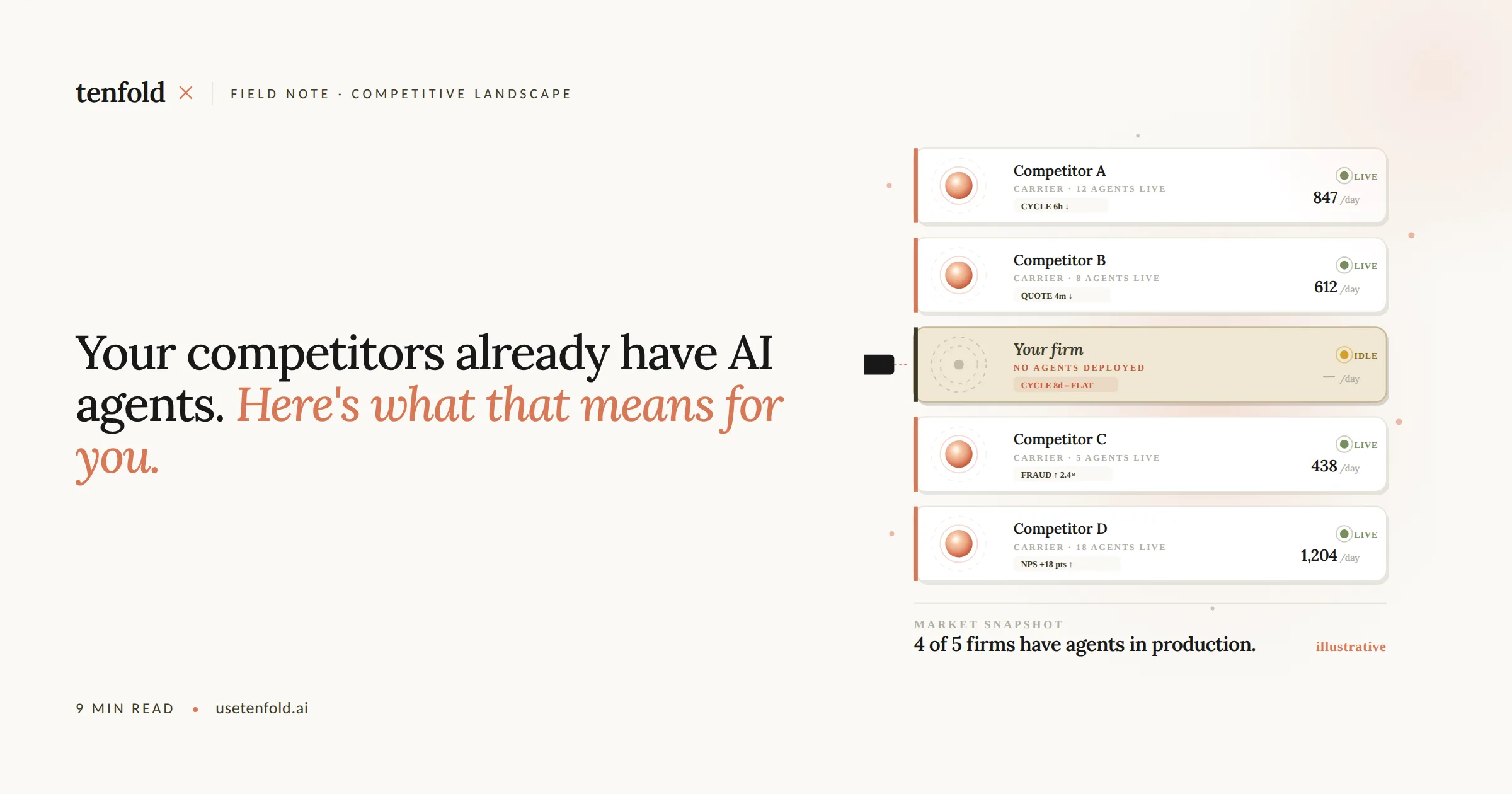
Your Competitors Already Have AI Agents. Here's What That Means for You.
The competitive question around AI agents isn't whether to move. It's whether you've already waited too long. <cite index="7-1,7-2">According to PwC's 2025 AI Agent Survey, 79% of organizations say AI agents are already being adopted in their companies — and of those adopters, two-thirds report measurable value through increased productivity.</cite> That's not a pilot stat. That's production.
If you're still evaluating, you're not in the early majority. You're approaching the trailing edge.
Key Takeaways:
Nearly 8 in 10 organizations are already using AI agents at some level
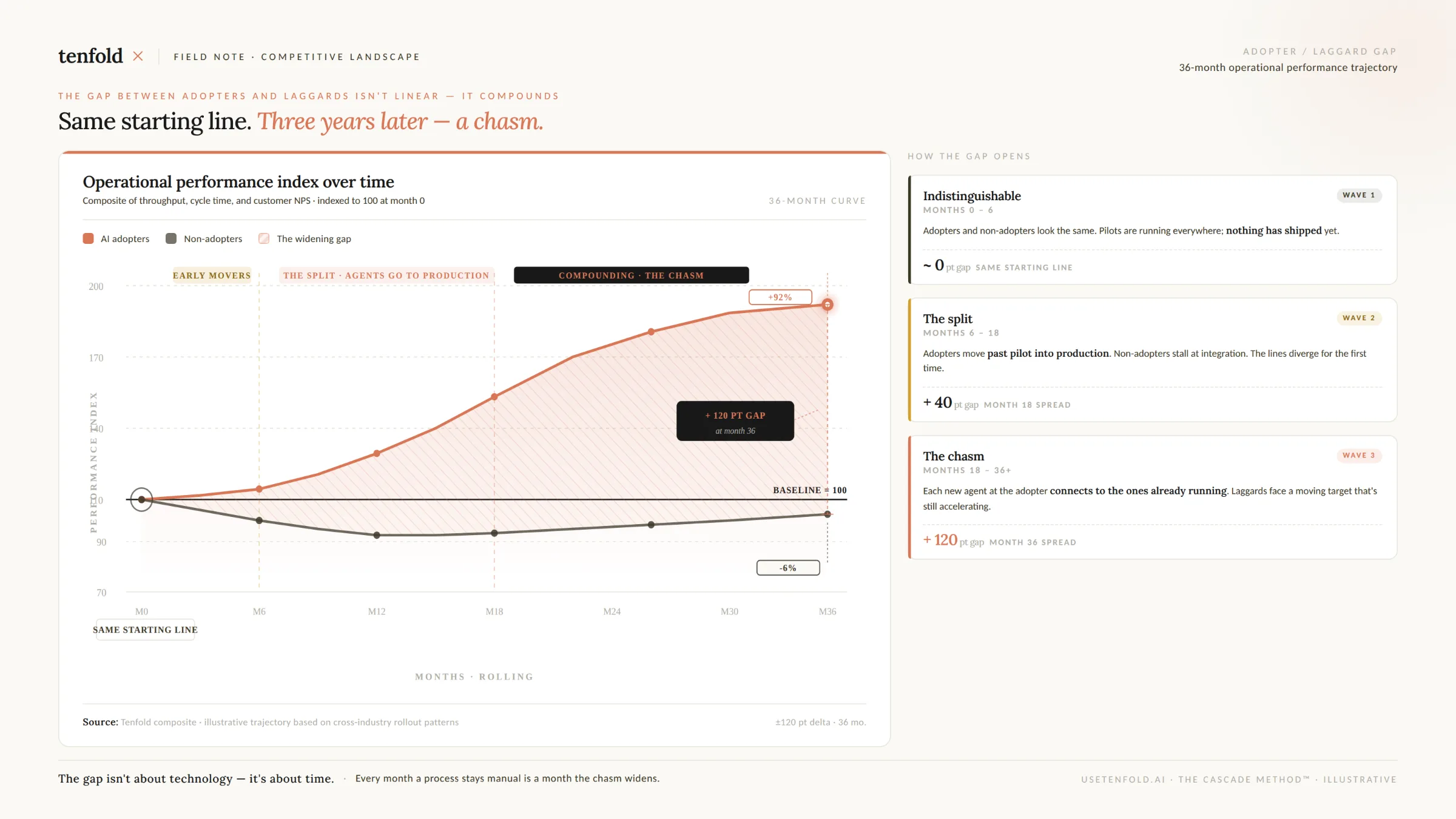
The ROI gap between early movers and laggards is compounding, not static
The bottleneck isn't AI capability — it's organizational readiness to delegate to it
Most companies stop at pilots; the ones winning are redesigning how work gets done
Implementation speed and governance quality determine outcomes, not ambition alone
Quick Answer: Your competitors using AI agents are operating faster, at lower cost, and with more consistent output than teams running manual workflows. The competitive gap isn't just operational — it's structural. Every quarter without agents in production is a quarter of compounding disadvantage.
The Adoption Curve Has Already Turned
<cite index="11-15">According to McKinsey's State of AI 2025, 23% of organizations are actively scaling an agentic AI system, with an additional 39% experimenting with AI agents</cite> — a combined 62% engagement rate. This isn't exploration anymore. It's a race.
<cite index="1-21">93% of business leaders believe organizations that successfully scale AI agents within the next 12 months will gain a competitive advantage over peers.</cite> The window isn't wide open. It's closing.
The companies moving fastest aren't the ones with the most ambitious AI visions. <cite index="12-6,12-7,12-8,12-9">McKinsey identifies a group of AI high performers who treat adoption as a strategic initiative — deploying agents across multiple functions rather than isolating them to single teams, and investing significantly more in data quality, workflow redesign, and leadership involvement.</cite>
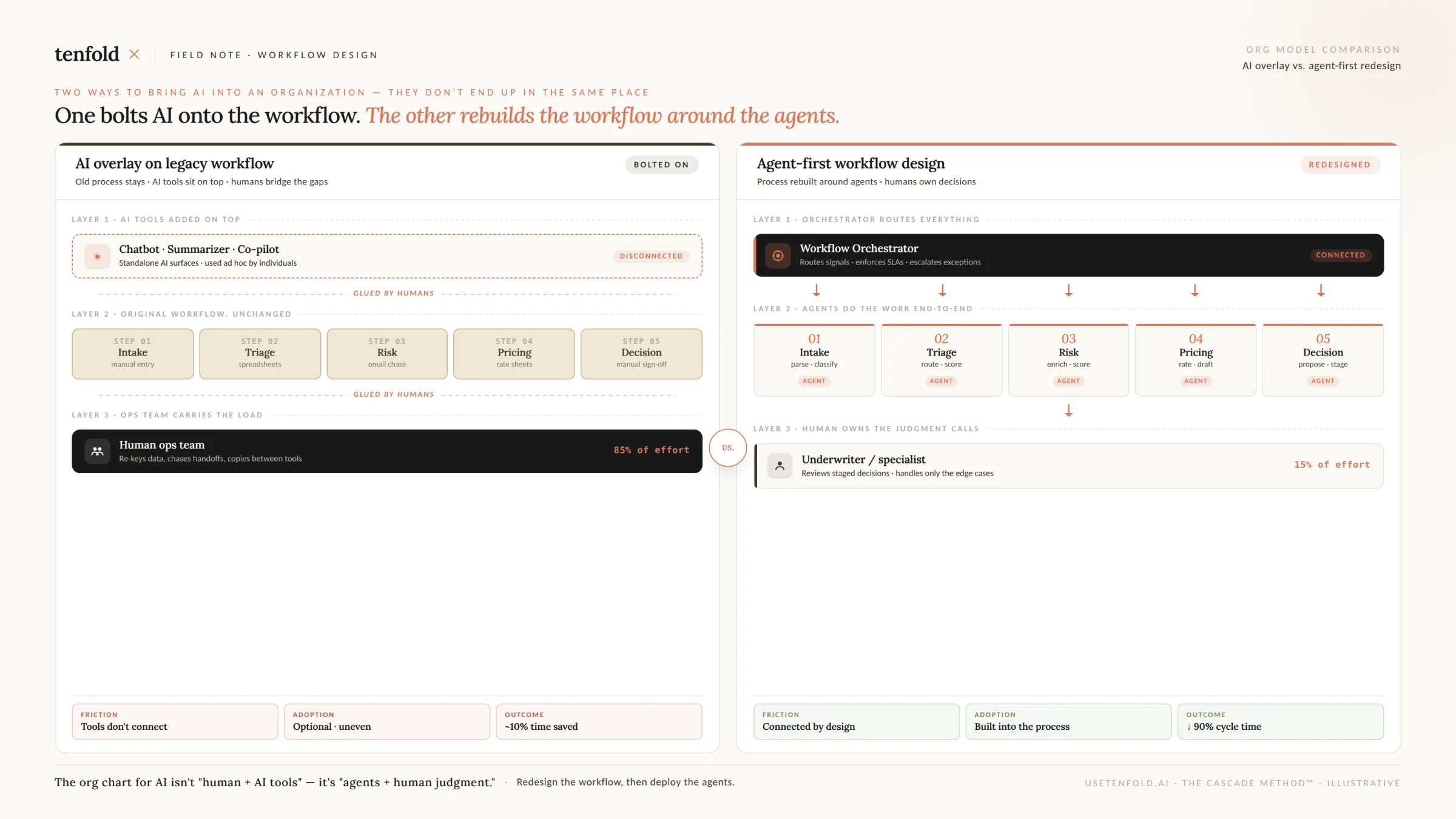
<cite index="12-10,12-11,12-12">High performers are more than three times as likely to pursue transformative AI use cases instead of incremental ones — and they redesign processes rather than layering AI onto legacy workflows. This is why the gap between high performers and the rest is widening.</cite>
What "Already Using AI Agents" Actually Means
There's a difference between a team using an AI feature in their CRM and an organization that has restructured workflows around autonomous agents.
<cite index="15-21,15-22">PwC notes that broad adoption doesn't always mean deep impact — many employees are using agentic features built into enterprise apps to speed up routine tasks like surfacing insights, updating records, and answering questions.</cite> That's table stakes. The competitive advantage doesn't come from that layer.
It comes from production deployment at scale.
<cite index="7-15">Of companies adopting AI agents, 35% say they're doing so broadly, while another 17% say AI agents are being fully adopted in almost all workflows and functions.</cite> That 17% — roughly 1 in 6 organizations — isn't just ahead. They're operating with a fundamentally different cost and speed structure.
<cite index="5-14">Organizations that automate workflows with agentic AI systems are achieving up to 70% cost reduction.</cite> Those savings don't just lower expenses. They redeploy capital into growth, speed, and further advantage.
The question to ask isn't "are our competitors using AI agents?" It's "how deeply, and in which workflows?"
The ROI Case Is No Longer Theoretical
Early AI agent discussions were full of projected returns. Those projections are now trailing behind actual results.
<cite index="8-17,8-18">As of 2025, 79% of organizations report some level of agentic AI adoption, with companies reporting average ROI of 171% — and U.S. enterprises achieving around 192%, which exceeds traditional automation ROI by three times.</cite>
<cite index="10-21">ServiceNow documented 80% autonomous handling of customer support inquiries and a 52% reduction in time needed for complex case resolution, generating $325 million in annualized value from enhanced productivity.</cite> That's one deployment, in one function.
<cite index="5-9">Organizations project an average ROI of 171% from agentic AI deployments, while U.S. enterprises specifically forecast 192% returns.</cite> And <cite index="5-11">62% of organizations anticipate exceeding 100% ROI on their agentic AI investments.</cite>
The ROI isn't evenly distributed, though. <cite index="8-19">The key challenges include cybersecurity concerns (top barrier for 35% of organizations), data privacy (30%), regulatory clarity (21%), and risk management failures causing 40% of project failures.</cite> The organizations capturing the strongest returns are the ones who solved for governance before scaling — not the ones who moved fastest without guardrails.
The Gap Is Structural, Not Just Operational
Here's the part most "AI strategy" conversations miss: this isn't a tooling gap. It's a structural one.
<cite index="20-4,20-5,20-6,20-7,20-8">MIT Sloan Management Review and BCG's 2025 report on the agentic enterprise notes that executives have long relied on simple categories — tools automate tasks, people make decisions. That framing is no longer sufficient. Agentic AI complicates these boundaries: these systems can plan, act, and learn on their own. They are not just tools to be operated or assistants waiting for instructions.</cite>
Organizations that grasp this distinction early are building a compounding advantage. <cite index="20-9,20-10,20-11">Organizations applying traditional investment frameworks to agentic AI systematically underinvest in continuous learning and adaptation, leading to rapid value decay — while companies that embrace integrated AI ecosystems can create compounding returns as their systems learn and adapt. The window for establishing this strategic advantage is narrowing.</cite>
The bottleneck isn't AI capability. It's that most organizations aren't yet set up to delegate to it.
<cite index="15-25">Companies that stop at pilot projects will soon find themselves outpaced by competitors willing to redesign how work gets done.</cite> At Tenfold, we see this pattern consistently: the orgs that capture outsized returns from agents aren't the ones with the biggest AI budgets. They're the ones who redesigned the workflow before they deployed the agent.
What To Do in the Next 90 Days
If your organization is in the 62% still experimenting or planning, the goal isn't to catch up overnight. It's to stop treating this as a future problem.
<cite index="1-14,1-15,1-16">The data shows a widening divide between leaders and laggards. A handful of enterprises are redesigning workflows, investing in data and governance, and treating AI agents as long-term infrastructure. Most others remain stuck testing tools without the organizational changes needed to scale.</cite>
Here's the practical path forward:
1. Identify one high-value, repeatable workflow. Not the most complex one. The one where manual effort is highest and output variability is most costly. That's your first agent.
2. Assess your data readiness before you build anything. <cite index="1-25">Fewer than 20% of organizations report having mature data readiness, and over 80% lack mature AI infrastructure constraining large-scale deployment.</cite> Skipping this step is why 40% of AI projects fail.
3. Define what "production" looks like — not just what "piloting" looks like. A pilot that never ships doesn't close a competitive gap. Set a 90-day target for your first agent in production, not in testing.
Summary
The competitive reality is straightforward: AI agent adoption has crossed the inflection point. Nearly 8 in 10 organizations are already using agents at some level, and those who've crossed from pilots into production are compounding advantages in cost, speed, and output quality. The risk of waiting isn't abstract — it's measurable, and it grows every quarter.
At Tenfold, we help operations and C-suite leaders move from evaluation to production — with the governance, workflow redesign, and implementation depth that separates real ROI from a demo. The proof is how Inforge, our sister company, runs its own delivery model: full implementations delivered entirely through AI agents, not headcount.
If you're ready to move past the pilot stage, [talk to the Tenfold team](https://tenfold.ai/contact) and let's map your first 90 days.
Frequently Asked Questions
Q: How do I know if my competitors are actually using AI agents or just talking about it?
A: Look at their job postings, their pricing, and their delivery timelines. Companies operating with agents typically post fewer operational headcount roles while accelerating output. If a competitor is delivering the same scope faster and at lower cost, agents are a likely reason.
Q: What's the difference between AI automation and AI agents?
A: Traditional automation follows fixed rules — if X, then Y. AI agents plan, reason, and take multi-step action across systems without step-by-step human instruction. An automation handles one task; an agent handles a workflow. The distinction matters because agents can adapt to edge cases that break rule-based systems.
Q: What's the biggest reason AI agent projects fail?
A: Infrastructure and governance, not the AI itself. <cite index="8-19">Risk management failures cause 40% of project failures</cite>, and the majority trace back to poor data readiness, unclear scope, and insufficient oversight design — not model limitations.
Q: How long does it realistically take to get an AI agent into production?
A: For a well-scoped, single-workflow agent with clean data, 4–8 weeks is achievable. Most timelines stretch to 3–6 months because organizations scope too broadly, skip data readiness assessment, or lack a clear production definition. The fastest deployments start narrow and expand.
Q: Do I need to redesign my entire operation to get value from AI agents?
A: No — but you need to redesign the specific workflow where the agent will operate. Layering an agent onto a broken or undocumented process doesn't fix the process. The organizations seeing the strongest returns invest in workflow clarity before they invest in the agent.
